The HomelandCulture

The students who brought Qrji Bazar to the stage 
A woman in her 60s, an opera singer, is performing in what may be her final production. The next morning, she will take her place behind a stall at Qrյi Bazar, one of Yerevan’s best-known flea markets, selling secondhand goods. An artist through and through, she is nevertheless forced to make a living by selling discarded objects that suddenly become valuable. After spending hours searching through Yerevan’s vintage markets without success, someone finally finds exactly what they are looking for at Qrji Bazar.

She agreed to tell her life story to 22-year-old Mher Mheryan. What she does not know is that Mher is the one portraying her on stage. A young man in his 20s steps into the role of a woman in her 60s — a woman who has lived through more than a lifetime’s worth of experiences.

A young actor steps into the role of a woman in her sixties

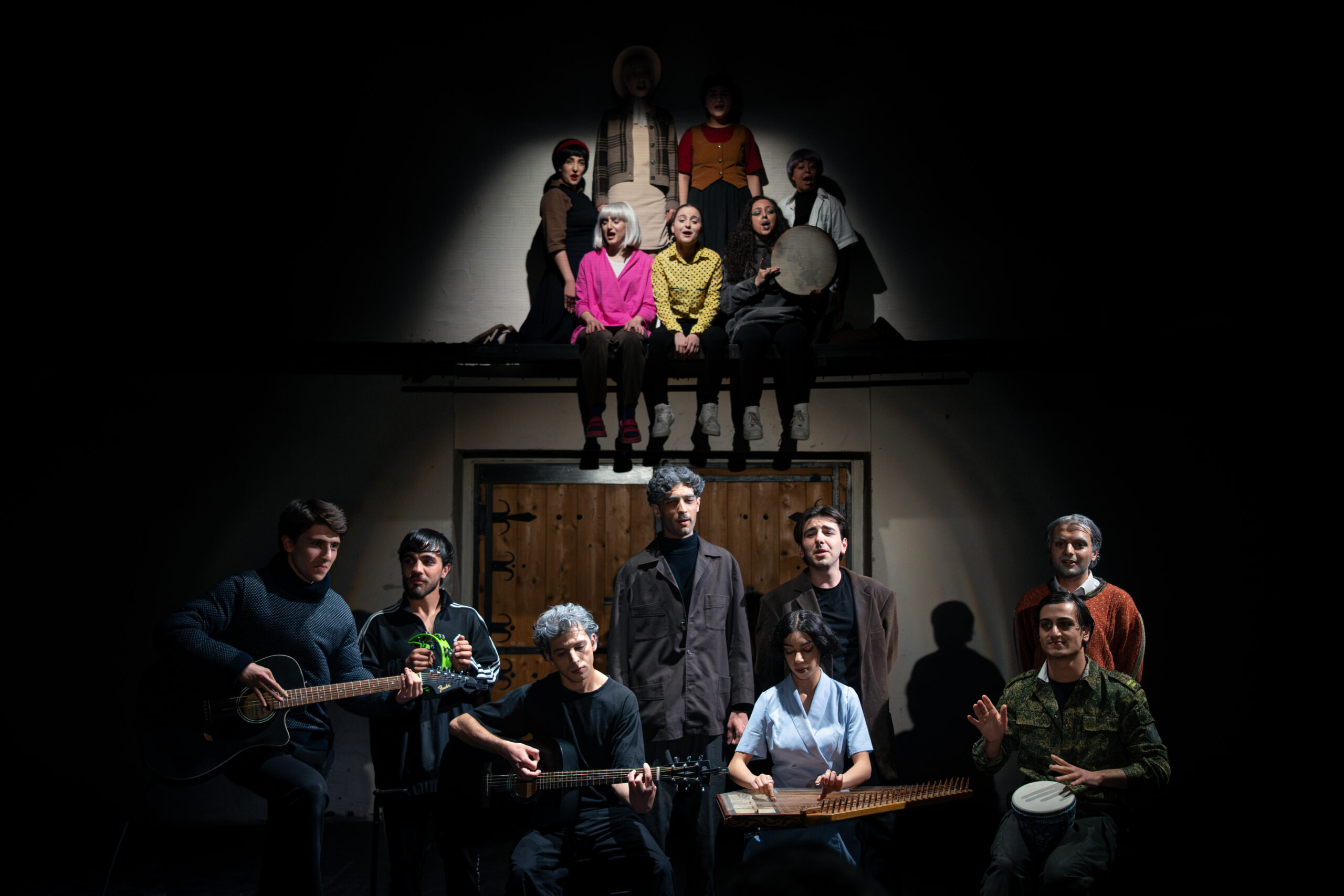
Shushanna Alikhanyan and Mher Mheryan, second-year students in Ruben Babayan’s workshop at the Yerevan State Institute of Theater and Cinematography, are among the 15 students and co-directors Nadezhda Israelyan and Diana Radiel. The verbatim performance, titled “Qrji Bazar,” is based on real-life documentary testimonies from Qrյi Bazar. The Armenian word “qurj” means a rag, worn-out clothing or something discarded as worthless. The names and surnames of the people featured in the performance were changed for privacy and security reasons. It is a verbatim piece that none of the real-life characters had seen before. 

Students of the Yerevan State Institute of Theatre and Cinematography perform Qrji Bazar.

Israelyan, who has been directing documentary performances with Diana Radiel for four years, was assigned as a master’s degree student to create a performance with the students. Soon, they realized verbatim theater was what they were looking for. Verbatim means using a person’s exact words, word for word, in speech or writing. 

The form requires strong acting tools, a lot of research, fieldwork and interviews — a difficult but enjoyable challenge for students ages 21 and 22. Israelyan said Qrji Bazar seemed like one of the best places for theater people to find antiques, clothing and other items for performances. She had gone to the bazaar so many times that staging a performance about it became an obvious choice. 

Advertisement Donate Today!

“I remembered that Qrji Bazar is full of fascinating people. We were interested in the people working there, what they were thinking and what dreams they had. Some of us have stereotypes connected to this market, and we wanted the students to explore these people, become friends and share their stories.” Israelyan told the Weekly. “Some of the people working there refused to speak with the students, but those who agreed told us so many things that we did not even include in the performance because they were too intimate.”

This slideshow requires JavaScript.

Shushanna had visited Qrji Bazar once, while Mher had never been there. But he enjoys experiments and action, which is why all 15 students were curious to see what would happen. It is not very common in Armenia to use verbatim theater or raise modern social issues that interest the public. Theaters usually stage classic more modern literature, but they do not write a special script based on real-life testimony. The topic of Qrji Bazar remains relevant because it is part of the city and has witnessed so much worth sharing. 

Mher said he met a person whose character he thought would be easy to play. During the first few days, he was focused on finding someone who could be “played” easily, so he did not delve into the details. Everything changed when that person refused to give him an interview and was reluctant to be recorded. “I understood this was going to be even more challenging than I had thought. But maybe that was when something shifted in me. Then, suddenly, this woman approached me and said she was an actress. I discovered so many patterns in her that I came to Nadia and said, ‘I am the one who should play this character.’” Mheryan said. 

Mher Mheryan portrays a woman in her sixties, an opera singer and vendor at Yerevan’s Qrji Bazar.

At the time, Mher probably did not fully realize the difficulties of playing a woman. Verbatim theater is not about imitation or parody. It demands the precise reproduction of a person’s speech, gestures, facial expressions and mannerisms. The actor has no room to invent or speculate because the character is not fictional. She is a real person who already exists, with a distinct personality, temperament and physical presence. Every movement, pause and intonation belongs to someone else’s lived reality. That is precisely what makes the process so challenging. When I watched the performance, I thought I would recognize Mher. Only when he started to sing at the end did I remember that his character was an opera singer. It was obvious the young actor had worked meticulously on the role. Otherwise, it could have become speculation or a cheap parody. Instead, strong empathy and hard work were visible in every gesture and facial expression. 

“The fieldwork and interviews lasted more than three months. When everything was ready, Diana and I started working with each person separately,” Israelyan said. “Mher was struggling with the character, but I think he worked it out, as did all the other members of the performance.”

The second-year class consists of 15 students who began the recording process together. Each student was responsible for interviewing one person who worked at Qrji Bazaar. Shushanna found her character not very sociable, but they somehow built trust, and the actress spent a long time doing fieldwork to gather the material she needed. For background sound and music, the students played different musical instruments. The directors avoided using real environmental sounds, choosing instead to experiment with the students. The verbatim performance begins with the students singing and playing before the monologues take over, filling the theater hall from time to time with laughter and excitement. 

Shushanna Alikhanyan plays a character from Qrji Bazar.

“Many things my character told me stayed in the recording because they were too intimate. I thought portraying certain episodes from her life would feel painful,” Shushanna said. “Besides going there every weekend, when all of us were at the market — it is open on the weekends — some of us met our characters outside the market. That provided a space to create trusting relationships between us,” she said.

The performance was staged several times, and it seems to have grown in significance, going far beyond what was initially an institute experiment. Shushanna said they did not expect to see the audience so engaged in the process and so impressed by what they had done. It was obvious there were people who wanted to listen to stories from real life. Many audience members approached the team and said they wanted to meet the characters. One person even said he wanted to pay for a character to go to the sea. However, the performance team does not provide any contact information because the initial agreement was to keep the characters anonymous. 

“Some of them came several times, and even now, when people see us around, they are probably the biggest response you can hope for — when people keep repeating what you said, and in a good way,” Shushanna said. “I really appreciate the emotional impact it has on the audience. They do not just pity the characters. They genuinely connect with their stories, laugh, get moved and experience everything alongside the actors,” she said. 

At Qrji Bazar, people sell things others have discarded. On stage, the students did something different: They took stories that might otherwise go unnoticed and gave them a space to be heard, remembered and carried beyond the theater. 

“They do not just pity the characters. They genuinely connect with their stories.”

Kushane Chobanyan

Kushane Chobanyan is a journalist and podcaster based in Armenia, with over a decade of experience covering human-centered stories related to conflict, displacement, inclusion and education. She collaborates with UNICEF Armenia and is the sound producer of the Armav AAC educational app, which supports children with communication challenges. Chobanyan is also the creator of an animated podcast series that explores the taste memories of displaced people, combining storytelling with audio-visual art to amplify underrepresented voices.

Leave a Reply

Your email address will not be published. Required fields are marked *


Back to top button