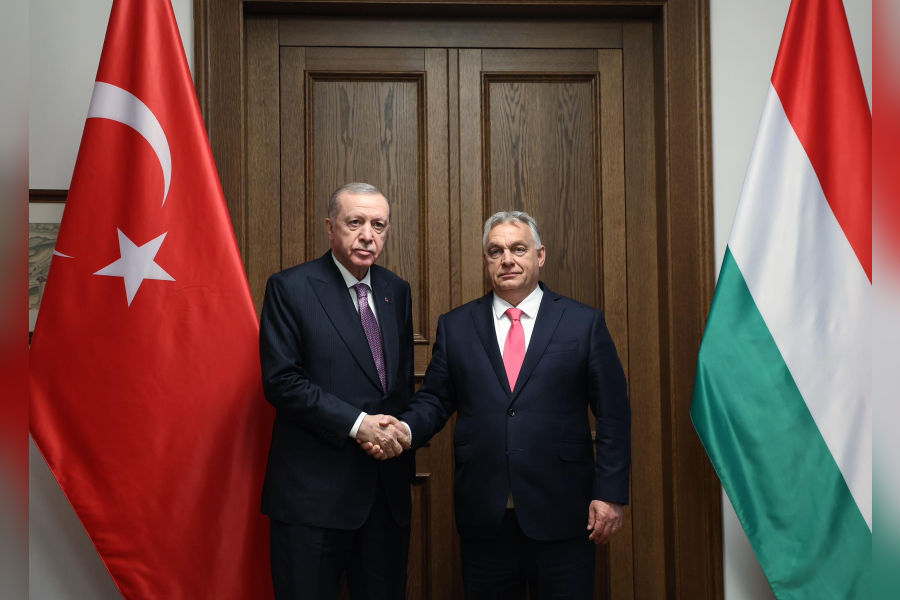
Turkish President Recep Tayyip Erdogan (left) meets with Hungarian Prime Minister Viktor Orban on the sidelines of the Informal Summit of the Heads of State of the Organization of Turkic States in Budapest, May 21, 2025. (Photo: Presidency of the Republic of Türkiye/Facebook)
Turkey–European Union relations have faced many ups and downs over the decades, starting from April 14, 1987, when Turkey submitted an official application to join the European Economic Community (EEC), the predecessor of the European Union (EU). Over time, however, this membership bid has become an area of contention, rivalry and complexity, shaped by both elite and public perceptions.
Kevork Yacoubian is assistant editor of the Armenian Weekly. He graduated magna cum laude from Haigazian University with a bachelor’s degree in political science. He later earned a master’s degree in international affairs from the Lebanese American University, where he presented a thesis titled “A Neoclassical Realist Analysis of Turkish Foreign Policy Toward the Caucasus: The Cases of Armenia and Azerbaijan, 1991–2024.” His research interests include electoral politics, foreign policy trajectories, identity construction and the cultural influences on state behavior.
One Comment
We know that Turkey will never become a EU member, not only because it is undemocratic, poor and very populous (if it were a EU member, it would be its most populous member with 85 million people), also because it is Muslim, has an Islamist plurality and is run by an Islamist dictator, with a culture and outlook which is totally incompatible with European culture, values and outlook. Cyprus (40% of which is occupied by Turkey), Greece, France, among others, would certainly veto Turkey’s entry into the EU, and in polls, most people in every EU country, oppose Turkey becoming a EU member. So Armenia doesn’t have to worry about Turkey becoming a EU member ever.
Hungary will not always have a pro-Turkey/pro-Azerbaijan government like under Viktor Orban, so relations between Armenia and EU will not perennially continue be held hostage to a Hungarian veto, once Orban leaves office and is not replaced by another Turkophile successor like him.
Being located at the periphery of Europe, being Christian and having a small population, Armenia could hypothetically apply for EU membership. However, meeting all EU criteria would be a huge challenge, and because of its remoteness, being landlocked, being surrounded by volatile and hostile neighbors, and because of geopolitics, other EU members could oppose EU membership for Armenia for these reasons (not just Hungary for its different abovementioned reasons).







We know that Turkey will never become a EU member, not only because it is undemocratic, poor and very populous (if it were a EU member, it would be its most populous member with 85 million people), also because it is Muslim, has an Islamist plurality and is run by an Islamist dictator, with a culture and outlook which is totally incompatible with European culture, values and outlook. Cyprus (40% of which is occupied by Turkey), Greece, France, among others, would certainly veto Turkey’s entry into the EU, and in polls, most people in every EU country, oppose Turkey becoming a EU member. So Armenia doesn’t have to worry about Turkey becoming a EU member ever.
Hungary will not always have a pro-Turkey/pro-Azerbaijan government like under Viktor Orban, so relations between Armenia and EU will not perennially continue be held hostage to a Hungarian veto, once Orban leaves office and is not replaced by another Turkophile successor like him.
Being located at the periphery of Europe, being Christian and having a small population, Armenia could hypothetically apply for EU membership. However, meeting all EU criteria would be a huge challenge, and because of its remoteness, being landlocked, being surrounded by volatile and hostile neighbors, and because of geopolitics, other EU members could oppose EU membership for Armenia for these reasons (not just Hungary for its different abovementioned reasons).