



Part 2: Turkey’s persecution of minorities from 1930-1941
This is the second article in a three-part series (to read part one, click here) about Turkey’s persecution and systematic violation of human rights of Armenians, Assyrians, Greeks and Jews from 1930 to 1941, as documented by Turkish historian Ayşe Hür:
September 18, 1930: Justice Minister Mahmut Esat Bozkurt uttered his famous maxim: “My opinion, my conviction is that this country itself is Turkish. Those who are not pure Turks have only one right in the Turkish homeland, and that is to be servants, to be slaves.”
October 1930: During the municipal elections, when the newly formed Free Republican Party (SCF) had six Greeks, four Armenians and three Jews on its list, the ruling Republican People’s Party (CHP) launched a fierce anti-non-Muslim campaign. The party was forced to dissolve itself 99 days after its establishment, but the resentment towards non-Muslims did not end.
June 11, 1932: The Law on Arts and Services Reserved for Turkish Citizens was enacted, prohibiting foreigners from working in certain professions. It particularly affected Greek citizens in freelance professions, small businesses and street vendors.
November 1932: Every Jew in Izmir was made to sign a pledge promising to adopt Turkish culture and speak the Turkish language. The Jews of Bursa, Kırklareli, Edirne, Adana, Diyarbakır and Ankara followed suit.


1933: The Syriac Patriarchate in Mardin, Turkey, unable to withstand covert and overt pressure, moved temporarily from Mardin to Homs in Syria, “in accordance with the wishes of the community” and “due to perceived necessity.” However, it has not been possible for it to return since then.
June 14, 1934: Following the Settlement Law, which divided the country into three groups: “those of Turkish culture who speak Turkish” (true Turks), “those of Turkish culture who do not speak Turkish” (Kurds) and “those not of Turkish culture who do not speak Turkish” (non-Muslims and others). Greeks and Armenians in various parts of Anatolia were deported to regions deemed suitable for them.
June 21 and July 4, 1934: Crowds incited by anti-Semitic and racist writings attacked Jews in Çanakkale, Gelibolu, Edirne, Kırklareli, Lüleburgaz and Babaeski. During these events, Jewish homes and shops were looted, women were raped and a rabbi was murdered. As a result of events apparently organized by CHF (later renamed CHP, Republican People’s Party), Thrace branch, 15,000 Jews were forced to flee to other cities and countries, leaving behind their belongings and property. According to a report prepared by CHF, of the 13,000 Jews living in Thrace and Çanakkale, 3,000 had migrated to Istanbul, and many had lost their belongings in looting and sold their properties at rock-bottom prices.
July 24, 1937: According to an advertisement in the Cumhuriyet newspaper, one of the requirements for students to be admitted to the Ankara Military Veterinary School was “being of Turkish descent.”
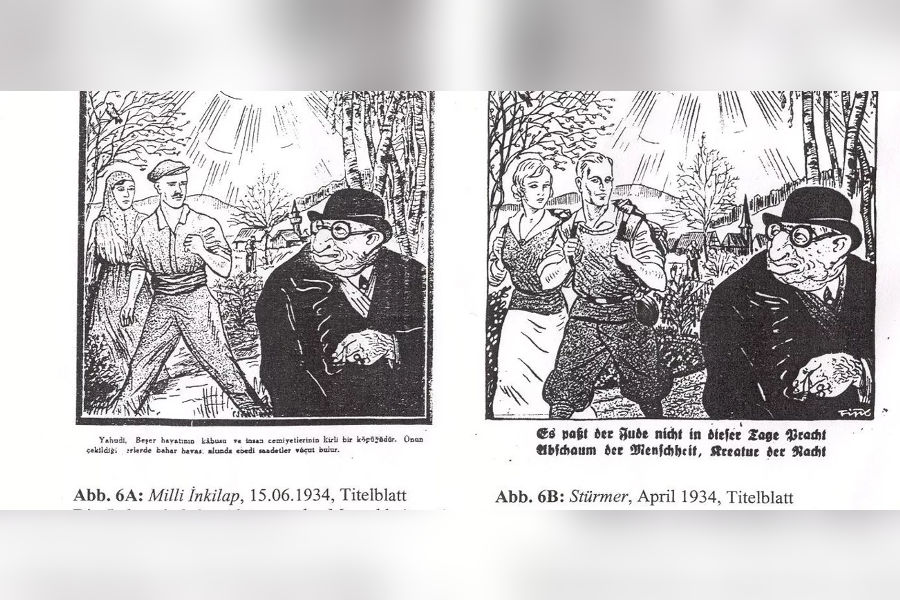
August 1938: The government issued Decree No. 2/9498, stating that “Jews, regardless of their current religion, who are subjected to oppression in terms of living and traveling in the state territory of which they are subjects, are prohibited from entering and residing in Turkey.” 26 Jewish employees of the country’s only official news agency, Anadolu Agency, were dismissed. There was an explosion of articles and cartoons in newspapers and magazines generally blaming minorities, and specifically Jews, for the country’s suffering.
1938-1939: Non-Muslims living in rural areas of Anatolia were relocated to large urban centers on the grounds that they would threaten national security in the approaching war. Those who could not adapt to the living conditions in the big cities were forced to emigrate from the country.
July 1939: During the annexation of Hatay [Iskenderoun] by Turkey, Armenians in the region migrated to Syria due to oppression.
August 8, 1939: The Parita ship, carrying 860 Jewish refugees gathered from various parts of Europe to Palestine, was forced to take refuge in Izmir due to problems encountered en route. Despite the passengers’ cries of “Kill us, but don’t send us back,” the ship was escorted out of the port on August 14 by two police boats. As the ship was leaving, the Ulus newspaper, close to the CHP, ran the headline “Wandering Jews left Izmir.”
December 28, 1939: Upon hearing of the great earthquake in Erzincan that killed tens of thousands of people, Jewish communities in Tel Aviv, Haifa, Buenos Aires, New York, Geneva, Cairo and Alexandria collected money and clothing and sent them to Turkey. However, articles and cartoons mocking this Jewish gesture and suggesting malicious intent appeared in the newspapers.
December 12, 1940: The Salvador, nicknamed the “floating coffin” (a boat for 40 people), arrived in Istanbul from the port of Constanta, Romania, carrying 342 Jewish refugees. Although it was clear the ship was in no condition to travel even a mile, Turkish authorities forced it to continue its journey. The result was tragic: on December 13, caught in a violent storm off the coast of Silivri, the wreckage of the Salvador yielded 219 dead bodies.
April 22, 1941: 12,000 non-Muslim men were sent by gendarmes to camps teeming with mosquitoes and malaria, plagued by dampness, mud, extreme heat and severe water shortages, lacking proper infrastructure. The voices of the sergeants and officers shouting, “Forget Istanbul!” remain etched in the memories of all minorities who lived through that period. These “soldiers,” known as the 20th Reserve, were forced to work in hard labor battalions, such as tunnel construction in Zonguldak, construction of Gençlik Park in Ankara, stone crushing and road building in the provinces of Afyon, Karabük, Konya, and Kütahya and were only discharged on July 27, 1942.



Let’s not kid ourselves and beat around the bush. The small and steadily diminishing non-Muslim minorities’ situation in the Republic of Turkey has not really improved since the worst excesses they experienced from Turkish state and population during the 1930s/40s/50s, will not improve, but will actually get worse like in those decades, and it is already getting worse. The non-Muslim minorities in Turkey have always lived under the constant threat of violence by the Turkish state and population, along with suffering the indignities of state discrimination and second-class status. The countless massacres and genocides they suffered under the Ottoman Empire and from Turkish mobs for centuries, are obvious. Those who entertain the idea that the situation of the non-Muslim minorities in Turkey will improve, are deceiving themselves, because the Armenophobia, Hellephophobia, Anti-Semitism and Anti-Christianism in the Turkish population and state are deeply entrenched like a cancer, and removing them from the Turkish mentality, would be the equivalent of a non-existent brain transplant. Rather than enduring discrimination, ostracism, humiliation, villification, verbal threats and occasional violence, along with the increasing uncertainty and volatility as well as the ever present threat of becoming victims of the next pogrom or terrorist attack, many more non-Muslims, including Armenians, are leaving Turkey for a better and safer future. Who can blame them? 99.9% of the Armenians and 95% of the Assyrians living within the borders of the Republic of Turkey, are not living in their ancestral homelands of Western Armenia and Mesopotamia respectively anyway, from where they have been violently ethnically cleansed during the Armenian and Assyrian genocides, but in Istanbul, which is expected to be destroyed by the inevitable megaquake, and that is why all the non-Muslim minorities living there, need to leave that city to avoid getting killed and extinguished.