




Persecution of minorities in Turkey did not end in 1915
Editor’s note: The following is the first in a three-part series.
Turkey’s persecution and systematic violation of human rights of Armenians, Assyrians, Greeks and Jews did not end in 1915. A century after the Genocide, the Turkish government continues to enforce racist, exclusionary and discriminatory policies against these minority groups.
In recent months, some pro-Pashinyan Armenians have been incorrectly claiming that Turkey has no interest in attacking Armenia. Such claims ignore not only the historical record of the Armenian Genocide, but also Turkey’s direct military involvement in the 2020 Artsakh War, which resulted in the deaths of roughly 4,000 Armenian soldiers and left thousands more injured. Furthermore, Turkey’s blockade of Armenia, imposed in 1993, is still in place today.
Few people are aware that in 1993, Turkey even considered direct military intervention against Armenia. Leonidas Chrysanthopoulos, Greece’s ambassador to Armenia at the time, later described the circumstances of that aborted plan in his memoirs.
Turkish historian Ayşe Hür has compiled an extensive chronology of the Turkish government’s anti-Armenian, anti-Assyrian, anti-Greek and anti-Jewish policies. Her list starts in 1923 and ends in 2007, the year Armenian journalist Hrant Dink was assassinated in Istanbul by an extremist Turk. In 2018, Hür herself was sentenced to 15 months in prison for her social media posts — though the sentence was suspended on the condition that she refrain from similar offenses for five years.

Here is the first part of her documented record:
March 16, 1923: Mustafa Kemal Ataturk declared in a speech in Adana: “The country has finally settled in the hands of its true owners. Armenians and others have no rights here. These fertile lands are purely and truly Turkish lands.”
June 1923: Jewish, Greek and Armenian officials were dismissed from government positions and replaced by Muslims. Restrictions were imposed on the movement of non-Muslim minorities in Anatolia. Many who had temporarily left their homes were unable to return. At the same time, obstacles were placed in the path of Jews attempting to migrate to Palestine.
September 1923: A decree prohibited the return of Armenians who had fled Cilicia and Eastern Anatolia during the war.
December 1923: The small Jewish community of Çorlu was ordered to leave the city within 48 hours. Although the decision was postponed after an appeal by the Chief Rabbinate, a similar order for the Jews of Çatalca was immediately enforced.
January 24, 1924: A new law required pharmacists to be “Turkish,” effectively barring non-Muslims from the profession.
March 3, 1924: Forty French and Italian schools were closed down, following the Law on the Unification of Education. Minority schools faced strict limits on repairs, expansion, and new construction. Their curricula and examinations came under the control of the Ministry of National Education.
April 3, 1924: Under the Lawyers’ Act, 960 lawyers were evaluated for “moral character.” As a result, 460 lawyers lost their licenses. 57 percent of Jewish lawyers and three-quarters of Greek and Armenian lawyers were forced out of the profession.
January 29, 1925: Greek Patriarch Konstantinos Araboğlu was forcibly placed on a train and expelled to Thessaloniki, Greece, simply because the Turkish government disliked him. Greece appealed to the League of Nations citing a violation of the Treaty of Lausanne, but withdrew the appeal after Turkey threatened to expel the Patriarchate itself. The incident was later portrayed as a voluntary resignation.
February 17, 1926: After the adoption of the Civil Code, Armenian, Jewish and Greek communities were pressured to renounce the minority rights guaranteed to them under the Treaty of Lausanne.
April 22, 1926: A law requiring all commercial correspondence to be conducted in Turkish led to the dismissal of thousands of non-Muslims who lacked proficiency in written Turkish. 5,000 Greeks lost their jobs under this regulation.
August 1, 1926: The Turkish government declared its right to confiscate all property acquired by non-Muslims before August 23, 1924 — the date the Treaty of Lausanne took effect.
August 17, 1927: Elza Niyego, a 22-year-old Jewish woman, was murdered by Osman Ratıp Bey, a married man with grandchildren who had been harassing her for a long time. When the Jewish community dared to protest the state’s attempt to cover up the crime, a wave of anti-Semitic attacks erupted in the press. Several Jews were prosecuted for “insulting Turkishness.”
January 13, 1928: Istanbul University Law students, seeking to ingratiate themselves with the regime, hung banners reading “Citizens, Speak Turkish!” on ferries and trams. Newspapers amplified the campaign and many non-Muslims were prosecuted for “insulting Turkishness” simply for speaking their native languages.
April 11, 1928: A new law, on the Manner of Practice of Medicine and Related Professions, restricted the practice of medicine to those deemed “Turkish,” effectively, excluding non-Muslims from the profession.
September 1929: The Treasury decided to tax donations and transfers made to Jewish schools, Or Ahayim Hospital, Ortaköy Orphanage and synagogues, considering them commercial establishments. The implementation was started retroactively from 1925. The Chief Rabbinate, unable to pay these high taxes, faced foreclosure. Government pressure continued, and donations were closely monitored.
1929 and 1930: In 18 months, 6,373 Armenians from Turkey were forced to immigrate to Syria.


In Turkey (more precisely in Istanbul, since more than 90% of the country’s indigenous non-Muslim minorities, who number no more than 100,000 in a country of 86 million, and since more than 99% of the country’s Armenians live there, who declined to 35,000), another pogrom like the 6-7 September 1955 Istanbul Pogrom against non-Muslim minorities, is always possible.
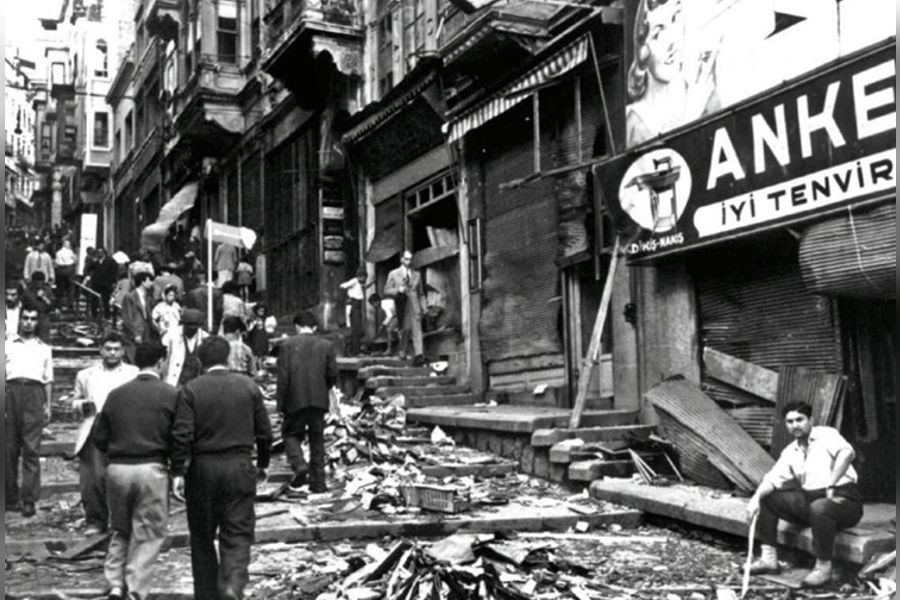
The 1955 Istanbul Pogrom accelerated the exodus of these minorities, with the Greek minority falling from 105,000 in 1955, to 30,000 in 1964, to 5,000 in 1975, and to 1,000 today; with the Armenian minority falling from 76,000 in 1955, to 50,000 in 2007 (the year the brave Armenian journalist Hrant Dink was murdered, culminating in another exodus of Armenians), and to 35,000 today; and with the Jews falling from 45,000 in 1955, to 25,000 in 2008 (the year when Erdogan fell out with Israel over the Gaza War and his support for Hamas, culminating in an exodus), and to 10,000 today. Before World War 1 started, Istanbul had a population of more than 1 million in 1914, of whom 500,000 were Turkish Muslims, 300,000 were Greeks, 120,000 were Armenians, 70,000 were Jews, 10,000 were Europeans, and 70,000 from other ethnic groups, meaning that Turks were not the majority, but a plurality in the city. What happened to the 2 million Armenians and the 1.6 million Greeks within the current borders of the Republic of Turkey, are of course obvious. After all the calamities which happened to the Armenians, Greeks and other non-Muslim minorities between 1914-1923, the constant exodus of the non-Muslims, has been a fixture since the Republic of Turkey was founded in 1923.
The constant villification of the Armenians, Greeks and Jews in the Turkish media, and more troubling, by Turkish politicians, by the Turkish government and by the agent provocateur Erdogan, along with the entrenched very high Armenophobia, anti-Semitism and Hellephophobia, is a powderkeg that can always lead to another anti-Armenian, anti-Greek and anti-Semitic pogrom. Vandalism against non-Muslim places of worship, cemeteries, schools and other institutions, as well as verbal threats and physical attacks against non-Muslims are commonplace, and which are not taken seriously and tackled by the very same government who villifies them.
The pessimists who sensed the warning signs, fled in advance, or who survived the massacres and genocides in the Ottoman Empire, and later during the pogroms in the Republic of Turkey, fled immediately afterwards to avoid becoming victims of the next one. The optimists who didn’t notice them or downplayed the warning signs and stayed, were murdered, and under the Republic of Turkey, they continue to suffer constant discrimination and humiliation from the state and the Turkish population, and are always susceptible to become victims of another pogrom. With Istanbul, which has a population of more than 16 million, expected to be destroyed by the inevitable megaquake, everyone living on this ticking time bomb are living on borrowed time, and the Armenians, Greeks and Jews, need to leave that city, not only to avoid becoming victims of the next pogrom, but from getting killed, which is predicted to become one of the most devastating and deadliest earthquakes in history.