


The Vatican’s quiet alignment with Azerbaijan
International relations are driven by realpolitik and national interests, often at the expense of moral integrity. Western countries, which portray themselves as champions of democracy and civil liberties, seem indifferent to Azerbaijan’s long-documented human rights violations while openly criticizing and opposing the current Georgian government, accused of democratic backsliding and a pro-Russian foreign policy. This behavior persists despite clear evidence that Aliyev’s regime exercises far tighter control over political life than Kobakhidze’s government, with stronger repression of opposition and civil society.
In fact, Baku has become fundamental to Europe’s energy security, increasingly important for Western countries since Russia’s invasion of Ukraine in 2022. Some nations, such as Italy, have adopted a staunchly pro-Azerbaijani position, promoting a narrative that whitewashes the Caspian dictatorship.
What stands out, however, is not only the geopolitical convenience behind these attitudes, but also the surprising extent to which Azerbaijan has managed to reshape its international image. Through a combination of energy diplomacy, cultural initiatives and targeted lobbying campaigns, Baku has successfully positioned itself as a stable and indispensable partner. This strategy has proven successful: high-level visits, symbolic gestures and diplomatic caution have increased, even as independent organizations continue to report severe repression, censorship, corruption and human rights abuses within the country.
Within this “Azerbaijani-friendly bloc,” there is one country whose existence is frequently forgotten: Vatican City.
During his pontificate, Pope Francis showed his concern over the situation in the Southern Caucasus, calling on belligerents to “silence their weapons.” In July, September and October 2020, the Holy Father expressed solidarity with the victims of the bloody skirmishes between Armenian and Azerbaijani forces, appealing for a peaceful solution.
However, his rhetoric — while showing commitment to peace and interethnic coexistence — lacked clear condemnation of Aliyev’s regime, responsible for war crimes, ethnic cleansing and cultural genocide against the Armenian people.
On Dec. 18, 2022, during the Angelus, the pontiff declared: “I am concerned about the situation that has arisen in the Lachin Corridor in the Southern Caucasus. I am particularly concerned about the precarious humanitarian conditions of the population, which risk further deterioration during the course of the winter season. I ask everyone involved to commit themselves to finding peaceful solutions.”
A similar statement came on Jan. 29 2023: “I renew my appeal regarding the serious humanitarian situation in the Lachin Corridor, in the South Caucasus. I am near to all those who, in the dead of winter, are forced to cope with these inhumane conditions. Every effort must be made on the international level to find peaceful solutions.”
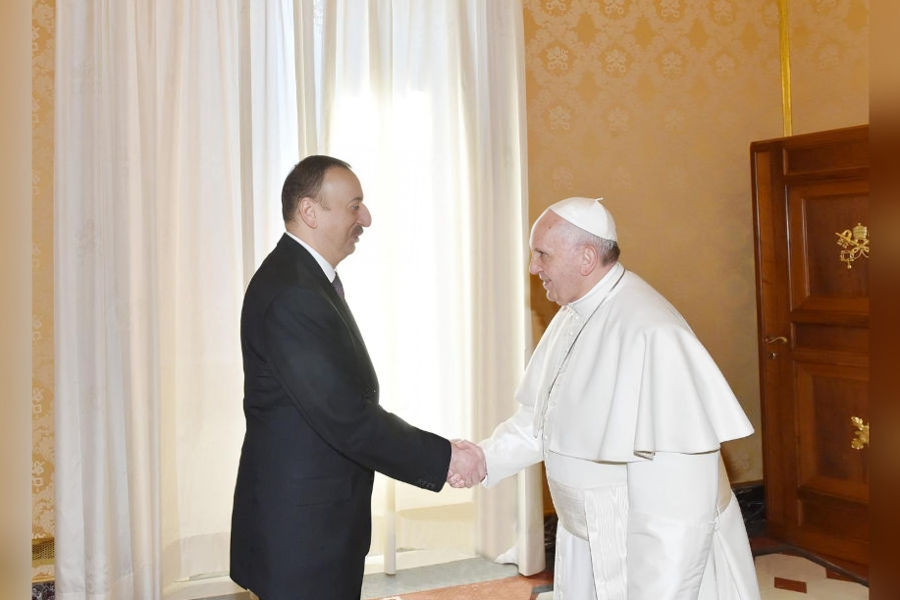
Nevertheless, he failed to mention who was responsible for the worsening of the humanitarian conditions in the region, nor why Aliyev cut off Artsakh from the rest of the world. Years earlier, during his pontifical visit to Baku in 2016, Vladimir Fekete, head of the local Catholic Church, noted that “Pope Francis regards and values Azerbaijan as a tolerant country.”
The plight of Armenian refugees was cited only occasionally after Azerbaijan’s full capture of Nagorno-Karabakh. Just days before his death, during the Easter Urbi et Orbi address, Pope Francis prayed for a final peace agreement between Yerevan and Baku, hoping the region would heal from its wounds but without giving more details.
None of the statements addressed crucial issues: Azerbaijan’s aggressive posture, Aliyev’s imperialistic and genocidal ambitions, the systemic destruction or falsification of Armenian heritage or the complete erasure of the Armenian presence in Artsakh.
Some view this neutral and formulaic rhetoric as characteristic of the Vatican’s approach, focused on promoting peace and dialogue without taking sides. On the other hand, such a conduct tends to ignore power imbalances or the different intentions of the contenders, validating a false equivalence between victims and aggressors. In other contexts, such as Nigeria and the Middle East, the pope has used different language, denouncing the persecution and mistreatment of Christians without ambiguity.
A closer look reveals a deliberate alignment with Baku cultivated over the past 20 years. In the early 2000s, Cardinal Claudio Gugerotti, appointed nuncio for Transcaucasia in 2001, met Azerbaijani authorities multiple times, establishing a privileged channel with Heydar Aliyev’s dictatorship. Gugerotti played a crucial role in rising Vatican-Baku relations, often assuming an Azerbaijani-friendly approach. He described Azerbaijan as a “country [that] is a symbol of peaceful coexistence between people of different religions,” a statement made only a decade after the tragic expulsion of the nation’s Armenian minority during the First Nagorno-Karabakh War and amid the continued destruction of Armenian heritage in Nakhichevan.
The nuncio’s effort led to the first historic agreement regulating relations between Rome and Baku, signed in 2011. According to Christianity in Azerbaijan, a 2019 book published by the Mənəvi Dəyərlərin Təbliği Fondu (“Moral Values Promotion Foundation”), Gugerotti “expressed gratitude to the [Azeri] government for creating the conditions that made possible [the agreement], emphasizing that our country always remained committed to the principles of tolerance.” The Cardinal went further by declaring that “Azerbaijan has proved its tolerance once again. Now, the whole world has witnessed it.”
Another key figure in this diplomatic intrigue is Cardinal Gianfranco Ravasi, honorary president of the Pontifical Council for Culture and chairman of the Pontifical Commission for Sacred Archaeology, often considered the highest-ranking Vatican official to have sought dialogue with Baku. In 2007, Pope Benedict XVI appointed him to the Pontifical Council for Interreligious Dialogue, involving him in diplomatic initiatives with non-Christian communities. In 2013, Azerbaijani authorities awarded Ravasi the Dostluq ordeni (“Order of Friendship”), a high honor recognizing his “special contribution to the development of friendship, economic and cultural relations between Azerbaijan and a foreign state.”
The Cardinal met with President Ilham Aliyev and First Lady Mehriban Aliyeva twice between 2014 and 2015 to discuss cultural cooperation between the two countries. Azerbaijani authorities have also financed numerous Vatican-related projects, aimed at restoring several historical monuments in Rome, including the Catacombs of Commodilla and of Marcellinus and Peter, the St. Sebastian Sarcophagi and the Basilica of Saint Paul Outside the Walls. Furthermore, a new Catholic church in Baku, dedicated to Saint John Paul II, is set to be constructed as a sign of this growing cooperation. Archbishop Paul Richard Gallagher laid the first stone in December 2024, blessing the worksite.
These projects, costing roughly €640,000, are supported by the Heydar Aliyev Foundation, which functions as a de facto global lobby promoting Azerbaijan’s image. In this context, the aid provided by the Caucasian regime can be read as an effort to whitewash the country’s reputation, portraying it as tolerant, multicultural, Christian-friendly and committed to the preservation of world heritage.
In a letter to Ravasi, Aliyeva proclaimed: “Azerbaijan, through the activities of its Heydar Aliyev Foundation has demonstrated all these years that all elements of cultural heritage are equally dear to us. And we share the view that Christian catacombs are the samples of world heritage, without geographical, cultural and religious limits, and as such should be protected and enhanced.” A few lines later, she added: “As a result of military aggression and illegal occupation by Armenia of Nagorno-Karabakh and seven other regions of Azerbaijan that lasted almost 30 years, enormous damage has been done to the unique cultural heritage of Azerbaijan in those territories.”
The dispatch thus draws a connection between the state of cultural heritage in Karabakh and Azerbaijani restoration works promoted in Rome.
Hence, the Eternal City has become a useful stage for rhetoric aligned with Aliyev’s propaganda. In April 2025, the Pontifical Gregorian University hosted a conference titled “Christianity in Azerbaijan: History and Modernity,” attended by Ilgar Mukhtarov, Azerbaijan’s Ambassador to the Vatican. The event can be seen as part of an ongoing campaign aimed at denying the Armenian presence in Nagorno-Karabakh by reframing Armenian religious sites in the region as “Albanian” and thus “Azerbaijani.”
In response, more than 350 scholars and professionals worldwide signed a letter that accused the Holy See of “moral bankruptcy” for permitting the initiative, claiming it legitimized the “cultural genocide” suffered by Christian Armenians. A representative of the Pontifical Gregorian University later clarified that the institution had not endorsed the event, noting that it had only provided the classroom space.
Unfortunately, the situation does not seem to have improved under Leo XIV’s pontificate. On Sept. 18, the Vatican signed new collaborative agreements with Aliyev’s government, initiating partnerships with Bambino Gesù Children’s Hospital and the Vatican Apostolic Library and Apostolic Archives. Critics condemned the move as an example of Azerbaijan’s “caviar diplomacy,” using economic and cultural leverage to influence Vatican policy in Transcaucasia. The following month, Azerbaijan’s Vice-President met with Pope Leo XIV during her official visit. According to Azerbaijani outlets, “Cardinal Parolin commended the construction of the second Catholic church in Baku as a commendable development and expressed gratitude to Azerbaijan for this initiative, noting it as a manifestation of the country’s respect for all religions.”
Unfortunately, Aliyev’s success in courting the Holy See is not an anomaly, but a symptom of a wider erosion of moral boundaries in international relations. “Caviar diplomacy” thrives where ethical standards yield to strategic interests, shielding repression under the guise of partnership and relegating victims to diplomatic footnotes.


Every student of political science frequenting academic institutions in North America, from the early stages of his/her academic journey is exposed to key principles that shape and colour international relations;
a) Politics is an amoral endeavour where you have NO permanent enemies, NO permanent friends, ONLY permanent interests.
b) Moral principles are adopted, exploited, or casually discarded to protect interests, NOT to build utopian societies where justice and prosperity for all prevails.
Unfortunately, as a nation we failed to understand the valuable principles mentioned above, and often, throughout our well documented history of the last 17 centuries, we invested very high hopes in friendships and questionable alliances, all the while immersing ourselves in the delusion that “Friends”, “Allies”, “Western Democracies”, “Christian Co-religionists” will run to our rescue, especially when we are facing an existential challenge.
Our relationship with the Vatican has been always tumultuous and controversial, but NO different than the relations we forged with France, Britain, The US, and Russia. Like the Vatican they all betrayed us and decided to place a higher premium on their own vested interests, and to discern the tragic dimension of the painful backstabbing and desertion imposed on us by the “Civilized West” one has to review the events of 2022-23 that sealed the fate of Artsakh.
It started on December 12, 2022 when Azerbaijani intelligence agents masquerading as “Environmental Activists” blocked the Lachin corridor, thus cutting off vital supplies badly needed by the 130,000 indigenous Armenians living in that territory. Artsakh’s blockade was described by a group of prominent British religious and political figures as a
“…war of terror being waged by Azerbaijan, with a medieval style siege, inflicted in the 21st century and continuing into 2023, against the Armenian people in the historic Armenian land of Nagorno Karabakh [Artsakh]– relocated by Stalin in Azerbaijan. Perhaps stretched and preoccupied by the horrors in Ukraine the media’s virtual silence is tragically allowing terrible atrocities to occur under the shadow of darkness.” [David Alton.net]
The Vatican was well informed about the hardships imposed by Petro-Dictator Aliyev on the 130,000 Armenians exposed to the horrors of the Azeri blockade. The Pope paid “Lip Service” to the victims of the siege. “Western Democracies”, like The Vatican, offered an abundance of hollow moral support and crocodile tears. The Vatican embassy in Ottawa/Holy See Diplomatic Mission to Canada/Apostolic Nunciature to Canada, together with the embassies of 27 European countries were told that options do exist to lift the siege of Artsakh, if political decision makers can muster the courage to defy Petro-Dictator Aliyev. Each embassy received the following article that detailed the solution:
“The Airdrop That Can Lift The Artsakh Blockade”
https://artsakhtheinadequateresponse.blogspot.com/2023/01/the-airdrop-that-can-lift-artsakh.html
Not a single tangible measure was adopted by the “Civilized West” to alleviate the suffering of the 130,000 Armenians struggling with hunger and illness in Artskh. The Vatican was too worried about any interruption in the flow of Azeri donations badly needed to restore the treasures of the Holy See. European leaders were preoccupied with the uninterrupted supply of Azeri gas and oil to keep their populations warm during the harsh winters of the European continent. Azeri oil was and still is heavier than Armenian blood.
Who do we blame in the big picture depicted above? Those who peddled to the victims empty promises or those who bought the lies, despite knowing well that not a single country will sacrifice its own interests to save Artsakh’s population?
When the next existential challenge hovers over Armenia, should Armenians recollect the following words of Pope Francis:
“Courage contains a humble strength that is supported by faith and God’s closeness. This courage disorients the corrupt and puts them, as it were, in a corner with their closed and hardened hearts.”
“Those who are courageous do not aim for their own protagonist, but for solidarity with their brothers and sisters who bear the burden of their fears and weaknesses…In the face of injustice, the Spirit gives us the strength not to resign ourselves, arouses in us outrage and courage: outrage in the face of these unacceptable realities and the courage to try to change them.”
Or should the Armenian nation remember the words of Bagrat Serpazan currently languishing in a jail based on the whimsical decisions of Pashinyan, a Prime Minister who practices “Telephone Justice”:
“We will avoid political beggary from the rest of the world, and armed with our political agenda we will pursue our noble goals with dignity. We should resign not from seeking friendships, but from focusing our hopes on friends only…
We will fight fearlessly to shape our own destiny because in our lands blood has streamed more abundantly than the waters that charted the course of our rivers, and with blood we protected our ancestral homeland with total disregard for the intensity of our sacrifice, and with blood we will never allow Artsakh to be integrated into the territorial sovereignty of our enemy.”
Չեմ ներելու հանուն քեզ, Արցա՛խ. Բագրատ Սրբազան
https://www.youtube.com/watch?v=TxwKR7nSnAA
Why would anyone be shocked about the corruption and hypocrisy that permeates and oozes out of the Vatican. It goes back centuries to the time of the Medicis and continues on. This is an institution that systematically protected pedophile priests preying on innocent children. I would argue that the Vatican is an ideal partner for the despotic genocidal regime in Baku. They are both amoral and degenerate institutions and as such can work seamlessly on dishonest initiatives.