



Israel’s real estate fever: The case of Armenian land in Jerusalem

The Old City of Jerusalem is of great importance for the three monotheistic religions. It contains many sacred sites: the Church of the Holy Sepulchre for Christians, the Dome of the Rock and Al-Aqsa Mosque for Muslims and the Temple Mount and Western (Wailing) Wall for Jews. In addition to its religious, cultural and educational importance, Jerusalem plays a significant political role.
The Palestinian issue reemerged after Israel’s occupation of East Jerusalem in 1967. East Jerusalem became a subject of dispute between Israel and the prospective Palestinian state. Israelis consider Jerusalem their eternal capital, while Palestinians regard it as the capital of their future state. Israel continues to race against time to gain control over as many strategic, sensitive and vital areas as possible in the Old City of Jerusalem, exploiting its military and political occupation of East Jerusalem to do so.
Before the creation of the State of Israel on May 14, 1948, in historic Palestine, there was no frenzied buying and selling of real estate like the one we witness today in the Old City. After the Arab-Israeli (Six-Day) War began on June 5, 1967, the real estate trade escalated into a feverish phenomenon driven by political, ethnic and religious motives — particularly from the Israeli side.
When Muslims conquered Jerusalem in 638 AD, they preserved the property of its inhabitants. The Pact of Umar (العُهدة العُمرية), written by Caliph Umar ibn al-Khattab (الخليفة عمر بن الخطاب) to the people of Aelia (Jerusalem), guaranteed the protection of their churches and properties. This is considered one of the most important documents in the history of Jerusalem. At the main entrance to the Armenian monastery in Old Jerusalem, an Arabic inscription carved into stone proclaims the safety of Armenian holy sites and exempts Armenians from the poll tax. These words are believed to belong to the Egyptian Sultan al-Zahir Abu Said Shakmak (1437).

During Ottoman rule (1516-1917), the British Mandate (1920-1948) and Jordanian administration (1950-1967), the Old City of Jerusalem witnessed a reasonable and acceptable real estate trade, free from overt interference or manipulation by the governing powers.

However, after Israel’s occupation of East Jerusalem in June 1967, Jewish settlers — with the support of the Israeli occupation government — began, in a frenzied and accelerated manner, to seize real estate within the Old City, especially in areas near and leading to the Jewish Quarter. They do so through force, threats, material enticement and various forms of extortion. This campaign aimed to assert Jewish presence and dominance at the expense of other ethnic and religious communities.

In addition to targeting the general population of Jerusalem’s Old City for land purchases and leases, particular attention was directed towards the patriarchs of the Christian denominations and the clergy responsible for real estate. Indeed, Jewish settler groups succeeded in infiltrating both the Greek Orthodox and Armenian Orthodox Patriarchates, exploiting internal corruption to acquire strategically located properties close to the Jewish Quarter.
Recently, among the most prominent and important strategic landmarks that Jewish settlers succeeded in seizing (in one way or another) within the walls of Old Jerusalem are the Petra and Imperial hotels, belonging to the Greek Orthodox Patriarchate, and the Cows’ Garden and its annexes, belonging to the Armenian Orthodox Patriarchate. The importance of these three places lies in their size and location, as they are large, expansive properties situated along the main road leading to the Western (Wailing) Wall in the Jewish Quarter. The Western Wall, considered the holiest site in Judaism, holds deep religious significance because it forms part of the Temple Mount — known to Muslims as Haram al-Sharif.
The Armenian presence in Jerusalem
The permanent Armenian presence in Jerusalem dates back to the early fourth century, following Armenia’s adoption of Christianity as its national religion in 301 AD — the first nation in the world to do so. Because Jerusalem is the site of Jesus’ death, burial and ascension, Armenian monks and pilgrims soon began visiting and establishing a continuous presence in the city.
The Armenian Quarter in the Old City of Jerusalem developed around the St. James Monastery, and took its modern shape by the 19th century, making it the oldest continuously inhabited Armenian community outside the Armenian homeland. The first recorded Armenian pilgrimage to the Holy Land was an early fourth-century delegation of priests.
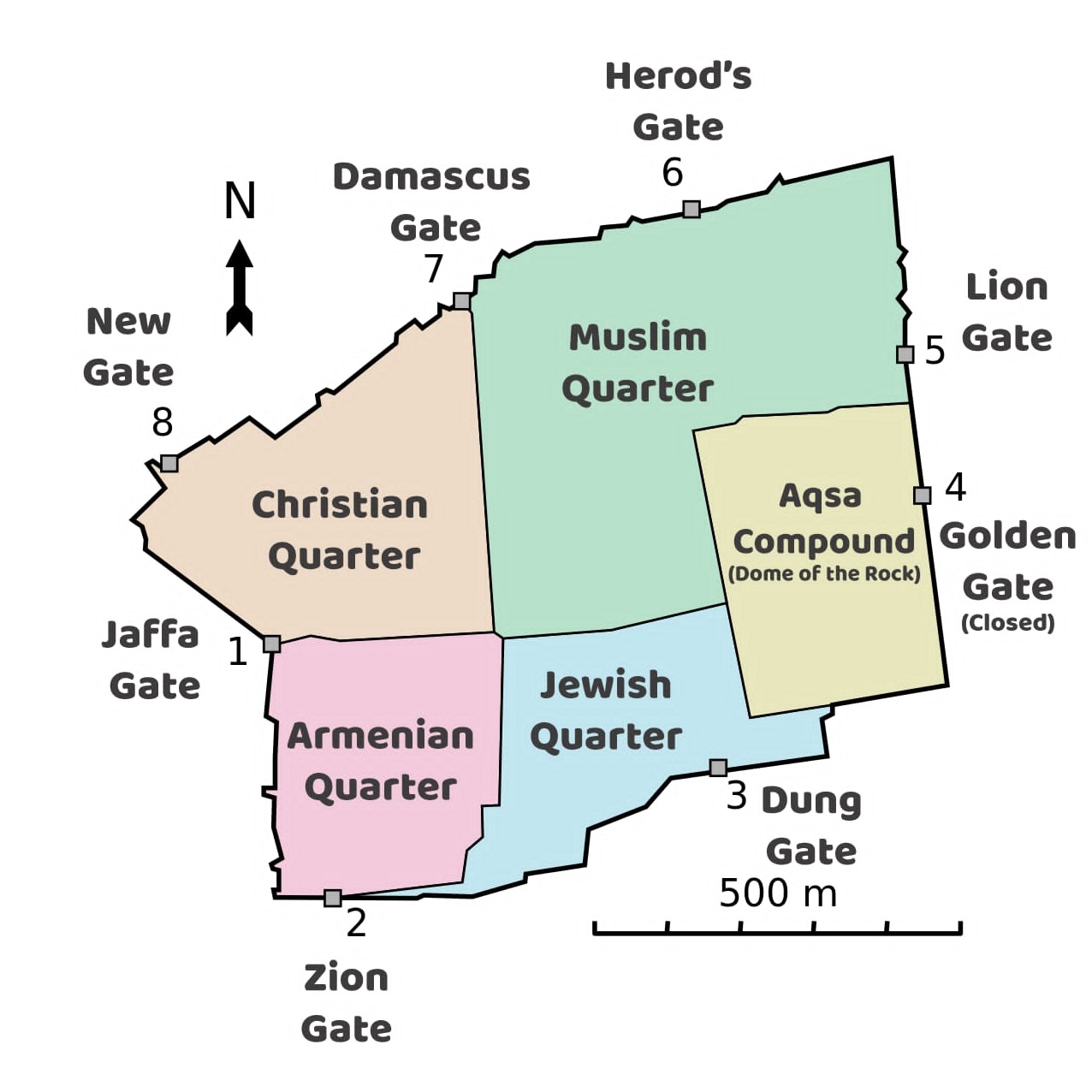
Today, the Armenian Quarter is the smallest of the Old City’s four quarters, comprising about 14% of the area. Located in the southwestern corner of the Old City walls, it can be accessed via Zion Gate (Bab al-Nabi Dahoud) and Jaffa Gate (Bab al-Khalil). The Jewish Quarter lies to the southeast and can be accessed via Jaffa Gate, Zion Gate and Dung Gate (Bab al-Maghariba). The two quarters are separated by Souk al-Hosur Street (Habbad Street), which some describe as an imaginary line. In reality, the two neighborhoods are deeply intertwined — a fact that has become our misfortune and calamity.
The Armenian Patriarchate of Jerusalem, founded in 638 AD, remains a badge of honor for Armenians worldwide due to its rich history and location in one of the world’s most important cities. Its first patriarch, Abraham I, served from 638 to 669 AD. The Patriarchate endured financial hardship during the period between 1666 and 1715. It was documented that Krikor VI Shiravantzee (“the Chain-Bearer”) served as the patriarch from 1715 to 1749. He famously wore a heavy iron chain around his neck for years and vowed not to remove it until the Patriarchate’s debts were paid — a vow he fulfilled, earning his title and enduring admiration for his integrity and devotion.
Today, however, the Armenian Patriarchate in Jerusalem presents a markedly different picture — one that demonstrates neglect, indifference and betrayal.
This deal was signed without the approval of the Brotherhood of St. James/Holy Synod, rendering it legally and canonically void. Leasing such a strategic property for nearly a century would effectively sever the community’s lifeline, depriving Armenians of their only parking area and hindering access to homes, schools and churches.
Beyond logistical hardship, this proposed hotel would likely be transformed into an extremist Jewish settlement outpost — similar to what happened, and will happen, with the Petra and Imperial hotels — depriving Armenians of their social and religious freedoms and intensifying the daily harassment currently perpetrated by settlers.
Armenians living under Israeli occupation face a critical struggle for survival, created not only by Jewish settlers but also by corrupt, incompetent and indifferent Armenian clergymen who lack the courage to acknowledge or apologize for the painful consequences of their actions. On the contrary, these clergymen participate in social events, shamelessly smiling and appearing unaffected by the situation they have imposed on the community.
If we lose the “Cows’ Garden,” it will be the beginning of the gradual end of the Armenian presence in Jerusalem.
From a religious perspective, both Heaven and Jerusalem represent the future of humanity: the afterlife, eternal life (Vereen Yerousaghem).



Apart from the Zionist claim to all of Jerusalem, which includes expropriation in order to demographically Judaize the whole city, the reason why Armenians are constantly harassed by Israel, is also because they are regarded as the friends and allies of Palestinians and of Arabs in general, and are lumped together with them as hostile to Israel.
That is why, no protest will occur and no help will come from the United States, especially from the powerful Evangelical Protestant lobby, which is firmly allied with the Israel/Jewish lobby.
That the Armenians, Palestinian Christians and other Christians in Jerusalem, Palestine and Israel, are not Evangelical Protestant Christians, is another factor for this indifference by American Evangelical Protestants and the U.S. government.
American Evangelical Protestants have shown as much indifference to Armenians as Israel does, except that the Jewish state is additionally hostile to Armenians.
That is why, the issue of Christian properties of Armenians in Jerusalem, and the plight of Armenians generally in West Asia, has been met with ice-cold indifference by American Evangelical Protestants.
Many intolerant Evangelical Protestants, regard other Christian denominations as alien (especially the Eastern Christian Churches, like the Armenian Apostolic Church, the Coptic Church or the Eastern Orthodox Churches), even heretical and one step short of paganism.
Since the perpetrator is Israel, not Muslims, don’t expect Trump to accuse Israel of “persecuting Christians” and designate it as a “country of particular concern”, citing “severe violations of religious freedom”, which he now did against Nigeria for failing to protect Christians (millions of whom happen to be Evangelical Protestant) from jihadi terrorist attacks and massacres.
Trump of course did nothing, let alone condemn, when nominally Muslim Azerbaijan attacked Artsakh and killed thousands of Armenians in 2020, during his first presidential term. (Biden, who claimed to be “sensitive” about “human rights”, also did nothing, let alone condemn, when Artsakh was starved and violently taken over by Azerbaijan during his presidency.)
When it comes to the plight of Armenians, Palestinians, etc, it is the powerful and unjust against the powerless and just.
Why these traitors Nourhan Manougian, his deputy, Archbishop Sevan Gharibian and then-real estate manager Father Baret Yeretzian still around?