



From ghapama to ghosts: An Armenian take on spooky season
October in the United States has a strange feel. Streets are lined with pumpkins carved into jack-o’-lanterns, scarecrows are placed nowhere near the farms they were once created to protect and houses are decorated to resemble cemeteries. For many, Halloween is a highlight of the season, with neighborhood children parading the streets in costumes, offering us the choice of providing a treat or receiving a trick.
Growing up in a multi-generational Armenian household, I realized that some of these practices were foreign. Yet, some of our traditions carried their own version of a “spooky season.” My grandmother and grand aunts didn’t carve pumpkins into faces, but they passed down stories and still believed in superstitions and protective rituals that had kept families safe for generations.
It made me wonder: what does Halloween look like through an Armenian cultural lens?
Like many cultures, Armenians have long believed in the power of the evil eye (char atchk). At least three generations of women in my family were devout Christians; yet, they sincerely believed in superstition as if it were another type of religion! Warding off the evil eye was a serious matter in our home.
The evil eye was thought to be a curse from people who may or may not have known they possessed the power. It was primarily triggered by admiration, envy or malicious jealousy. It could have been brought on through comments such as, “What a cute baby,” or “Your daughter is so smart,” or “I wish I could have a new car like yours.”
It is the prevention and antidotes that I recall with humor, fondness, rolling eyes and a touch of “what if they were right?” A small glass bead (gabout khoulum) was essential for warding off the evil eye and was a must-have for all babies, brides and inside glove boxes in new cars, to name a few.

Many new grandmothers celebrate the birth of grandchildren by showering them with gifts, money and anything they need. Naturally, my mother did the same — minus the baby shower, which was strictly forbidden and considered bad luck: another superstition. First and foremost, my mother presented a tiny safety pin with a small blue bead and a cross, which she pinned on me as an infant, and advised me always to pin one on my children’s onesies. Candidly, I wasn’t very pleased and was mortified to tell my day care provider why my babies wore a strange pin on their onesies. Let’s face it: it defies all common sense and safety protocols. And, of course, my mother happened to have a spare — in case I let it slip through the laundry. As you may imagine, this was quite a burden for a new mother!
While these wise women may have outwitted the evil eye with a blue bead, they feared the risk of accidentally eliciting the evil eye and being unprotected. The antidote to counteract the evil eye is where this really gets embarrassing. You see, pinching your behind was the way to ward it off. When your mother or grandmother suspected you had been given the evil eye, she gave you that look and urgently spoke to you in Armenian to pinch your behind (voreeg’d gusmateh). And if you didn’t, she did it for you — in public.
Another beloved tradition is coffee cup reading. After sipping Armenian coffee, the grounds left behind are swirled and the cup turned upside down. Once it cools, someone skilled in the art examines the patterns and interprets meanings from the images. In my family, Aunt Yessa was the expert reader and often started her predictions with words such as “There’s going to be news,” or “You’re going on a trip,” or “You are going to come into money.” Now, when I smell and taste Armenian coffee, I’m transported back in time, where everyone gathered around the table in a warm kitchen, filled with the aroma of pilaf cooking on the stove.
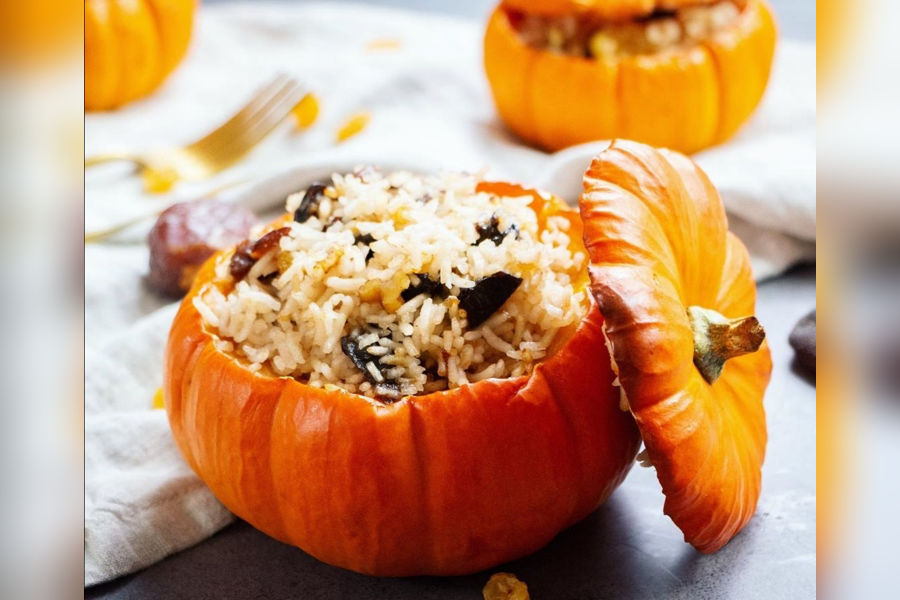
One symbol that connects American Halloween and Armenian autumn is the pumpkin! American families carve spooky faces to create jack-o-lanterns, while in Armenia, pumpkins are filled with rice, dried fruits, apples, cinnamon, melted butter and honey to make ghapama, a dish symbolizing abundance. While both cultures hollow out pumpkins, one wards off darkness and the other expresses gratitude for the light.
This October, as you light a jack-o’-lantern or enjoy a dish of ghapama, take a moment to honor the rich traditions and the unseen world our ancestors cherished, a belief that still resonates for many today. And if you’d like to try making ghapama for the holidays, click here for a video recipe.
Perhaps, in their own way, those old stories and superstitions still protect us and remind us that every culture has its ghosts.


Always enjoy reading your columns, they are interesting, informative, and entertaining.
Lovely! Did you have this stuffed pumpkin as a child?