



The greater community has your back: Lessons from the St. Stephen’s 100th Anniversary
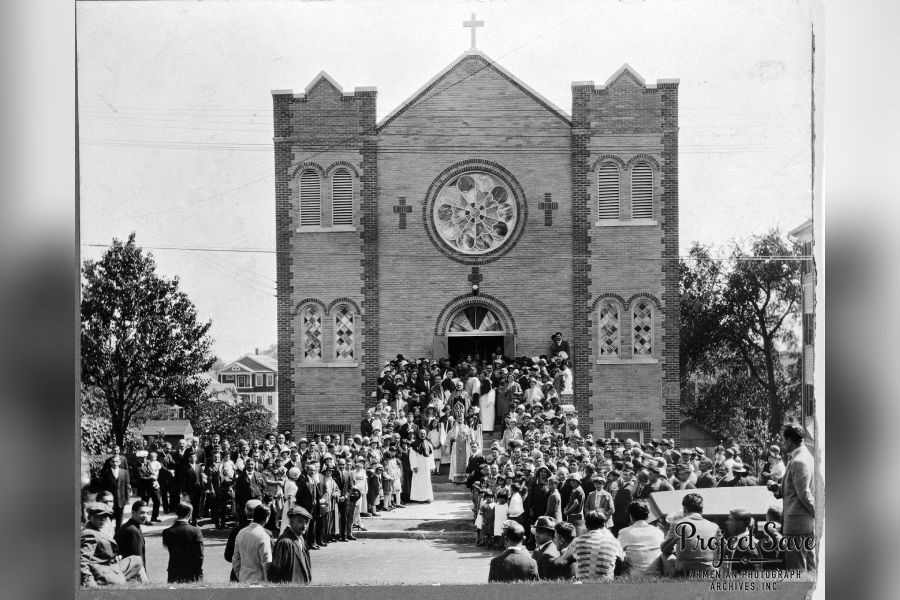
My wife and I attended a very unique event this past weekend in the Armenian community, honoring the 100th Anniversary of St. Stephen’s Armenian Apostolic Church in New Britain, Conn., wherein my maternal grandparents were founding members.
My mom was born and raised in that parish until she married my dad after the war in 1946. Despite the multiple generational experiences of the American diaspora, it is rare to witness the 100th anniversary of any of our institutions in America.
St. Stephen’s was founded a mere ten years after the start of the Armenian Genocide and was the second church founded in the eastern region after St. Illuminator’s Armenian Apostolic Cathedral (Mayr Yegeghetzi) in New York City. St. Stephen’s holds the distinction of being the first church built by Armenians since St. Illuminators is a 19th-century edifice purchased from a Protestant denomination.
Our purpose in attending was simple — sharing in the joy of such an incredible milestone and supporting their mission of revitalization (in the words of Vehapar Aram I).
The last several years have been difficult for this beloved parish with declining membership and spiritual leaders. The parish on Tremont Street began as the spiritual center of all Armenians in northern Connecticut until the tragic days of our church division in 1933. Until the establishment of the Prelacy in 1957, St. Stephen’s was one of several “unaffiliated” parishes that had no hierarchical affiliation and were spiritually attended to by a small cadre of dedicated priests who were either resident or visiting pastors, keeping the faithful spiritually nourished. For decades, Tremont Street was the home of many Armenian families who formed a community, so building the parish in its current location was a logical extension and created a “neighborhood” church.

One of the more recent problems of the Armenian churches in America has been the decline of neighboring churches as succeeding generations moved into the suburbs. This is particularly true for many of our older parishes that were established by the survivor generation in urban settings where the immigrant community resided. Living further from the church created opportunities for distractions and distancing from the community. This is not a unique problem for St. Stephen’s, but that does not dull the pain.
Many of these parishes are functioning due to a small core of remarkably dedicated people who are committed to the mission of the church and ensure the doors remain open.
We should all pray for the pastors and parishioners in this dilemma for the resurgence of their parish life. I applaud the St. Stephen’s parish and their pastor, Archbishop Khoren Toghramadjian, for openly confronting this challenge. They understand the impact of their dedication and what is at stake. There is no attempt to “sugar coat” the current reality — only a desire to find solutions.
Surpazan Khoren is a very interesting leader — well educated, experienced and articulate. He served as the Prelate both in Greece and Cyprus. He was assigned to the St. Stephen’s parish last May and has been a source of productive energy, serving as the spiritual leader of this community. It is unusual to have an Archbishop serve as a parish priest. When asked about this assignment, our beloved Prelate Anoushavan Surpazan offered a thoughtful response. He told the community that if God was so humbled in his love to become man, then certainly an Archbishop can serve a parish.
His response was nothing short of brilliant as it was based on faith, humility and service. Within this current environment, the pastor and community worked tirelessly to host this weekend celebration.
We acknowledge occasions such as a parish anniversary for two primary reasons. The first is to honor the inherited legacy and history of the past. It is important because our history contains our roots and our roots define our identity. We are the beneficiaries and, as such, the responsible stewards. This aspect requires extensive work but is usually a joyful experience. The second reason is more challenging and requires transparency — we celebrate the past but must also prepare for the future. Our responses can vary from denial to fatigue or displaying the courage to confront our challenges. I admire St. Stephen’s parish for their ability to honor both reasons.
The celebration was filled with detailed family histories, rich content on the evolution of the parish and a tribute to many of the individuals who made a difference through sacrifice.
I have always respected the “family” approach of the Prelacy in their ministries. It results in comfort for participants that encourages participation and devotion. If the church is a catalyst in the development of our relationship with Jesus Christ, then it must be not only a trusted institution but one that is approachable.
I witnessed something that day that should inspire the New Britain parish to succeed. Archbishop Anoushavan has a well-deserved reputation as a warm and wise leader, understanding challenges at a parish like St. Stephen’s and the importance of overcoming them.
In May, he appointed Archbishop Khoren as the pastor of the parish. Although viewed as unconventional, he saw an opportunity for St. Stephen’s and for a long-serving clergyman to add value here in the eastern Prelacy. Surpazan Khoren, by all accounts, is off to a great start, humble with a clear direction. His sermons and commentary on Facebook illustrate excellent communication skills in messaging his flock. His tireless efforts in the publications and programs for the 100th reflect a man of action, one who has listened to his parishioners.
The Prelacy sponsors the regional board of trustees and executive council meetings. Surpazan Hayr and the council showed the sensitivity and leadership to schedule the conference the morning of the 100th Anniversary Banquet at St. Stephen’s. This was not simply a symbolic act. It ensured a sizable presence of lay and clergy leaders from the Prelacy and sister parishes.
The message was clear from the region and the Prelacy council — we have your back, St. Stephen’s.
Surpazan stated that with faithful commitment, he will support not only maintaining the opening of St. Stephen’s but also actively supporting its resurgence. How? By doing the things that Prelates are called to do — by appointing energized pastors, by rallying the Prelacy to support a sister parish and by visiting often to make a difference in parish life.
The road to “revitalization” is long and arduous, just as the road of decline was not rapid. We live in challenging times with families struggling, and our society is overrun with secular behavior. The church is literally a sanctuary for those searching and seeking the truth. Those committed and faithful to St. Stephen’s understand the importance of remaining open. It is obvious that our Prelacy leaders also have internalized this mission, as they made it intimately clear this past weekend with a clear message of Armenian Christian love.
I would respectfully ask each of us to pray for this parish that has played such a significant role in the diaspora. A 100-year-old parish is literally a reflection of the history of our beloved church in America. This parish, given its longevity, has experienced the best and worst of times, which is a learning opportunity if we choose to absorb the wisdom. We can all help by encouraging those in the area who have drifted from the church to come home to worship.
Resources are challenging for churches such as St. Stephen’s, so sharing resources between parishes can be effective in initiating new programming. For example, in starting a Sunday School class, it may be difficult to obtain teachers. One solution may be to connect classes virtually between parishes via video conferencing technology. This is one of many examples of how we can bring creative and timely solutions to our brethren.
The spirit of the October 4 celebration illustrated our beautiful legacy and our commitment to a bright future. There were many wonderful and emotional surprises, but the most inspiring was the Prelacy finding new ways to display their support.
While St. Stephen’s travels down this path of hopeful recovery, many will ensure that they are not alone. “The church” does not mean a parish; it should mean the Body of Christ, to which we are all members.
We learn the most during times of adversity. This is an opportunity to strengthen St. Stephen’s and develop new skills of collaboration. God bless our eternal church.


This is for Stepan Piligian. Back in the late 1990’s I was in a CPE program at Hartford Hospital with Serge Artounian. Recent events in Iran have brought him back to mind even though we lost contact years ago. He was good friends with a young priest at your church (whose name I do not recall). If you have any knowledge of these persons I would be grateful to be able to reach one or both. Serge’s parents still live in Tieran, to the best of my knowledge.