



This fall, you can “Meet the Cartozians”: An interview with playwright Talene Monahon
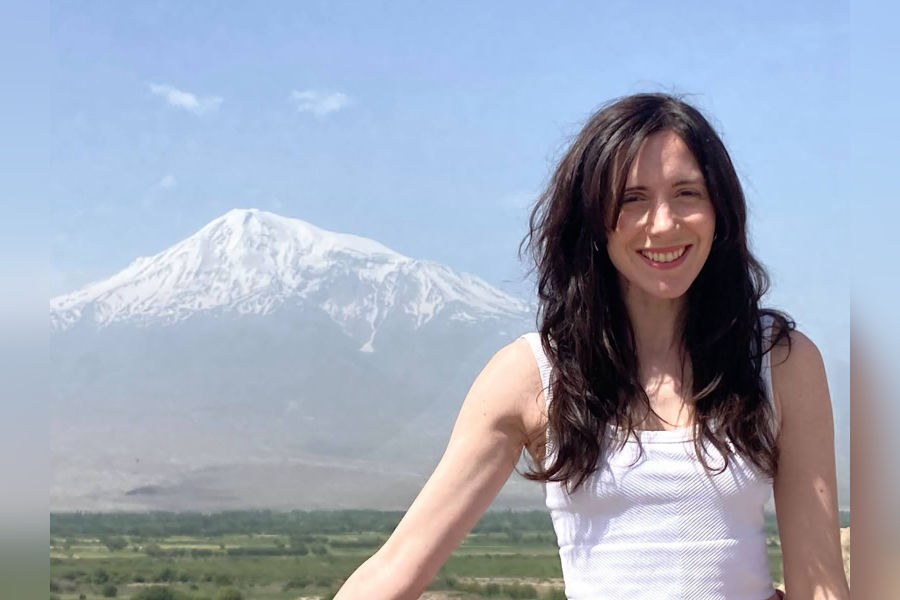
Originally from the Boston area, Talene Monahon is a New York City-based actor and playwright. Many of her plays have graced off-Broadway stages, including “The Good John Proctor,” “Jane Anger” and her debut, “How To Load A Musket.”
Her newest play, “Meet the Cartozians,” pays homage to her Armenian heritage, featuring a majority-Armenian cast and crew. The historical fiction play juxtaposes a 1925 court case with a present-day reality show to explore Armenian identity, legacy and community.
The Weekly caught up with Monahon ahead of the fall opening of “Meet the Cartozians” to discuss culture, inspiration and the one impactful court case that inspired her newest play.
This interview has been edited for length and clarity.
Rosie Nisanyan (R.N.): Do you have a favorite show you’ve seen recently on- or off-Broadway?

Talene Monahon (T.M.): I really love Prince Faggot! It’s at Playwrights Horizons and is going to be transferring to Studio Seaview in the Fall. I think it’s really extraordinary and funny and adventurous and beautifully directed and performed.
R.N.: Your play “Meet the Cartozians” opens off-Broadway this Fall — what inspired you to write it?
T.M.: A few years ago, I found myself feeling confused about Armenian identity and its relationship to the Middle East and to whiteness in America. This identity is such a strong part of my day-to-day existence, but I struggled to understand how to contextualize it. Also, very few people that I have encountered in the U.S. even know where Armenia is.
I tracked down this court case, United States v. Cartozian, where this question of whether or not Armenians are white was actually litigated. In 1925, Tatos Cartozian, an Armenian immigrant living in Portland, Oregon, applied for U.S. citizenship. He was granted citizenship, only for it to be almost immediately revoked by a naturalization examiner, who argued that because Tatos wasn’t white, he couldn’t become a U.S. citizen. To give context: at this point in American history, naturalization laws limited American citizenship to people who were either white or Black. All immigrants from Asia and the Middle East had to basically make the case that they were white in order to naturalize. It’s a really wild chapter in history!
The Cartozian trial took place just a few years after the Armenian Genocide, and the Armenian community rallied around the Cartozians, who made the legal argument that Armenians were white, which was rooted in assimilation potential. The argument leaned heavily into Armenian Christianity to support the case. I think the reverberations of that case, coupled with the incessant pressure to assimilate, have lasted through today. It was integral in the categorization of Middle Eastern people at large as white on government census counts, which has only very recently changed with the Biden administration and the census.
In this play, I’m interested in tracing the origins of how Armenians think about their identity, and how fighting for citizenship in the Federal Court one hundred years ago might have informed that.
I wanted to explore the unspoken legacy of the Genocide and the complex overlapping of trauma, privilege and assimilation that defines Armenian-American history.
R.N.: This is so fascinating, I’ve never heard of that court case before.
T.M.: It’s wild, the whole transcript exists online. I took my knowledge of the court case and the reading that I’ve done about the court case and then I imagined family dynamics. So, I would say the play is historical fiction.
R.N.: What can audiences expect from “Meet the Cartozians?”
T.M.: The first act of the play takes place during the lead-up to the case, with the family preparing to go to trial. The second act takes place in 2024 on the set of a reality TV show that centers on an Armenian family. In the play, a group of prominent Armenian-Americans from the Glendale area has been asked to come on the reality show and speak with the lead about the Armenian-American experience.
The scope of the play is really large, and I’m interested in thinking about the way that history informs the present day and how the present day reflects on history.
We have some amazing actors in the play, including my dream, Andrea Martin! I wrote this role for her without knowing her personally, but dreaming that she would do it someday. Two years ago, I visited Armenia and went with my family to the countryside, where I was so thrilled to see the Andrea Martin Performing Arts Auditorium — this beautiful theater for Armenian children. I was about halfway through writing the play at the time and was so inspired by Andrea’s legacy — both for Armenians and in the performing arts generally — in theater and in comedy. To have her in this play feels unbelievably special.
In the cast, we also have Raffi Barsoumian and Tamara Sevunts, both amazing Armenian actors. Our set designer, Tatiana Kahvegian, is Armenian and from Brazil. I’m really hoping to engage as much of the Armenian community with the play as possible. We’re looking into doing a SWANA Night or Armenian Night.
To have a play that prominently features and involves Armenians, both on-stage and off-stage, is so rare.
R.N.: Many of your plays, such as “Meet the Cartozians,” “The Good John Proctor” and “Jane Anger,” are historical in nature. What draws you to historical characters and events?
T.M.: I just find it fascinating to think about how people lived in times when there were different conceptions of ideas of what it meant to be alive. With “The Good John Proctor,” I was really interested in looking at how trauma would manifest in a society where the word “trauma” didn’t really exist and the concept of trauma was completely foreign.
With “Meet the Cartozians,” I’m really interested in looking at how the concept of a “white person” was invented and refined. The roots of whiteness and the categorization of “white” already existed, but in this case, it was legally “reinvented” at the time. The idea of whiteness is still really slippery and exclusionary and tied to patriarchy and obviously white supremacy, but I wanted to look at how it was reconfigured and the harm that was done through this period of legal canonization. I mulled over the legacy of the Genocide now versus then — what does it mean to be descended from a group of people who experienced this collective trauma stemming from a genocide that was, in many ways, very successful.
In the play, the characters in the first act don’t really speak about the Genocide. It’s only been a few years after and they’re not talking about it. And then, in the second act, everyone’s talking about their trauma from the Genocide, but it’s 100 years later after the actual event. The term itself is so loaded, and there is such harm in being denied it, so I should say I am thinking a great deal about the horrible genocide occurring in Gaza right now and the Palestinians who are suffering without aid.
R.N.: You’re both an actor and playwright. What inspired you to pursue these paths, and how do you balance them?
T.M.: I began as an actor and then sort of transitioned into being a playwright. I was always writing, but I was making documentary theater plays for a long time — I was doing interview-based plays, like “How To Load A Musket.” I still act and I love acting, but playwriting is how I make a living and the thing I most love. I feel very lucky that I get to do it and to have been able to make this transition. Also, my boyfriend [Will Brill] is an amazing actor who’s actually going to be in “Meet the Cartozians!”
R.N.: You also have a play that’s coming to South Coast Repertory in Costa Mesa, CA, next year. Can you tell me more about “Eat Me”?
T.M.: “Eat Me” is a story about a man who develops a very rare eating disorder where he becomes obsessed with gourmet food. It’s about relationships and bodies and the capacity for change, but it’s interwoven with this fixation on gourmet food and on achieving a type of culinary experience that feels unattainable.
Part of where his fixation goes is that he spends a lot of time on this subreddit, which is for people having extraordinary gourmet experiences. I wanted to explore how obsession and fixation can take over a mental headspace, so the play is mysterious and slippery and murky. We are sort of in his head while existing in the real world at the same time. It’s very different from “Meet the Cartozians,” but I also think that, for me, coming from a culture like Armenian culture, where food is so omnipresent…that can’t help but inform the play.
R.N.: How have your Armenian and Irish heritages influenced your writing?
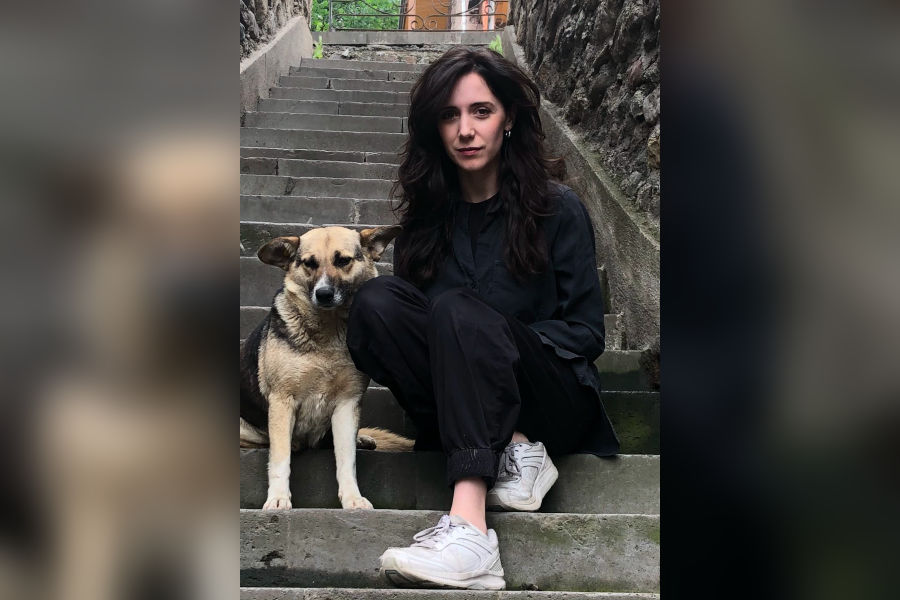
T.M.: I would say in general, my Armenian identity is my foremost identity. I’m half Armenian, and I grew up outside of Boston in this very vibrant Armenian-American community. I went to an Armenian sleepaway camp; I went to an Armenian nursery school; we lived 5 minutes away from my Armenian grandparents. It’s been a huge part of my life culturally. My other half is not as purely Irish; it’s Irish with a little bit of Scottish and Swedish thrown in there. I’m very close to my dad and my dad’s side of the family, but it’s not a cultural presence in the same way. However, there is a character of Irish descent in “Meet the Cartozians,” and, in the last few years, I’ve grown very interested in Irish history and the relationship of the Irish to whiteness and oppression as well.
R.N.: What are you working on now? What can we expect next?
T.M.: “Meet the Cartozians” is coming to Second Stage this Fall, and “Eat Me” will be at South Coast Rep in May of next year. I have another play called “Wonder! A Woman Keeps a Secret” that will be in Vermont at Northern Stage in May of next year and then will come into New York the following year. That one’s a sex farce, so completely different!
R.N.: How has the Armenian community supported you?
T.M.: The Armenian community has been so supportive. Starting with Eric Bogosian — I was very scared of writing this play and Eric really encouraged me to write it. He then hosted the first readings of the play, read early versions of the play and just really did everything he could to make me feel empowered to keep moving the ball forward.
There have been so many people in the Armenian community who have been in readings of the play or who have been advocates for it in the arts community. My Armenian family has been really wonderful. My family are not actors, but we did a reading of the first act of the play when we were in Armenia, which was very fun. My cousin Tamar Wolfson has been a really wonderful friend throughout this process. There have been so many Armenians that I’ve reached out to, because there were so many things that I was learning about, whether they be historical or census-related, so John Tehranian and his writing have been really influential. Kohar Avakian and Thomas Simsarian Dolan have been really wonderful. The people at NAASR, at the Mardigian Library, let me do a lot of research there.
R.N.: Do you have any advice for aspiring Armenian actors or playwrights?
T.M.:
For a long time, I felt like my identity as an Armenian was too niche to really own and explore as part of my artistic practice. I now understand that was a fallacy and that, in stories, there is always universality in the specific.
I think the interest that the play has received and having Evan [Cabnet] champion it and program it at Second Stage is a testament to the fact that the story is not too specific, it’s not too niche. I hope all sorts of people will come see it, but of course, I’m most excited for the Armenians.
Tickets are now available for “Meet the Cartozians” at Second Stage Theatre in New York City (performances begin October 29) and for “Wonder! A Woman Keeps a Secret” at Northern Stage in Vermont (performances begin May 13, 2026). Keep an eye out for tickets for “Eat Me” in Southern California early next year. You can follow Talene on Instagram @talenemonahon to stay up-to-date on future projects and performances.
All photos are courtesy of Talene Monahon


She’s a woman not a man.
She’s an “actress” not an “actor”.
No! to American style wokery in Armenia.