



A creative world where gypsum and bronze become the language of emotions — this is how one could describe the art of Momik Manukyan. The young sculptor believes that art is a divine gift that must not be ignored. Each piece presented in his first solo exhibition is not only a form shaped from material but also an echo of inner emotion. Manukyan shared insights about his art in an interview with the Weekly.
From September 13 to 19, the “Pyunik” Development Center at 3/1 Buzand Street hosted his debut solo exhibition of sculptures and paintings. The show featured 10 sculptures and 21 paintings, reflecting emotions, portraits, still lifes and other imagery. His primary working materials are gypsum and bronze, often combined with nitrate-based substances to create distinctive textures.
Manukyan is originally from the village of Chiva, near Yeghegnadzor. His father, painter Gerasim Manukyan, has played an invaluable role in his artistic journey. “My father is currently engaged in sculpture and khachkar-making,” Manukyan explained. “My family often recalls that around the time I was born — in the 1990s — my father was working in Noravank and took part in the restoration of the church dome.”
The sculptor was deeply moved by the feedback from his exhibition. He recalled one woman telling him she had discovered a genius sculptor.
“It was so unexpected and touching. In the end, that woman gave me a book about the medieval Armenian master Momik. It’s very heartwarming that people understand and praise my art — that is the greatest happiness for an artist,” he said.


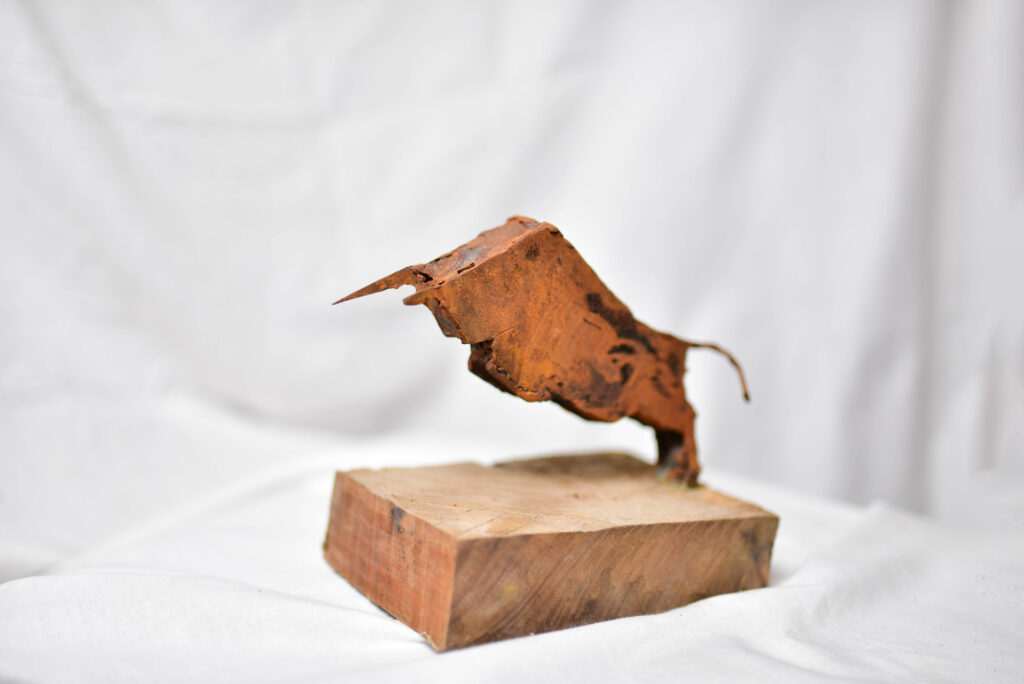
Manukyan’s works often draw from folklore and literature — heroes of epics like David of Sassoun and Abu Lala Mahari. Most of his pieces were created between 2012 and 2025, Manukyan stated. Manukyan’s workshop, located in the basement of his home, is where he feels most at ease and free to create. “My father and I are often in the studio together, but mostly I prefer to be alone in my creative world. I often listen to Ruben Hakhverdyan or Arthur Meschian, who inspire me greatly while working,” he added.
Manukyan studied sculpture at the Panos Terlemezian State College of Fine Arts. His studies were interrupted by military service, after which he entered the sculpture department of the State Academy of Fine Arts of Armenia. At the start of his military service, it was difficult for Manukyan to adapt. Once he was given a personal room, however, he began to create, which eased his state of mind. There, he sculpted a statue of the great military Commander Andranik Ozanian and later a bust of Commander Garegin Nzhdeh.


Each of his sculptures carries a story. At one point, while listening to Viktor Tsoi, he sculpted a piece inspired by the musician. He also created Avetik Isahakyan’s Lilith, and is especially fond of The Assembly of Mice sculpture, which he jokingly compares to Armenian politics. Another favorite is Chronos, whose chains, according to the artist, symbolize mastery over time.
Manukyan has also exhibited pieces at the Artists’ and Writers’ Unions. He believes that every artwork must carry a message and convey the creator’s philosophy. He also reflected on his unusual name, given in honor of the medieval master Momik:
“During my school years, I often received odd reactions because of my name. That somewhat continued in university. Then I was drafted into the army, and while going through a period of personal growth and becoming a man, those issues faded away. I’ve always been at peace with my name — it was given to me in honor of the medieval Armenian master Momik. Nowadays, I combine sculpture with graphic design, though I mainly see myself in sculpture.”
The sculptor noted that if he ever stopped sculpting, he would feel as if he were being punished: “I feel that if I don’t cherish the gift given from above, I might be punished for it — and I don’t want that.” He is currently planning a sculpture inspired by Armenian sharakan hymns, noting that creative ideas are constantly fermenting within him.
Walking silently through the gallery, we moved among the immense emotions evoked by the sculptures. We approached a bronze-colored work, its surface seeming to bear the carved traces of time like fingerprints. Manukyan stood beside it, gently touching the surface with his hand.
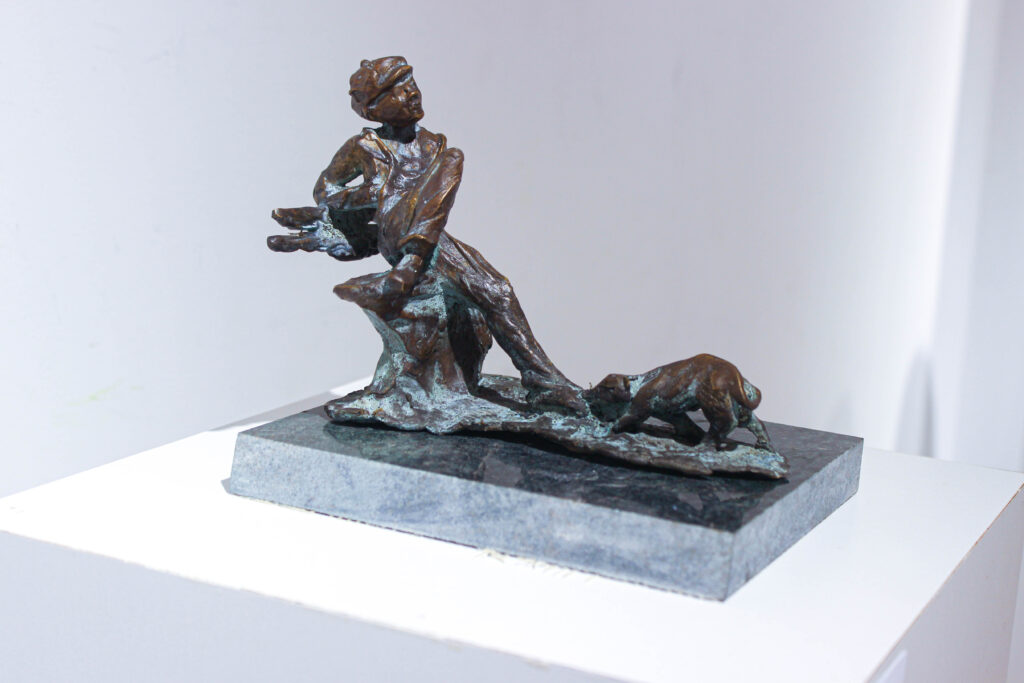
“This is called In Memories,” he explained. “While creating it, I tried to give shape to memory. At that moment, I was thinking about how memory lives within our bodies — hidden in gestures, in silence, in abandoned forms.”
The figure seems to be suspended at the edge of time: neither fully human nor entirely material. “That incompleteness is a symbol for me — of what never fully returns yet always lives inside you,” he reflected. “The person depicted in the sculpture remembers someone whose presence they can still feel, though their face is gone. That’s why only the body remains at the top of the sculpture — without a face: it’s the emptied place of memory, where the eyes, the smile, the gaze never return.”
The figure is seated in an unbalanced, almost unstable position, and yet at the same time, it appears very strong. It is curled inward, as if embracing its own pain, memories and the ghosts of the past. “This posture also suggests waiting — waiting to recall that face through memories, but never quite managing to do so.”
“For me, this work is memory incarnate — a recollection you can touch and feel how time slips through your fingers,” the sculptor concluded.
Momik Manukyan’s artistic path speaks of boundless dedication and inner integrity. His works are not merely materialized images but tangible echoes of the soul, resonating with time, culture and the essence of humanity.
You can explore his works on Instagram.
Photos are provided by the artist unless otherwise stated.