


Fresh from Armenia, put your hands together for Jack Jr.!
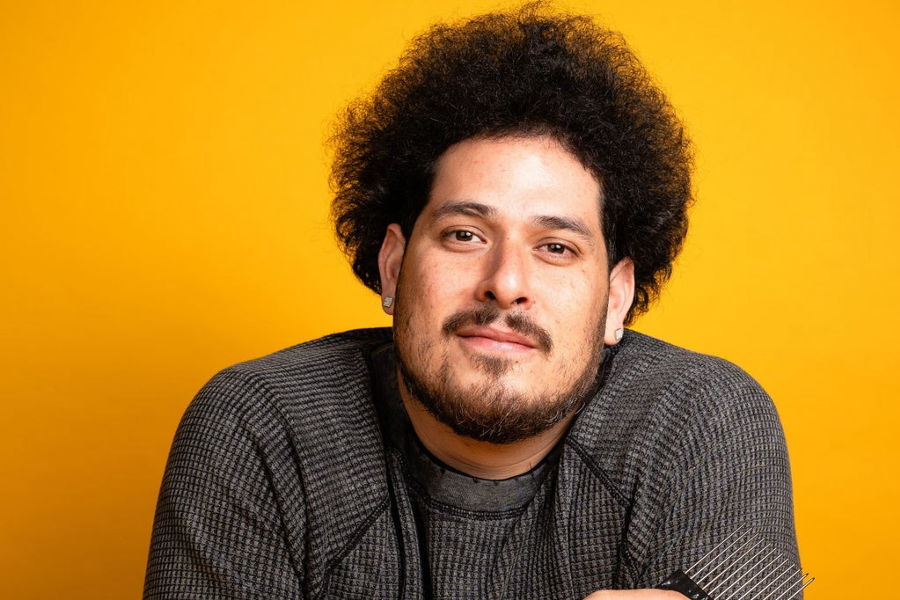
“Goozes???” If you hear that coming from someone’s phone, they are probably watching a Jack Jr. clip!
Known for engaging with the audience, Jack Assadourian Jr. has toured the country—and most recently, Armenia—delighting the public with his unique brand of comedy. Every stand-up show guarantees real-life stories about growing up in the diaspora as an Armenian and Mexican, live matchmaking on-stage and of course, hilarious crowd work.
The Weekly caught up with Jack Jr. ahead of his East Coast shows to talk about his upbringing, his recent trip to Armenia and the documentary he is working on.
This interview has been edited for length and clarity.
Rosie Nisanyan (R.N.): How did you get started in comedy? I know your parents own The HaHa Comedy Club, but did you always want to be a comedian?
Jack Jr. (J.J.): I never wanted to become a comedian. Working there as a kid, I hated it—setting up the bar, putting ice, sweeping and cleaning the bathrooms. My parents were all about hard work and I was always under their shadow. You see all these comedians go in and fail—you have to have really tough skin for this. I see comics I saw as a kid still trying to make it. So, it is really hard to break that barrier. I never really wanted to do it, but I did learn how to hustle from my parents.
When I was 19, I started dating a girl who had a kid. My parents said, “If you want to be a man and take care of a child, you cannot live at home. You need to start a family and move out.” I do not know if they told me that to scare me, but I ended up leaving. Her family did not want us to be together because we were so young, but being an instant father made me want to hustle even more.
I saw a sign in the mall that said: “T-Mobile. Now hiring. Commission-based.” I worked there for four years. I was trilingual, crushed it—top five in California in sales. My dad would always say, “Why are you promoting someone else’s dream? Start your own dream.” “But dad, I’m #5 in California.” “Yes, but you are not T-Mobile. You gotta make your own brand.”

My girl and I ended up breaking up. I was crushed—I lost the will to work, the drive. I started partying, drinking and going to clubs. After learning that my new girl was expecting, I once again became an instant father—reigniting my hustle.
I saved up enough money to open an accessories cart in the Glendale Galleria—then, two other kiosks. I had a Verizon kiosk, and I was very successful.
Then, my girl divorced me. Life punched me in the face, and once again, I was in this dark, dark hole. I was doing everything right, raising a kid, trying to be a good father, trying to be a good person and then it did not end up my way. I started doing drugs, I was drinking heavily and I was down this depressing, dark hole that I felt like I could not get out of.
I finally went back to my dad. I was like, “Dad, I lost all my money in attorney’s fees, etc. I lost all my businesses and I am broke. Is there any way you can help me with therapy? Because I am thinking dark thoughts.” And then my dad goes, “You know how expensive therapy is? Come to the club. Go, cry on stage.” My typical Armenian father just goes, “You want to kill yourself? Come, die on stage and have people laugh at you.”
I went to my first open mic, and I got the comedy bug. I have been doing it for 16 years now, and it literally pays all the bills. I have not had a 9-5 job in over eight years.
I ended up reuniting with my first girl—the one I dated who had a kid. Now, we have two kids together. So, we are like this huge blended family. I feel like I have lived 10 different lives.
R.N.: Who are some of your comedic influences?
J.J.: I never really watched stand-up because I was around it so much. As I got older, I started watching Mitch Hedberg, George Carlin, Damon Wayans Sr.—not for their jokes, but for their timing.
Every comic has their style. I was trying to find my own. And it did not really hit me until the Artsakh War in 2020. Before that, I would make fun of my ex-wife, my kids or general topics—just a comedian trying to be funny.
When the Artsakh War happened, I felt like the media was not talking about what was going on there—they still are not. Something came over me, and I started talking about Armenians on stage.
But comedy comes from pain. I started talking about it on stage, and then it just kind of blew up. I got better as a comedian; I started talking more about myself, my parents, my kids. I just got better at stand-up because it is all real. I have gotten so comfortable on stage that I can walk up to any room and make everybody laugh.
R.N.: Can you talk more about your dual Armenian and Mexican upbringing?
J.J.: My Armenian side did not kick in until much later. My parents were always working, so I spent a lot of time with my sisters and my Mexican grandmother. She taught me to ride a bike, she told me to go to church, she wanted me to pray every night—it was all in Spanish. I grew up very, very Mexican, so I talked a lot about my Mexican side when I first started doing stand-up.
But when I got older, my dad put me in Armenian school and the Armenian influence kicked in. Most of my Armenian relatives lived in Beirut or Armenia, and they did not come over here until 10-15 years ago. I have a lot of Armenian family in New Jersey, which is too far, so I did not connect with them. My mom did not speak Armenian, so we spoke English and Spanish at home.
I am finally at the age where I am comfortable saying, “No, it’s not about choosing one or the other; I’m both.” But as a kid, I had to learn—I am hanging out with Mexicans today, I am hanging out with Armenians today. I kept moving schools, so I had to keep switching friends.
The funny thing is, I ended up marrying an Asian girl. I think it is because I married a Mexican girl and we got divorced. I tried with Armenians, but when you date an Armenian girl, you are dating her family, too.
I married my Filipino-Portuguese wife, and she is the best! I say, “My kids are Armenian, Mexican, Filipino and Portuguese. I made a Pokémon.”
R.N.: Your sets include a lot of crowd work. How do you prepare for crowd work versus your other material?
J.J.: It is striking up conversations and having a good time. It comes with practice—I am always doing crowd work. At family parties, anniversaries, weddings, the gas station, the park, the Americana in Glendale—anywhere I talk to somebody, I am trying to make them laugh.
I used to go up to girls at bars and practice crowd work: “Hey, where are you from? What is your name?” and just try to make them laugh.
I have always been an insecure guy—I have a big nose, I am a little overweight, I am hairy—so, if I am ever gonna get a girl, I gotta make ‘em laugh. Damon Wayans Sr., one of the comics I look up to, gave me advice: “Best advice, man: make the guys want to be you and make the girls want to do you.”

R.N.: You just finished performing a few shows in Armenia. Had you been to Armenia before? How was that experience?
J.J.: I had never been, and it was not really on my bucket list. As a kid, I was ashamed of how I was treated in Armenian school—bullied for being half-Mexican. Kids would say, “Did your parents go to IHOP this morning because you hopped the border?” Stuff like that. My parents had a restaurant called Hola Amigo and the van had the logo on the side. All the other parents had BMWs, Mercedes and my parents dropped me off in this Mexican freaking van. So, I got picked on the whole year for that. I told my parents, “Please do not drop me off in the front; I will walk.” They would drop me off two blocks away, and I would walk to school.
But these past five years have been crazy—my social media numbers have skyrocketed. Armenians from Yerevan, Moscow, Belgium, the Netherlands, London—they kept messaging me: “Please come this summer.” There are not a lot of Armenians in Belgium, not a lot in Croatia—we are spread out, but there is not enough for me to go do a show.
I told my agent, “What if I go to Armenia?” My agent at the time was Persian, and he tried to reach out to Armenian venues, but nobody got back to him. He was like, “I don’t think Armenia is happening, bro.” My whole vision was to go in the summertime, because a lot of people go to Armenia in the summer, and I wanted to go to Vardavar. So, I just put a ticket link out to see what would happen. I asked my friend, Anush, who lives in Armenia, “Can you find me a venue?” She got Hard Rock, and warned them that my language is not appropriate—I am not a makour degha—and it got approved. Tickets went on sale and it just exploded! We sold out—300 tickets in a week.

When I got to Armenia, people kept asking for tickets. I ended up adding two more shows . And the best part of all, I was going up against the Homenetmen Games, Jlo, the Andy concert, comedian Kev Orkian. There was so much going on that week, and people went out of their way to come to my show. It was such a crazy feeling, walking the streets of Yerevan, and people grabbing me, asking for pictures.
The best way I can describe it: the little boy who was bullied as a kid is finally the cool kid. I was so emotional.
The best part of it all: I shot a documentary. I hired a camera crew to follow me around 12 hours a day for two weeks. We filmed everything—I went to the border that separates Armenia and Azerbaijan, as well as the Armenia-Turkey border. I went into villages and knocked on doors, and they welcomed me like I was their son. We interviewed all these older Armenian villagers, not from Yerevan—the old-school Armenians. I sat down and we spoke. I had a translator because my “Hayastanci” Armenian [Eastern Armenian] is awful, and I learned that “Beirutsi” Armenian [Western Armenian] does not work over there. We asked all these people, “How do you feel? I am Armenian, but my mom is Mexican.”
And almost every response was like, “Armenian is not out here…” Then, she grabbed my heart and said, “Armenian is in here.” I was like, “Aw, thank you, mom.”
Everyone showed me nothing but respect and love. It was so beautiful, and I cannot wait to edit it. When I go to shows here in the U.S. and say I am Armenian, non-Armenians right away say: fraud, scam artists, genocide. My vision for this project was to use my platform to show the world what Armenia really is and what it is not. We are villages, lakes, rivers, beautiful mountains.
We have so much history, we are Christians, we are good people. The food is amazing, we dance and we are just genuinely really good people.
We captured some amazing stuff. We’ll put it in film festivals, try for Netflix—I know it’s going to win some awards.
R.N.: I was in Armenia for Vardavar over 10 years ago! How did you like it?
J.J.: Oh my God, it was incredible! I was joking with everybody—I put soap in my water gun and said, “Look, it is the first day Armenians all showered!” It was a non-stop water fight. My socks and shoes were drenched.
Everyone was laughing—that was my favorite part. You saw the whole country smiling and laughing. We are always in conflict; there is always someone trying to get us. There is always a war or genocide or someone trying to take our ancestral land. We are very sad people; we are always angry and sad and pissed off at our leadership. But with Vardavar, it was the first day I saw everyone smiling, laughing, sitting down at a restaurant, soaked—it was great! I am definitely doing it again.

R.N.: You have some East Coast shows coming up—August 26 in Philly, and August 29 and 30 in NYC. What can audiences expect?
J.J.: Everyone says, “Why should I go see Jack Jr. when I saw him last week?” Because every show is different. It is always a fun, fresh show. I involve the crowd and play.
This time, I wrote 45 minutes just on my Armenia trip— real stories, my family, what’s been going on. As always, the front row is not safe—whoever’s in the front row is going to get it. And every show is filmed. We always post clips, so, if you are there with someone you are not supposed to be there with, do not sit in the front row!
R.N.: How do audiences vary from city to city? Do you have a favorite?
J.J.: People think I only perform for Armenians, but that is not the case. It is funny because [Armenians] are the ones who buy the tickets right away. But my audience is varied. I perform all over the U.S., and every show is different because I do not know who is going to be there. It is just a different experience in every city.
My favorite place to perform in is Arizona. I do not know if it is so hot and people just want air conditioning, but I get standing ovations there. Arizona is always a diverse group—it is always a mix of white, Black, Mexican and Armenian.
Obviously, the big cities are my favorites, too. It is also not about performing; it is about the hang, you know? If I go to Missouri, I am miserable, and I am going to stay in the hotel the whole time. But New York, New Jersey, Philly, D.C., Boston—all the East Coast is amazing. Vegas! I like performing in Toronto, Montreal. I am going to all these cities this year. Miami, Florida, is always a party; everyone is drunk before the show starts. Every city is awesome.
I love performing for non-Armenians, too, because people always think, “Oh, he is only funny in Armenian.” No. Everyone gets it, everyone is fair game.
R.N.: You are also bringing everybody together. My cousins in Irvine went to one of your shows in Orange County, and then I went a few weeks later to your New York show.
J.J.: Yeah, that is true with Armenians. I remember when I went to Denver, I had like 300 people there. This was right before the ICE raids happened, so I think 95% were Armenian. After the show, everyone said, “Thank you for putting your show together here. It is funny, we do not have an Armenian church, but today, it felt like an Armenian church.
I have also been doing the dating game at shows. I feel like Armenians struggle to meet people because, first, their parents are overprotective, and second, the guys are insecure. So lately, I have been bringing a couple of girls and a couple of guys on stage, and I try to connect them. I have actually connected a few people, and they are getting married! Sometimes it works, sometimes it goes badly. The other day, I had a girl on stage, and I went, “Dance with him.” And she goes, “No, I can’t. My dad is watching.” And I responded, “You’re not sleeping with him, you’re dancing with him.” So, sometimes it does not work. But I am doing my part, just trying to connect people.
R.N.: How can people support your comedy?
J.J.: Following me and sharing my content is the best free support. Financially, I offer sponsorship packages for major events. I had a sponsor for Armenia—getting there, hiring a film crew, etc.
But if you want to just do a small donation, you could buy a ticket, come to a show and laugh. I think I am doing 25 more cities before the year ends. I am going to Canada and Florida soon. We are working on getting to Belgium, London, Australia, Beirut and Yerevan again in a couple of years. So many of these countries reached out to me after I left Armenia, and I want to go there.
If you want to hire me to come to your city, just message me! I do not necessarily have to perform in a comedy club. If you have a restaurant or a venue that holds like 200 people, a banquet hall, we can arrange something—I do it all the time. All I need is a microphone, a DJ and some lights so people can see my face; that is it.
R.N.: Do you have advice for aspiring Armenian comedians?
J.J.: Hit me up, honestly. I help out comedians all the time. I am very involved in the comedy community—not just the Armenian community. I won’t name drop, but five of my past openers are top comedians right now. I do not like taking credit for their success, but I feel like I steered them the right way and I am very happy for them. I am all about giving back, so if anyone is looking to be a comedian or just wants to talk, my Instagram is always open and I am always up for helping people.
Even tonight, I have two comedians who have been doing this for less than two years, but they wanted some guidance and some stage time. That is the hardest thing to do right now— to get on stage somewhere when you suck. So, I am giving them a stage. They are going to perform for my audience, grow and hopefully, they will get that comedy bug and work as hard as I did—maybe even surpass me.
R.N.: How has the Armenian community supported you?
J.J.: The way it works with the Armenian community is—I give and they give; it is a back-and-forth relationship. I have teamed up with a bunch of organizations—I have been very, very involved with them and they have been involved with me.
It has been amazing, and we are very supportive. Sometimes, people tap me on the shoulder and are like, “I don’t even know who you are, but I saw you are Armenian and I came.”
Someone told me recently that Kirk Kerkorian, the billionaire who was a trailblazing businessman and investor in Vegas, in his book said something about how the Armenian community is the one that lifted him up to success. We need to keep doing that. We need to keep lifting each other because there is a lot of hate; a lot of people try to put us down.
When I first started, I got hated on so much. People told me I was not Armenian, that I should not talk about Armenian things. “Why is this half-breed representing us?” they said. And it was very hard for me. I kept thinking, “The freaking Turks are not even bothering me! You guys are. My own people are putting me down.” But I kept pushing, pushing, pushing and slowly, those comments started going away. Now, it is nothing but support, support, support.

I think in the past three to four years, I have probably raised over $250,000 in fundraisers for the community. Recently, when I was in Armenia, I donated the profits from the second show to Chalet Gyumri, a local nonprofit. I went to the actual physical location, and it was basically a museum of all these beautiful arts, pictures from families who had passed and they wanted the history to grow. They welcomed me there, and said that this is my home and I can come whenever I want.
It is just about finding the right organization. There are a lot of good people out there who are trying to make a difference. I really believe it. All you can do is pray, be a good Christian and a good Armenian and hopefully, everything works out.
You can follow Jack Jr. on Instagram @JackJrComic. Tickets are now on sale for Jack Jr.’s upcoming East Coast shows: in Philadelphia on 8/26 at Helium Comedy Club, and in New York City on 8/29 at Rodney’s Comedy Club and 8/30 at City Winery.
All photos are courtesy of Jack Jr.