


Youth Opinion

Peace by performance: What it means when diplomacy becomes theater
The recent Armenia-Azerbaijan peace accord signing at the White House was as much a theatrical spectacle as it was a political milestone. It blurred the line between diplomacy as a tool for political resolution and diplomacy as a carefully staged performance. This blending is neither new nor necessarily negative: history is filled with diplomatic moments where optics overshadowed practical impact.

Azerbaijan and Armenia have been in conflict since the early 20th century, which came to a head during the final years of the Soviet Union. In 1988, violence erupted over the disputed Nagorno-Karabakh enclave, whose majority Armenian population declared independence from Azerbaijan as the Soviet Union collapsed. Intermittent clashes killed more than 30,000 people in the early 1990s and at least 6,000 during a 44-day war in 2020.

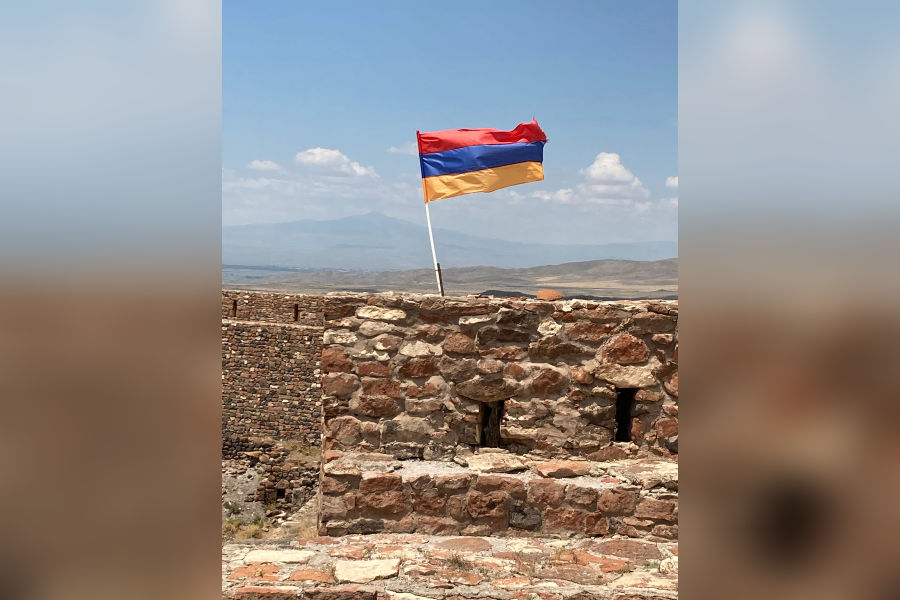
The spectacle of the signing began with the choice of venue: the White House itself. This location projects U.S. authority and centrality in the global order. Positioned before U.S. President Donald Trump, Azerbaijani President Ilham Aliyev and Armenian Prime Minister Nikol Pashinyan, a floral arrangement of white calla lilies symbolizing new beginnings visually framed the moment as a fresh chapter. The Armenian and U.S. flags stood side by side, symbolizing soft power alignment and sending a clear message to regional powers like Russia and Iran, particularly in light of Trump’s corridor plan: the United States stands with Armenia. The Azerbaijani flag, placed separately, was framed as independently important, yet kept visually apart from Armenia in the same shots. Not only was the Azerbaijani flag’s location meant to showcase the conflict between Azerbaijan and Armenia, but it also showed that one wrong move from Azerbaijan and their promised goods from Trump would once again be removed.

Trump himself was positioned physically between the two leaders, serving as the symbolic bridge. “Now, they are friends,” Trump declared, referring to Pashinyan and Aliyev, “and they are going to be friends for a long time.” Placing his hand over theirs, Trump asserted himself as the architect of the accord, underscored by warm gestures, staged laughter and carefully timed pauses for cameras.

This type of visual diplomacy echoes other recent examples. The 1978 handshake between Egyptian President Anwar Sadat and Israeli Prime Minister Menachem Begin, with President Jimmy Carter at the Camp David Accords, was likewise a media spectacle that generated global attention. With the same staging, Israel’s flag was farthest away from the United States, once again signaling who was in charge. The U.S. still has all of the under-the-table deals it will make with certain countries, even as it frames public gestures like the handshake as symbolic breakthroughs.

Yet, despite the historic optics, substantive progress on peace often failed to materialize, and talks in many such cases ultimately collapsed. This history serves as a reminder that pageantry can create momentum but risks unraveling if it outpaces the hard work behind the scenes.

In a similar theatrical flourish, both Aliyev and Pashinyan promoted President Trump’s nomination for the Nobel Peace Prize during the signing ceremony—a headline-grabbing moment met with symbolic gifts from Trump, including commemorative coins and a “key to the White House.” President Aliyev proclaimed, “This is the end of 33 years of sanctions. It has been possible thanks to President Trump.” Trump responded with lighthearted banter, remarking on Aliyev’s grandchildren and encouraging the delegation to come forward for photographs.

Major news networks ran jubilant coverage, looping footage of the handshake and the smiling leaders. Yet, as the spectacle captivated audiences worldwide, the risk remained that optics would outpace substance. As of now, no legally binding agreement has been signed, and this moment echoes the 1995 Dayton Accords, where a handshake symbolized the end of war but masked complex structural compromises that have since caused political paralysis.

Trump lifted sanctions on Azerbaijan, and his corridor plan, connecting Azerbaijan to its Nakhchivan exclave through Armenian territory, was framed as a major win for Baku, offering direct access to Turkey and European markets. While presented as a concession to Armenia, the corridor resolves a longstanding Azerbaijani demand and strategically undercuts Russian influence in the region, particularly as Moscow remains focused on Ukraine. Now, Armenia will benefit from many other things in their own agreement that they have signed with the U.S.

I asked Aram Hamparian, Executive Director of the Armenian National Committee of America (ANCA), “From an advocacy perspective, what concrete outcomes must follow this accord for it to be considered a genuine step toward peace—and how can Armenian advocacy groups ensure those promises are actually kept given the lack of binding enforcement mechanisms?”

Hamparian answered, “Any just and lasting peace needs to start with the return of Armenians to Artsakh, the release of all Armenian hostages and the removal of Azerbaijani forces occupying sovereign Armenian territory… Absent that, what we are talking about is not a peace agreement but coercion, imposed at the point of a gun.”

At present, no detailed timelines or mechanisms for independent verification have been publicly announced.

For displaced people from Artsakh and border communities, a handshake without clear guarantees on return rights, security or compensation can feel purely symbolic.

The bilateral gifts from Trump carry their own risk, as they can be rescinded, leaving both parties’ expectations precarious.

I asked Gev Iskajyan, ANCA’s representative to Artsakh and former head of its office in Stepanakert, “As someone who spent over a year in Artsakh helping build the ANC office, what is your perspective on the fact that the people of the region have no voice in these negotiations, and how do you think their absence will shape the accord’s legitimacy and long-term viability?”

“A true peace is one that takes all voices into account,” said Iskajyan. “For the 120,000 Armenians who were ethnically cleansed from Artsakh, this ‘peace deal’ ignores not just their plight, but their entire existence. There is no peace in the absence of accountability, justice or any regard for human rights.”

Furthermore, regional powers have voiced concerns, most notably Iran, which has threatened to block the corridor, raising doubts about enforcement and long-term stability.

While we Armenians debate the pros and cons of this diplomatic spectacle, it remains to be seen whether the carefully staged performance will translate into lasting peace on the ground. The challenge for all involved is to ensure that the spectacle serves as a foundation for durable reconciliation, rather than a fleeting moment of diplomacy-as-theater.

Advertisement

Grace Yacobe

Grace Yacobe is an Armenian-American student passionate about strengthening community and unity within the diaspora. She writes on identity, faith and the future of the Armenian people.

3 Comments

  1. This article was extremely well-written and it felt like reading a piece from a well-seasoned professional from a news outlet like Reuters. This article also did a phenomenal job of exposing the underbelly of the peace deal’s real purpose of being a well-thought out performance rather than an actual efficient tool for peace in the region.

  2. The idea that the Armenia–Azerbaijan accord signing at the White House was “mostly theatre” falls apart the moment you stop treating speculation as fact. Yes, there was ceremony. Yes, there were cameras. But this wasn’t some hollow performance—it was a deliberate first step in a process that, in conflicts this deep and bloody, can’t even begin without visible, symbolic gestures.

    The flag-placement theory is a prime example of reading too much into something that has a straightforward explanation. State events follow established diplomatic protocol for where flags go—based on symmetry, sightlines, and often sheer practicality. Turning that into a coded message about punishing Azerbaijan isn’t just reaching; it’s projecting motives that aren’t grounded in evidence. The same goes for the “floral symbolism” angle—sometimes a flower arrangement is just a flower arrangement.

    Then there’s the Trump focus. Was he front and centre? Absolutely. Every U.S. president who’s hosted a major peace event has been. Carter was literally the physical link between Sadat and Begin at Camp David, Clinton pulled Rabin and Arafat into a three-way handshake on the White House lawn, and both moments are remembered as historic—not because of where the presidents stood, but because those staged moments gave political cover for the real negotiations to follow. This isn’t unique to Trump, and pretending it is ignores decades of precedent.

    The original piece also cherry-picks history in a way that undercuts its own point. It points to Camp David as “media spectacle” while failing to acknowledge that Camp David led to a treaty that has held for over 40 years. That’s not optics outrunning substance—that’s optics enabling substance.

    As for the gifts, commemorative coins and symbolic “keys” are standard fare in diplomacy. They’re not bargaining chips ready to be snatched back at the first disagreement. They’re goodwill gestures meant to humanise the interaction and set a positive tone. Reading them as veiled threats turns basic diplomatic courtesies into imaginary weapons.

    And this idea that “it’s meaningless until it’s legally binding” completely misses how most peace processes work. They start with framework agreements or public declarations to build momentum and trust. The binding documents come later—if you can even get there. Without an initial, visible breakthrough, you never will.

    The concerns about displaced Armenians, hostages, and occupied territory are absolutely legitimate. But they won’t be solved by sneering at the opening act of a process that might, just might, give both sides enough breathing room to address those issues. Optics aren’t the enemy of substance. In this case, they’re the precondition for it.

    So strip away the overanalysis of flowers, flags, and camera angles, and here’s what’s left: two sworn enemies stood together, shook hands, and publicly committed to a different future. That’s not theatre—it’s history in the making. And history always starts with a first scene.

  3. This was a very precise and well-composed article, Grace. I was only aware of the basic facts of this recent meeting between the three heads of state, and your piece encouraged me to learn more about the extensive history and nuance to the situation. Coming back to your article a bit better educated, I found it very thought-provoking; your skillful writing truly conveyed the gravity of this deal and what it should mean for the Armenian people and nation.

Leave a Reply

Your email address will not be published. Required fields are marked *


Back to top button