



What are the prospects of Turkish-Armenian normalization?
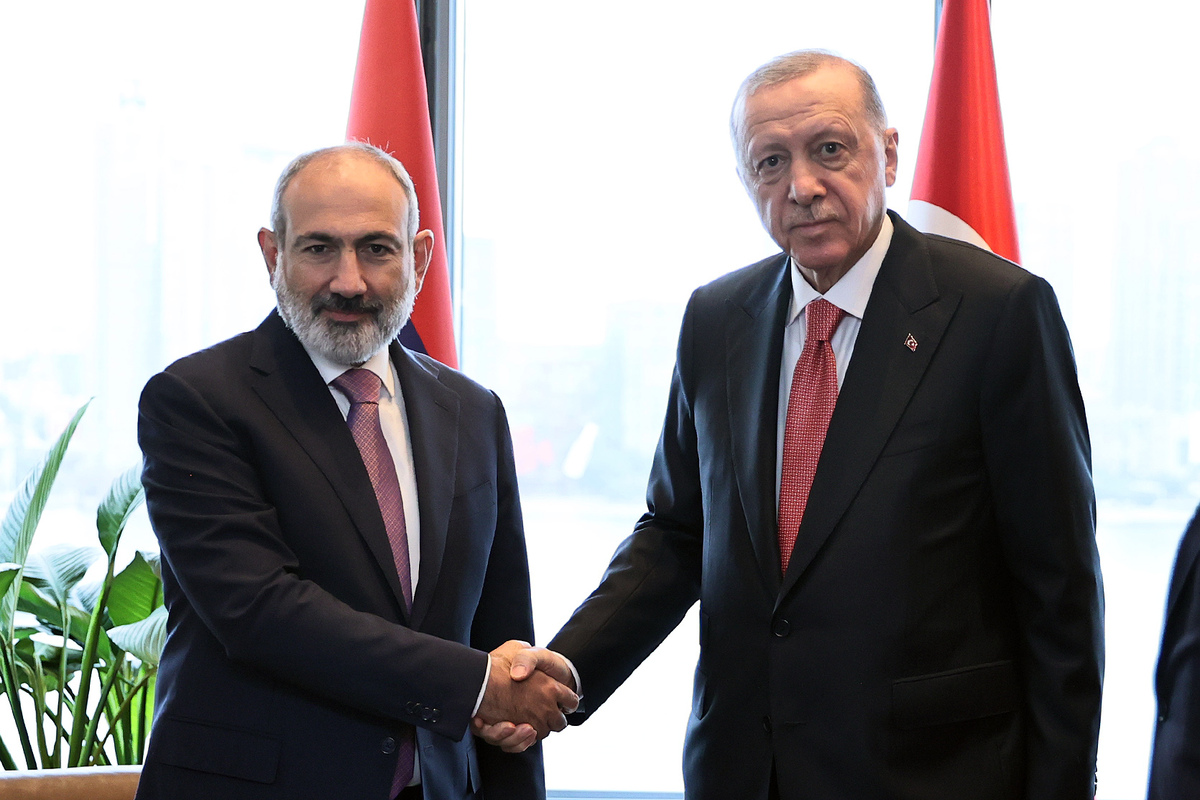
In the geopolitical context of the South Caucasus, Armenia and Turkey reflect an interesting fabric of shared history, a century of animosity predated by centuries of prudent cooperation and coexistence within the Ottoman Empire. Following the Second Artsakh War in 2020 and the loss of the remaining parts of Artsakh (Nagorno-Karabakh) in September 2023, Ankara and Yerevan have expressed in numerous instances their desire to normalize relations. However, considering the historically turbulent relationship between not only the states but the people, how likely is normalization to materialize in the current cultural, societal and economic contexts?
The uniqueness of the Ottoman Empire in the early years of the 16th century lay in its cosmopolitan, multicultural and multiethnic nature. The state did not espouse the policy of ethnic assimilation, rather favoring an ethnic mosaic to take advantage of the expertise, arts and crafts or economic prowess of the people they controlled. The Armenians, like other ethnic groups, benefitted from this system, and some rose to powerful positions, such as the Grand Vizierate in the 17th century. However, the empire lost its tolerance and in the 20th century, under the leadership of the Committee of Union and Progress, organized what became known as the Armenian Genocide.
Following the independence of Armenia from the Soviet Union and the First Artsakh (Nagorno-Karabakh) War, Turkey became adamant in its support for Azerbaijan. Unlike what classical realists or neo-realists would claim, beyond rationality, Armenia and Turkey drifted away from any possibility of cooperation and normalization in the 1990s. For example, post-independence, Armenia signed crucial security agreements with Greece, Bulgaria, Russia, Iran and Syria. These states were antagonistic to Turkey back then and some until now. On the other hand, the rise of Heydar Aliyev to the presidency in Azerbaijan, while ousting the pro-Turkey Abulfaz Elchibey, did not yield critical changes in the behavior of Azerbaijani policymakers toward Turkey. Baku and Ankara realized the benefit of cooperation, and while prudent, they maintained their collaboration in the face of limited domestic dismay from both sides. Concerning the Turkish stance in the early 1990s, then Prime Minister Suleyman Demirel (1991-1993) stated that in any circumstance Turkey would never be “indifferent to the suffering of the Azerbaijanis, but one step too many by Turkey would put the whole world behind Armenia.”
In the 2000s, following the rise of Recep Tayyip Erdogan and the Justice and Development Party to power in Turkey, a Pan-Islamic and Neo-Ottoman shift occurred in the structural nature of Turkey’s foreign policy, affecting decision-making and policymaking in the long run. However, geopolitical considerations and rationalism continued to outweigh ethno-cultural considerations. Following the Russia-Georgia crisis, Turkish Prime Minister Erdogan proposed a new platform consisting of Armenia, Russia, Georgia, Azerbaijan and Turkey, aiming to resolve differences and contribute to regional stability. At that period in time, all states responded positively. Erdogan attempted to accommodate the interests of Russia while situating itself staunchly in the camp of Western powers and NATO, with whom Azerbaijan and Georgia also tried to improve relations, as Georgia feared Russian aggression and Azerbaijan perceived Moscow as pro-Armenia and against its own interests. Here, we observe a diplomatic attempt similar to the current 3+3 format.

This unlikely approach adopted by Turkey stemmed from a desire to become a regional mediator or power with the leverage and capabilities to influence policies, agreements and developments. As such, significant attempts at normalization between Turkey and Armenia were made after the election of President Serzh Sargsyan in Armenia in 2008, who attempted to lead Armenia toward a Western economic model while preserving its strategic and security ties with Moscow. These diplomatic endeavors became known as “Football Diplomacy,” as Sargsyan and his Turkish counterpart Abdullah Gul watched a World Cup qualifier between their respective countries in Yerevan. Throughout the process, President Sargsyan initiated talks with the European Union to sign economic agreements between Brussels and Yerevan, which were rejected under pressure from Moscow and amid heightening tensions in Nagorno-Karabakh. Some experts argue that this was meant as a signal to the authorities in Yerevan that the national security of Armenia and the people of Nagorno-Karabakh was dependent on Moscow, and the EU or outside powers could not contain or counter Russia’s influence in the region. Ultimately, these attempts at normalization yielded no results due to geopolitical pressure, domestic rejection from both sides and pressure from the Armenian diaspora.
Normalization between Armenia and Turkey is intricately linked with geopolitical realities, and to a significant extent, ethno-cultural considerations. First, culturally, both states are excessively antagonistic, not due to differences in nature but rather in their respective soft power. Turkey is a soft power giant in the Middle East, Balkans and Caucasus. On the other hand, Armenia does not have the capabilities to compete in this arena due to economic factors and a lack of strategy. Furthermore, the Neo-Ottomanism of the late 2000s and early 2010s has been periodically replaced with Pan-Turkism. These developments could be attributed to President Erdogan having to ally himself with the ultranationalist MHP of Devlet Bahceli to ensure his reelection in 2018 and 2023. The Pan-Islamist Erdogan has grown increasingly nationalistic over the past decade to appease domestic concerns. In this context, Pan-Turkism is a policy synonymous with the ideas of Ziya Gokalp and the Young Turks of the CUP that inherently signifies antagonism to everything that is not “Turkish.” As such, normalization has become increasingly difficult due to security considerations and cultural overextension by Turkey into the Southern Caucasus.
From the societal perspective, the Armenian Genocide remains a primary concern for most Armenians in the homeland and the Diaspora. The hypothetical recognition of the Armenian Genocide by the Turkish political elite would be thwarted by the government. For example, in a surprising aspect of the presidency of Turgut Ozal, the late statesperson aspired to resolve the issue of genocide recognition by conducting a study of state archives from 1915, leading to concerns within Turkey that the president might recognize the atrocities as genocide. The main opposition to President Ozal back then was the military, which through its institutions and raw influence over the state prohibited any action on the part of the president. Consequently, within the normalization process, the influence and role of the military-industrial complex over Turkish politics cannot be underestimated. Moreover, Turkish public opinion toward Armenians has extended to the research sphere with the opening of a Research Center for Turkish-Armenian Relations in Erzurum last year. One analyst called it a center for the propagation of Armenophobia, as it contains a library solely documenting acts by Armenians against Turks in Eastern Anatolia. These policies make any reconciliation, even excluding recognition, highly unlikely. However, the government of Armenia has taken surprising and at times dubious stances, such as when Foreign Minister Ararat Mirzoyan said Armenian Genocide recognition is “…not our number one priority.” It remains to be seen what other stances the Armenian government might take to indirectly hint at Yerevan’s willingness to provide concessions in return for normalization.
Finally, economic concerns remain crucial in Armenian-Turkish normalization. Ankara is an economic powerhouse compared to Yerevan. While some businesses in Armenia might benefit from the establishment of economic ties with Turkey, others might not be able to compete with Turkish imports, which will most certainly hurt local products. The government of Armenia, if able to reach normalization with Turkey, must be prepared to adopt specific economic policies to protect its financial stability. Already, Armenia is absent from regional economic projects such as the Baku-Tbilisi-Ankara railway or the Baku-Tbilisi-Ceyhan pipeline. Any economic cooperation is unlikely to benefit Armenia, considering the main economic project under discussion is the “Zangezur Corridor,” a national security threat and infringement upon the sovereignty of Yerevan.
While Armenian Prime Minister Nikol Pashinyan’s administration is willing to normalize relations with Turkey, Ankara states that a major precondition for such a process is the signing of a peace treaty between Armenia and Azerbaijan. The Armenian stance, excluding that of the government, has consistently been to normalize without preconditions as a follow-up to the recognition of the Armenian Genocide. It is unlikely that Ankara would take such a step. However, Turkey’s preconditions signal a lack of political will within Ankara to normalize relations with Armenia, in fear of domestic opposition or shifts in the political balance. On the other hand, Russia and Iran, while supporting normalization openly, might refrain from facilitating the process given geopolitical changes. The current developments in Syria, Ukraine and Lebanon, alongside the reelection of U.S. President Donald Trump, might affect these stances.
It is worth noting that partial normalization has been achieved with the opening of the Turkey-Armenia border for cargo trade and mutual flights. Normalization without concessions and losses for Armenia remains unlikely, while for Turkey, the status quo with the continuation of partial normalization seems more desirable.

It is also worth noting that it is always Pashinyan, who from a position of weakness, is eager and pressing for a full normalization and a peace treaty with Turkey and Azerbaijan, whereas these two Turkic countries are not all in a hurry and are happy with the status quo.
Even if Pashinyan offers concessions at the expense of Armenia’s, which these two Turkic countries press for and which is entirely possible, they will only be satisfied, when they have Armenia on a leash and becomes their puppet.
A full opening of borders for people looks unlikely, especially with Azerbaijan, which has more or less permanently closed all its land borders for people crossings, except for cargo trade by trucks.
A full normalization and a peace treaty with Turkey and Azerbaijan for Armenia under the “best” conditions, would be a cold peace, in which Armenia would make minimal possible concessions and keep the Syunik corridor under its jurisdiction and control, and have its territorial integrity restored and recognized by Azerbaijan and Turkey. It is doubtful that Armenia would economically benefit, let alone prosper, with such a cold peace. Even this scenario could be wishful thinking, being situated in a region with such unsavory neighbors, where idealism is a luxury and a fantasy.
Unfortunately geopolitical realities coupled with population realities means Armenia will always be negotiating with its Turkic neighbours from a position of weakness. Unless Armenia is armed with nuclear weapons it will not be treated as an equal partner given Turkey’s economic, geopolitical and military strength and capabilities. Pursuing a strategy to establish peace and normal relations with all its neighbours represents Armenia’s most important and optimal strategy given its traditional ally Russia is now strategically cooperating with Armenia’s Turkic neighbours.
I keep saying that one has to be realistic , Russia is an unreliable ally and cannot be trusted . The US is not that much better either. Geography will not change and listening to armchair generals at home and diaspora heroes overseas will not benefit anybody in Armenia . It would be best to work out a modus vivendi with one’s close neighbours .
Nicely written and realistic analysis, devoid of the usual hysterics anytime subject includes Türkiye. In any case, unfortunately given its size and weight, Armenia today does not register high in the strategic considerations of Türkiye. Especially with so much happening elsewhere. Decades of stay under Russian thumb to counter an imaginary Turkish threat has consequences obviously. I still do not know why a full normalization with Turkiye today is not possible, especially since the Karabagh issue is behind us and Turks are not held back by Azeris anymore.
I despise this genocide denier and Islamo-fascist Turkish terrorist-in-chief Erdogan who loves to take the moral high ground and lecture others on what they should and should not do while he totally disregards the sovereignty of their neighbors by sending in his terrorist troops, armed with NATO supplied weapons, deep into their territories and without their consent to conduct terrorist activities and illegally setting up military bases in their territories in violations of international norms and laws. He is responsible for the civil war in Syria. He was hell-bent on toppling Bashar Aassad early on until he realized he could not causing millions to flee and seek refuge elsewhere, millions in today’s so-called “eastern Turkey”, aka occupied Western Armenia in particular. He armed and financed ISIS criminals to destabilize Syria and to terrorize and murder rival Shia Muslim populations and to uproot non-Muslim populations and desecrate their houses of worship, and in one particular case blowing up and destroying an Armenian Genocide Memorial Complex.
This Turkish terrorist also allowed the treatment of injured ISIS terrorists in Turkish hospitals and used them, by giving them Turkish passports, and the Syrian refugees to exploit and blackmail the Europeans for various concessions from them by threatening them to flood Europe with them. He also recruited and transplanted these ISIS terrorists in Armenia’s backyard to fight against Armenians on behalf of his pseudo-Turkish Azerbaijani brothers-in-crime to punish Armenians for their pursuit of the Armenian Genocide resolutions around the world and for the liberation of Armenian territories occupied by his pseudo-Turkic kin while his own genocidal state, born out of the terrorism and murder of the natives, is in occupation of most of the Armenian homeland. The Armenian border with terrorist Turkey has been closed since 1993 for no reason other than for the hatred and punishment of the freedom seeking Armenians and I hope it remains closed forever. The worst thing you can do is to appease a bully and conduct business with a unrepentant terrorist state.