



The Israeli government and the Jerusalem municipality are mocking Armenian community leaders
On Aug. 26, 2025, Israeli Prime Minister Benjamin Netanyahu told Patrick Bet-David — an American media personality — on his podcast that he recognizes the Armenian genocide. However, his response did not make it clear whether he was being serious or sarcastic. When asked by Bet-David why Israel did not recognize the Armenian genocide, Netanyahu said, “I think we did. I think the Knesset passed a resolution to that effect.” Netanyahu’s declaration that the Knesset has recognized the Armenian Genocide — while the Knesset has not passed any such official legislation — coupled with his sarcastic tone, is an insult to Armenians in General and Armenians of Jerusalem and Israel in particular.
On July 7, 2025, the Jerusalem Municipality named a small, modest square outside Damascus Gate in the Muslim Quarter of the Old City of Jerusalem after Elia Kahvedjian, an Armenian photographer and genocide survivor. While this initiative is commendable, it would have been more appropriate for the municipality to name a square, plaza or street outside or inside Jaffa Gate — where the Armenian Quarter begins — or within the Armenian Quarter itself after this accomplished photographer.
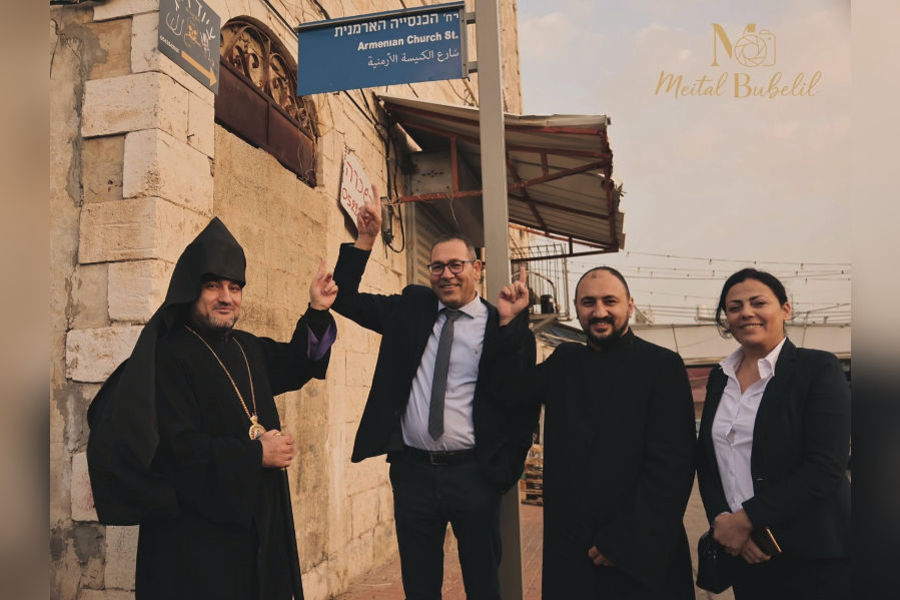
On Jan. 12, 2026, the Municipality of Ramleh, a small city within the Green Line with a population of 84,312, named a small corridor near St. George’s Armenian Church “Armenian Church Street.” The Ramleh municipality organized the event, which was attended by representatives of the Armenian Patriarchate and the mayor of Ramleh. It should be noted that after the establishment of the State of Israel, the government confiscated hundreds of dunams of land belonging to the Armenian population.
It is worth noting that the Israel does not recognize the Armenian genocide to this day. Even American Jewish lobbying groups are working in international forums to prevent countries from recognizing the Armenian Genocide. We have noted that U.S. Vice President J.D. Vance deleted his social media post on Feb. 10, 2026, which referred to the “Armenian genocide.” Israel’s contempt for the Armenian people reached its peak when, during and after its involvement in the Nagorno-Karabakh war against the Armenian people, it recruited educated young Armenians to work in its embassies and diplomatic missions abroad, particularly in Azerbaijan.
The Israeli government and the Jerusalem municipality are working to expand jewish settlements in the areas and neighborhoods surrounding the Jewish Quarter in the Old City of Jerusalem, specifically outside and inside Jaffa Gate, Zion Gate and Dung Gate. We have all heard, read and witnessed the encroachment on the “Cows’ Garden” located in the Armenian Quarter of the Old City of Jerusalem on the road leading to the Western Wall in the Jewish Quarter, in addition to the daily humiliation suffered by Armenian clergy at the hands of radical Jewish nationalists.

Jewish settlers, in cooperation with the Israeli government and the Jerusalem municipality, have seized numerous areas and neighborhoods in the Arab village of Silwan, which is adjacent to the Jewish Quarter and located outside Dung Gate on the southeastern edge of the Old City walls.
On Jan. 9, 2026, B’Tselem, a Jerusalem-based Israeli nonprofit organization, posted on its Facebook page: “Some 2,200 residents of Silwan in East Jerusalem — 84 families from the Batan al-Hawa neighborhood and 150 families from the al-Bustan community — are facing immediate expulsion from their homes.”
Batn al-Hawa is a residential neighborhood inside the village of Silwan, which is located southeast of the al-Aqsa compound, outside the walls of the Old City of Jerusalem. The neighborhood is located on a mount known in Arabic as Jebel Batn el-Hawa, which is the southernmost section, or southern extension, of the Mount of Olives ridge east of historic Jerusalem. It is separated from the Mount of Olives proper by the Silwan Valley, which connects to the Kidron Valley at the same point. Al-Bustan is a well-watered area and residential neighborhood located inside the village of Silwan in East Jerusalem and currently consists of more than 100 Palestinian homes.
As of 2014, approximately 1,000 people lived in this new neighborhood. In December 2020, several Palestinian residents in al-Bustan were served with demolition orders by the city, requiring them to demolish their own buildings or pay the cost of having the city carry out the demolitions. In February 2021, the Jerusalem municipality asked a court to reactivate demolition orders relating to more than 70 buildings housing 1,500 Palestinians in al-Bustan. On June 7, 2021, the Jerusalem municipality issued demolition orders affecting 13 families and 130 people, giving 21 days to evacuate and demolish their houses themselves.
On June 29, 2021, Israeli authorities demolished a butcher’s shop, the first in what locals fear could be a series of demolitions. The Norwegian Refugee Council issued a statement saying, “Israeli authorities must immediately stop forcibly displacing people and demolishing their homes and property,” and “Under the Fourth Geneva Convention, Israel has an obligation to protect civilians under its occupation and to refrain from destroying private property.”
On June 8, 2021, U.N. Secretary-General Antonio Guterres urged Israeli authorities to stop demolitions of Palestinian properties in occupied East Jerusalem. On Aug. 9, 2021, a court order froze most demolition orders until February 2022 but allowed 16 homes to be razed immediately. In the past two years, the Israeli government and the Jerusalem municipality, working hand in hand with settler organizations, have dramatically escalated their efforts to expand jewish settlements in the neighborhood and uproot its Palestinian residents.
On Feb. 1, 2026, the Jerusalem municipality issued demolition orders for 11 homes in the al-Bustan neighborhood, giving owners 21 days to vacate and demolish their homes. This order comes approximately two weeks before the start of the holy month of Ramadan. This policy is described as part of an ongoing campaign of ethnic cleansing led by the Israeli government and its prime minister. B’Tselem joins 17 human rights organizations in Israel in calling on the Israeli public and the international community to bring about the immediate cessation of all expulsion measures in Silwan and throughout the occupied Palestinian territories.
A catastrophe awaits the Batn al-Hawa neighborhood in Silwan
On Jan. 18, 2026, Al Jazeera published an article titled “‘Enormous pain in my heart’: Palestinian evictions mount in East Jerusalem.” The article states: “Since November, eight more families in the Batn al-Hawa neighborhood of Silwan have been forced to leave their homes, often violently, and Israeli settlers have quickly moved into and occupied the empty houses.”
These recent evictions indicate a significant acceleration in the pace of forced displacement that has been ongoing in the neighborhood for years. At the beginning of the new year, the Israeli Supreme Court rejected the final appeals filed by 150 Palestinians from 28 families residing in Batn al-Hawa who were facing the threat of eviction from their homes.
Approximately 700 residents of Batn al-Hawa, comprising 84 families, face the imminent threat of forced displacement, which, according to the Israeli NGO Ir Amim, constitutes the largest coordinated displacement of Palestinians from a single neighborhood in East Jerusalem since its occupation in 1967. Twenty-four homes belonging to the extended Rajabi family alone are subject to eviction orders, affecting the lives and stability of 250 people.
Previously, on Jan. 12, 2021, the 28 families who filed appeals received official letters from the Israeli Ministry of Justice Information Office demanding that they vacate their homes within 21 days. The Khalil al-Basbous family, neighbors of the Rajabi family, has already been forcibly evicted from its home as a result of the recent court decision. The Israeli government and the Jerusalem municipality began planning to demolish the Batn al-Hawa neighborhood and subsequently carried out the demolition in 2004.
East Jerusalem in general
On Feb. 15, 2026, the Israeli government announced an official decision to complete the surveying and registration of all lands in East Jerusalem in the land registry, or Tabu, by the end of 2029, a move aimed at registering 100% of the land within four years. Since the land registration process began in 2018, approximately 85% of the land has been registered in the name of settlements or the state, while only 1% has been registered in the name of Palestinians.
This decision will lead to the displacement of entire Palestinian communities; the issuance of eviction orders against families who were unaware of the changes to the land registry, particularly in areas where new settlements are planned; and the re-surveying, division and assignment of unregistered lands to a final, uncontestable owner. Consequently, they will be registered in the name of the state instead of their original owners.
These days, the residents of the Armenian Quarter in the Old City of Jerusalem are asking themselves, “When will it be our turn to be forced out of our homes, whether voluntarily or by force?” From time to time, we receive news that plunges us into a state of depression and pessimism. The latest such news came on Jan. 21, 2026, from the Save the Armenian Quarter Facebook page, which stated:
“On Dec. 23, 2025, defrocked priest Baret Yeretzian filed a financial claim in the Jerusalem District Court against Patriarch Nourhan Manougian and the Armenian Patriarchate of Jerusalem. The plaintiff seeks 2.6 million New Israeli Shekels, in addition to a public apology following the decision to defrock him in May 2023.”
If the defrocked priest Baret Yeretzian wins his lawsuit, it could be to the advantage of the Jewish settlers. Note that on July 8, 2021, Armenian Patriarch Nourhan Manougian, his deputy Archbishop Sevan Gharibian, and then-real estate manager Father Baret Yeretzian signed a contract with Danny Rubinstein, a Jewish settler and businessman from Australia.
The agreement stipulates a 98-year lease for 11,500 square meters of patriarchal land known as “Goverou Bardez,” or “Cows’ Garden,” for the construction of a luxury hotel. This land comprises about 25% of the Armenian Quarter. Leasing such a strategic property for nearly a century would effectively sever the community’s lifeline, depriving Armenians of their only parking area and hindering access to homes, schools and churches. Life would become unbearable.
In addition to the logistical difficulties, this proposed hotel is likely to become a residential outpost for an extremist Jewish settlement — similar to what is currently happening in the village of Silwan — depriving Armenians of their social and religious freedoms and exacerbating the daily harassment they face from settlers.
Furthermore, residents of the Armenian Quarter are unaware of the legal violations committed by the three aforementioned clergymen against families residing in the quarter, and they wonder, “Will we receive orders to vacate our homes in favor of Jewish settlers in the near or distant future?”
On Feb. 7, 2026, surveillance cameras at the Armenian monastery in Jerusalem’s Old City captured ultra-Orthodox Israeli Jews spitting at the entrance of the Armenian Cathedral of St. James in an act of anti-Christian aggression. In retaliation, these extremists began destroying all surveillance cameras in the area, including those at the homes of Armenian residents. Israeli police have been unable to prevent reported attacks by settlers , and we do not know whether they will be able to prevent more serious acts in the future.



The article title suggests it’s about the Israeli government actions against Armenian community, yet I struggled to find anything related to the title in the article.
I found it and all the concern was understandable, Armen, what about you or the Jew?
What a shock, Israelis stealing more land that does not belong to them. What a pack of liars and thieves. When there are no Palestinians or Armenians left in Israel then they will start stealing from each other. There are three countries in this world I will never visit, Turkey, Azerbaijan, and Israel. I simply refuse to spend a nickel subsidizing murderers, liars, and thieves.