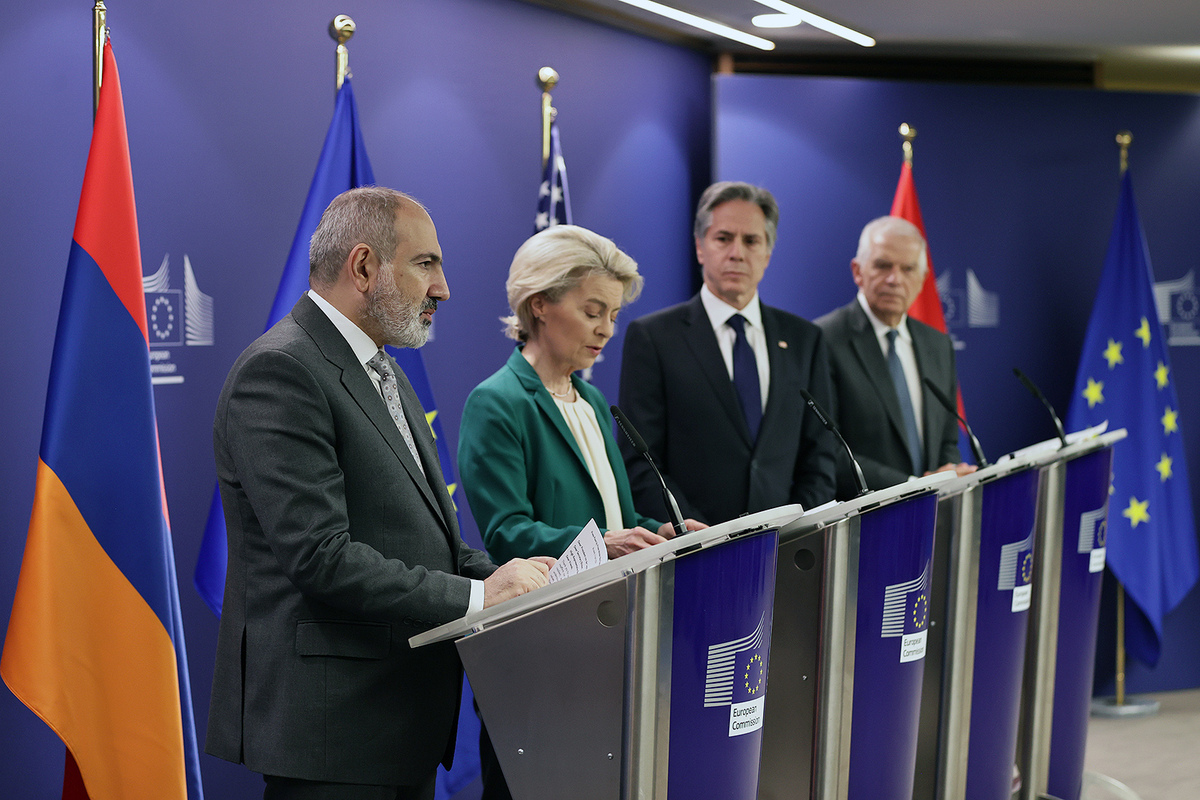
Armenian PM Nikol Pashinyan, President of the European Commission Ursula von der Leyen, U.S. Secretary of State Antony Blinken and EU High Representative for Foreign Affairs Josep Borrell
The events in Artsakh (Nagorno-Karabakh) during the past four years have spotlighted the role of Armenian Prime Minister Nikol Pashinyan’s government in enabling the genocide of the Armenians of Artsakh. Pashinyan’s recognition of
Ara Nazarian is an associate professor of Orthopaedic Surgery at Harvard Medical School. He graduated from Tennessee Technological University with a degree in mechanical engineering, followed by graduate degrees from Boston University, Swiss Federal Institute of Technology and Harvard University. He has been involved in the Armenian community for over a decade, having served in a variety of capacities at the Hamazkayin Armenian Educational and Cultural Society, the Armenian Cultural and Educational Center, Armenian National Committee of America, St. Stephen’s Armenian Elementary School and the Armenian Revolutionary Federation.
17 Comments
Nikol came to power and it was the most disastrous outcome for Armenia, at best he was a an average reporter, a man with average intellect and not suitable for a role as a PM, his is rather naive, and without any skills as a politician or negotiator, at every step he has bent down on his knees, giving in to demands of almost all regional players, he reminds me of a class clown who everyone makes fun of, but by grace of a bad situation he is voted as Class Captain, still laughed at but the outcome is far more serious. He must be removed at all costs
Realists and pragmatists will take Pashinyan anytime over his corrupt predecessors who foolishly place Armenia’s security in hands of Turk loving Russia which has sold off Armenia and Armenians since 1923.
Ari exactly Russia has messed Armenia around and the issues with Turkey and Azerbaijan have been an absolute boon to it’s relationship with Armenia who finally has realised why Russia isn’t keen for the issues to be formally resolved as that will negate their position . Indeed people were blinded to reason not seeing that Russia has been betraying repeatedly as long as it doesn’t do the killing itself it can continue to gull the Armenians and their insular tendancies however repeated disappointments and the internet means that Kremlin lies and Soviet ignorance don’t work as they once did.
So what is the answer for Armenia? Return to the old days when corruption was endemic? When despite positive rates of economic growth hundreds of thousands of Armenians continued to permanently leave Armenia? When Armenian leaders sold off Armenia’s prized economic assets to Russia not taking into account concerns about economic security and sovereignty? When elections were regularly rigged and falsified? When peace talks on Artsakh dragged on for decades allowing Azerbaijan time to strengthen its armed forces and economy, and be in a superior position to attack and reclaim Artsakh? When Armenian leaders promoted fantasy and not geopolitical realities? When Armenian leaders failed to increase the population of Armenia and Artsakh while Azerbaijan’s population grew by 40 percent between 1991-2023 while Armenia’s population declined by 17 percent over that period and Artsakh’s declined by 25 percent. When Armenia’s leaders were more interested in amassing personal wealth at the expense of the general population instead of strengthening the economy, public institutions and the army?
@Hagop
Exactly so alas how many deny this reality and indulge in fantasy. Recent events locally and further afield and the passing of time however have quietly led to a more realistic assessment about the goings on.
Horrible Pashinyan? If he was that horrible why do the Armenian people keep electing him? Maybe consider replacing the word horrible with “pragmatic and realistic”.
ONE PARTY RULE. Thusfar, Armenia has been governed by one party at a time. The last parliamentary election in Armenia took place on June 20, 2021 and again brought Nikol Pachinyan led Civil Contract centrist party to power having secured 54% of the votes. The Armenia Alliance had 21% of the votes and I have Honor Alliance had 5% of the votes – rounding the figures. Totaling them amounts to 80% of the votes. What happened to the remaining 20% of the votes cast? A total 26 parties, alliances, coalitions took part in that election. The remaining 23 competing entities shared the remaining 20% of the votes cast, naturally no one among them had more than the 5% of the votes that secured the I Have Honor Alliance seats in the parliament. There may be a good possibility that the upcoming parliamentary election in 2026, will see a coalition of elected parties come together and form the government. By the way, I do want to imply that would be any better, or for that matter, worst. Presently six parties make up the current government of Israel.
Armwnia is being dragged, kicking and screaming, into the realities of the 21st century. Those global realities were never a part of Armenia’s policy vis-a-vis Artsakh/Karabakh in the post-independence period. The Armenian military defeat can be blamed on successive Armenian governments and the blind nationalism of the diaspora. That defeat ultimately led to Azerbaijan’s regaining control of the so-called Republic of Artsakh. No leader of Armenia could have avoided this eventuality. And please stop calling what happened a “genocide”. It demeans the term.
Dear Hovhannes, do explain more how the “blind nationalism of the diaspora” created the Karabagh movement in the first place, created a series of corrupt regimes and an oligarchy far more interested in enriching themselves than in building a secure and prosperous Armenia, prevented the military from acquiring adequate defensive weapons, caused the government to ignore Azerbaijan’s decade’s-long military buildup, forced the Republic to rely entirely on Russia, etc., etc.
Definition
Convention on the Prevention and Punishment of the Crime of Genocide
Article II
In the present Convention, genocide means any of the following acts committed with intent to destroy, in whole or in part, a national, ethnical, racial or religious group, as such:
Killing members of the group;
Causing serious bodily or mental harm to members of the group;
Deliberately inflicting on the group conditions of life calculated to bring about its physical destruction in whole or in part;
Imposing measures intended to prevent births within the group;
Forcibly transferring children of the group to another group.
Elements of the crime
The Genocide Convention establishes in Article I that the crime of genocide may take place in the context of an armed conflict, international or non-international, but also in the context of a peaceful situation. The latter is less common but still possible. The same article establishes the obligation of the contracting parties to prevent and to punish the crime of genocide.
The popular understanding of what constitutes genocide tends to be broader than the content of the norm under international law. Article II of the Genocide Convention contains a narrow definition of the crime of genocide, which includes two main elements:
A mental element: the “intent to destroy, in whole or in part, a national, ethnical, racial or religious group, as such”; and
A physical element, which includes the following five acts, enumerated exhaustively:
– Killing members of the group
– Causing serious bodily or mental harm to members of the group
– Deliberately inflicting on the group conditions of life calculated to bring about its physical destruction in whole or in part
Imposing measures intended to prevent births within the group
– Forcibly transferring children of the group to another group
The intent is the most difficult element to determine. To constitute genocide, there must be a proven intent on the part of perpetrators to physically destroy a national, ethnical, racial or religious group. Cultural destruction does not suffice, nor does an intention to simply disperse a group. It is this special intent, or dolus specialis, that makes the crime of genocide so unique. In addition, case law has associated intent with the existence of a State or organizational plan or policy, even if the definition of genocide in international law does not include that element.
Importantly, the victims of genocide are deliberately targeted – not randomly – because of their real or perceived membership of one of the four groups protected under the Convention (which excludes political groups, for example). This means that the target of destruction must be the group, as such, and not its members as individuals. Genocide can also be committed against only a part of the group, as long as that part is identifiable (including within a geographically limited area) and “substantial.”
Such elaboration that the PM of Armenia is the collaborator that Armenia’s enemies longed for, reminds of ARF founding ideologue’s Kristapor Mikaelian famed treatise – Ամբոխային Տրամաբանութիւն – crowd mentality or groupthink, where he expanded on the notion – quoting him – “post hoc, ergo propter hoc- After the event, consequently because of the event.” He expanded on the notion at the time in defense of the Armenian revolution, against those who attributed mid 1890’s Hamidian massacres to the 1890 and earlier Armenian revolutionary fervor. Yes, Armenia’s catastrophic defeat happened under PM Nikol Pashinyan’s watch and after he came to power because of the 2018 Velvet Revolution in Armenia. Mounting that historic catastrophic loss to his coming to power is naive at best, destructive at worst to the political process to circle the wagons around what is left, the real estate that was once Soviet Socialist Republic of Armenia.
Why still some of my compatriots falsely believe that at anytime Artsakh/ gharabagh has been accepted by any country, that ” it is not part of Azerbaijan ” It is destructive thinking for anybody and any nation to believe in mythical, nonexistence facts, ideas, principles.
Excellent point. We Armenians do not highlight the fact that Artsakh was considered to be part of our eastern neighbours territory and when they spoke of territorial integrity that meant Artsakh being part of the territory of our eastern neighbour. The principle of self determination would have provided Artsakh with a degree of autonomy but not political independence. It is also ironic that no regional or global power recognised the independence of Artsakh including successive Armenian regimes.
The security and survival of the Armenian Nation is too important for such simplistic analysis, such as “Pashinyan is a traitor and must go” . Since 1895 Armenians have experienced some of the most harrowing times in their long history, and Armenians must develop new survival skills to survive and prosper in a cruel and unforgiving world. Witness the current plight of the stateless Palestinians and Kurds. If Armenians are not careful they may end up like them and also join the Assyrians and Chaldeans. Survival begins with a critical analysis of the sources of power: military, economy, technology, alliances, cultural and religious resilience, education, diaspora – Armenia collaboration, revival of diaspora life in the West through education and informal networks. This may sound too vague to some readers but one needs a “whole nation” approach to ENERGIZE the eight million or so Armenians around the world. If I were to cite one fundamental reason for Armenia’s difficulties it is that Armenians are underperforming as a nation and as a community relative to what they are capable. I agree that Pashinyan is mediocre but where are the brilliant leaders? We had the “Karabakh gang “, Kocharyan and Sargsyan who ruled for 20 years. They sold Armenia to the Russians hoping that the Russians will protect Armenia. Armenia had a GDP of $ 10 Bn, when other countries with comparable populations had GDPs at least $ 100 Bn or more. Guess what ? Azerbaijan and Turkey were offering more to Russia and Armenia lost out. A “ whole nation” approach would have called on all Armenians from 1990 onwards to rebuild Armenia , bringing the best talent from Armenia, Russia and the West.
The sale of national assets to Russia served to ensure dependency and weaknesses attendant from a dependency it seemed to work well when Russia supported Armenia but once it’s priorities and interests changed it became clear they had been suckered. After all they’re surrounded by enemies and have nowhere else to go (so we can treat them as we please and they will just have to put up with our interactions with Turkey and Azerbaijan often at Armenia detriment) was the cynical attitude of the Kremlin towards Armenia. The forced narrowing of the gas pipeline from Iran was part of this tie in so don’t feel too sorry for Russia losing it’s gas pipelines to Europe such as Nord stream as Russia prevented Armenia from being a gas conduit country and developing it’s initiative in foreign policies something fortunately coming to an end nowadays.






Nikol came to power and it was the most disastrous outcome for Armenia, at best he was a an average reporter, a man with average intellect and not suitable for a role as a PM, his is rather naive, and without any skills as a politician or negotiator, at every step he has bent down on his knees, giving in to demands of almost all regional players, he reminds me of a class clown who everyone makes fun of, but by grace of a bad situation he is voted as Class Captain, still laughed at but the outcome is far more serious. He must be removed at all costs
Realists and pragmatists will take Pashinyan anytime over his corrupt predecessors who foolishly place Armenia’s security in hands of Turk loving Russia which has sold off Armenia and Armenians since 1923.
Ari exactly Russia has messed Armenia around and the issues with Turkey and Azerbaijan have been an absolute boon to it’s relationship with Armenia who finally has realised why Russia isn’t keen for the issues to be formally resolved as that will negate their position . Indeed people were blinded to reason not seeing that Russia has been betraying repeatedly as long as it doesn’t do the killing itself it can continue to gull the Armenians and their insular tendancies however repeated disappointments and the internet means that Kremlin lies and Soviet ignorance don’t work as they once did.
So what is the answer for Armenia? Return to the old days when corruption was endemic? When despite positive rates of economic growth hundreds of thousands of Armenians continued to permanently leave Armenia? When Armenian leaders sold off Armenia’s prized economic assets to Russia not taking into account concerns about economic security and sovereignty? When elections were regularly rigged and falsified? When peace talks on Artsakh dragged on for decades allowing Azerbaijan time to strengthen its armed forces and economy, and be in a superior position to attack and reclaim Artsakh? When Armenian leaders promoted fantasy and not geopolitical realities? When Armenian leaders failed to increase the population of Armenia and Artsakh while Azerbaijan’s population grew by 40 percent between 1991-2023 while Armenia’s population declined by 17 percent over that period and Artsakh’s declined by 25 percent. When Armenia’s leaders were more interested in amassing personal wealth at the expense of the general population instead of strengthening the economy, public institutions and the army?
@Hagop
Exactly so alas how many deny this reality and indulge in fantasy. Recent events locally and further afield and the passing of time however have quietly led to a more realistic assessment about the goings on.
Never trust US diplomats and the state department. Many countries have been burnt on this trust with devastating results.
Let me understand this.
Armenia has two – and ONLY two – choices?
1. The horrible Pashinyan
2. Corrupt oligarchs
That seems to be what some people are saying.
Is this really the best Armenia and we as Armenians can do?
Horrible Pashinyan? If he was that horrible why do the Armenian people keep electing him? Maybe consider replacing the word horrible with “pragmatic and realistic”.
ONE PARTY RULE. Thusfar, Armenia has been governed by one party at a time. The last parliamentary election in Armenia took place on June 20, 2021 and again brought Nikol Pachinyan led Civil Contract centrist party to power having secured 54% of the votes. The Armenia Alliance had 21% of the votes and I have Honor Alliance had 5% of the votes – rounding the figures. Totaling them amounts to 80% of the votes. What happened to the remaining 20% of the votes cast? A total 26 parties, alliances, coalitions took part in that election. The remaining 23 competing entities shared the remaining 20% of the votes cast, naturally no one among them had more than the 5% of the votes that secured the I Have Honor Alliance seats in the parliament. There may be a good possibility that the upcoming parliamentary election in 2026, will see a coalition of elected parties come together and form the government. By the way, I do want to imply that would be any better, or for that matter, worst. Presently six parties make up the current government of Israel.
Armwnia is being dragged, kicking and screaming, into the realities of the 21st century. Those global realities were never a part of Armenia’s policy vis-a-vis Artsakh/Karabakh in the post-independence period. The Armenian military defeat can be blamed on successive Armenian governments and the blind nationalism of the diaspora. That defeat ultimately led to Azerbaijan’s regaining control of the so-called Republic of Artsakh. No leader of Armenia could have avoided this eventuality. And please stop calling what happened a “genocide”. It demeans the term.
Dear Hovhannes, do explain more how the “blind nationalism of the diaspora” created the Karabagh movement in the first place, created a series of corrupt regimes and an oligarchy far more interested in enriching themselves than in building a secure and prosperous Armenia, prevented the military from acquiring adequate defensive weapons, caused the government to ignore Azerbaijan’s decade’s-long military buildup, forced the Republic to rely entirely on Russia, etc., etc.
Definition
Convention on the Prevention and Punishment of the Crime of Genocide
Article II
In the present Convention, genocide means any of the following acts committed with intent to destroy, in whole or in part, a national, ethnical, racial or religious group, as such:
Killing members of the group;
Causing serious bodily or mental harm to members of the group;
Deliberately inflicting on the group conditions of life calculated to bring about its physical destruction in whole or in part;
Imposing measures intended to prevent births within the group;
Forcibly transferring children of the group to another group.
Elements of the crime
The Genocide Convention establishes in Article I that the crime of genocide may take place in the context of an armed conflict, international or non-international, but also in the context of a peaceful situation. The latter is less common but still possible. The same article establishes the obligation of the contracting parties to prevent and to punish the crime of genocide.
The popular understanding of what constitutes genocide tends to be broader than the content of the norm under international law. Article II of the Genocide Convention contains a narrow definition of the crime of genocide, which includes two main elements:
A mental element: the “intent to destroy, in whole or in part, a national, ethnical, racial or religious group, as such”; and
A physical element, which includes the following five acts, enumerated exhaustively:
– Killing members of the group
– Causing serious bodily or mental harm to members of the group
– Deliberately inflicting on the group conditions of life calculated to bring about its physical destruction in whole or in part
Imposing measures intended to prevent births within the group
– Forcibly transferring children of the group to another group
The intent is the most difficult element to determine. To constitute genocide, there must be a proven intent on the part of perpetrators to physically destroy a national, ethnical, racial or religious group. Cultural destruction does not suffice, nor does an intention to simply disperse a group. It is this special intent, or dolus specialis, that makes the crime of genocide so unique. In addition, case law has associated intent with the existence of a State or organizational plan or policy, even if the definition of genocide in international law does not include that element.
Importantly, the victims of genocide are deliberately targeted – not randomly – because of their real or perceived membership of one of the four groups protected under the Convention (which excludes political groups, for example). This means that the target of destruction must be the group, as such, and not its members as individuals. Genocide can also be committed against only a part of the group, as long as that part is identifiable (including within a geographically limited area) and “substantial.”
Such elaboration that the PM of Armenia is the collaborator that Armenia’s enemies longed for, reminds of ARF founding ideologue’s Kristapor Mikaelian famed treatise – Ամբոխային Տրամաբանութիւն – crowd mentality or groupthink, where he expanded on the notion – quoting him – “post hoc, ergo propter hoc- After the event, consequently because of the event.” He expanded on the notion at the time in defense of the Armenian revolution, against those who attributed mid 1890’s Hamidian massacres to the 1890 and earlier Armenian revolutionary fervor. Yes, Armenia’s catastrophic defeat happened under PM Nikol Pashinyan’s watch and after he came to power because of the 2018 Velvet Revolution in Armenia. Mounting that historic catastrophic loss to his coming to power is naive at best, destructive at worst to the political process to circle the wagons around what is left, the real estate that was once Soviet Socialist Republic of Armenia.
Why still some of my compatriots falsely believe that at anytime Artsakh/ gharabagh has been accepted by any country, that ” it is not part of Azerbaijan ” It is destructive thinking for anybody and any nation to believe in mythical, nonexistence facts, ideas, principles.
Excellent point. We Armenians do not highlight the fact that Artsakh was considered to be part of our eastern neighbours territory and when they spoke of territorial integrity that meant Artsakh being part of the territory of our eastern neighbour. The principle of self determination would have provided Artsakh with a degree of autonomy but not political independence. It is also ironic that no regional or global power recognised the independence of Artsakh including successive Armenian regimes.
The security and survival of the Armenian Nation is too important for such simplistic analysis, such as “Pashinyan is a traitor and must go” . Since 1895 Armenians have experienced some of the most harrowing times in their long history, and Armenians must develop new survival skills to survive and prosper in a cruel and unforgiving world. Witness the current plight of the stateless Palestinians and Kurds. If Armenians are not careful they may end up like them and also join the Assyrians and Chaldeans. Survival begins with a critical analysis of the sources of power: military, economy, technology, alliances, cultural and religious resilience, education, diaspora – Armenia collaboration, revival of diaspora life in the West through education and informal networks. This may sound too vague to some readers but one needs a “whole nation” approach to ENERGIZE the eight million or so Armenians around the world. If I were to cite one fundamental reason for Armenia’s difficulties it is that Armenians are underperforming as a nation and as a community relative to what they are capable. I agree that Pashinyan is mediocre but where are the brilliant leaders? We had the “Karabakh gang “, Kocharyan and Sargsyan who ruled for 20 years. They sold Armenia to the Russians hoping that the Russians will protect Armenia. Armenia had a GDP of $ 10 Bn, when other countries with comparable populations had GDPs at least $ 100 Bn or more. Guess what ? Azerbaijan and Turkey were offering more to Russia and Armenia lost out. A “ whole nation” approach would have called on all Armenians from 1990 onwards to rebuild Armenia , bringing the best talent from Armenia, Russia and the West.
The sale of national assets to Russia served to ensure dependency and weaknesses attendant from a dependency it seemed to work well when Russia supported Armenia but once it’s priorities and interests changed it became clear they had been suckered. After all they’re surrounded by enemies and have nowhere else to go (so we can treat them as we please and they will just have to put up with our interactions with Turkey and Azerbaijan often at Armenia detriment) was the cynical attitude of the Kremlin towards Armenia. The forced narrowing of the gas pipeline from Iran was part of this tie in so don’t feel too sorry for Russia losing it’s gas pipelines to Europe such as Nord stream as Russia prevented Armenia from being a gas conduit country and developing it’s initiative in foreign policies something fortunately coming to an end nowadays.