



YEREVAN — Azerbaijan is no longer concealing that it regards Armenia’s Constitution as another item on its list of postwar demands.
On Aug. 4, Azerbaijani presidential aide Hikmet Hajiyev said the process of adopting a new Armenian Constitution had effectively begun. According to Hajiyev, once Armenia removes provisions that Baku describes as territorial claims against Azerbaijan and Turkey, there will supposedly be no remaining obstacle to signing an Armenian-Azerbaijani peace agreement. He added that a “de facto state of peace” already exists in the region.
Hajiyev is publicly describing Armenia’s domestic constitutional reform as the anticipated fulfillment of an Azerbaijani condition.
Baku has repeated the same position for months. At the same time, Azerbaijani officials continue to promote a so-called “Zangezur corridor” and portray Armenia’s acceptance of Azerbaijan’s postwar terms as recognition of a “new geopolitical reality.”
The Armenian government’s response has not been to categorically reject this interference. Instead, it has gradually adopted the substance of Baku’s demand while insisting that the decision is being made independently.

From a demand to a project
The dispute concerns the preamble of Armenia’s Constitution. The preamble states that the Armenian people adopt the Constitution on the basis of the fundamental principles and nationwide objectives enshrined in the 1990 Declaration of Independence. The declaration, in turn, refers to the Dec. 1, 1989, joint decision of the Armenian SSR Supreme Council and the Artsakh National Council concerning the reunification of Armenia and Artsakh.
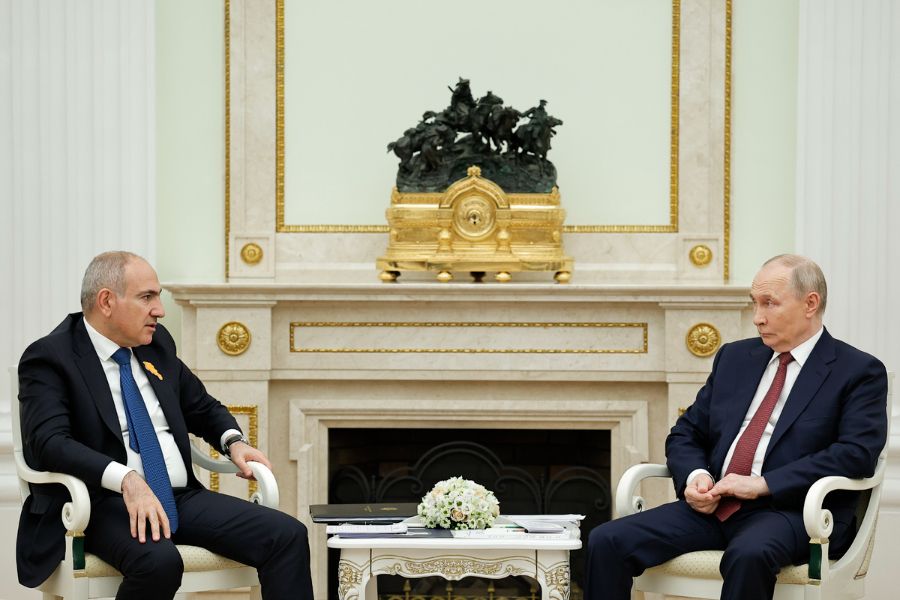
Baku presents this chain of references as a territorial claim against Azerbaijan. That interpretation has been rejected by Armenia, whose authorities have repeatedly maintained that the present Constitution contains no territorial claim against any neighboring country. Yet Prime Minister Nikol Pashinyan has simultaneously argued that a new Constitution should no longer refer to the Declaration of Independence. In April, Pashinyan stated that preserving the constitutional reference to the Declaration would mean continuing the Karabakh movement and returning to a logic of conflict. In his formulation, the constitutional and historical link to the Declaration is incompatible with the peace that his government says it is building. This produces an obvious contradiction. The government disputes Azerbaijan’s accusation while implementing Azerbaijan’s requested solution.
Civil Contract representatives have begun speaking even more openly. Taron Chakhoyan has argued that the Karabakh movement is already politically closed and that a new Constitution is needed to close that chapter legally as well.
Constitutional reform is being used to formalize the government’s decision that Artsakh must disappear from the political and constitutional identity of the Republic of Armenia.
The public is being offered a deceptively simple formula: erase the constitutional link to the Declaration of Independence, close the Artsakh question permanently and peace will follow. No evidence has been presented that this will work.
The imbalance becomes more severe when the territorial situation is considered. Armenian officials have acknowledged that Azerbaijani forces remain in control of more than 200 square kilometers of the internationally recognized sovereign territory of the Republic of Armenia. Yerevan says the matter will ultimately be resolved through delimitation. In other words, Azerbaijan is occupying Armenian territory while demanding that Armenia rewrite its Constitution to eliminate what Baku calls hypothetical Armenian territorial claims.
A peace agreement negotiated under such conditions cannot be assessed only by whether a document is eventually signed. The real question is what each side retains, what each side surrenders and what enforceable obligations each side accepts. So far, the Armenian government has not shown that Azerbaijan’s constitutional demand will be matched by the withdrawal of Azerbaijani forces, the release of prisoners or any comparable concession affecting Baku’s own conduct.
Tigranashen and the politics of “optimization”
The uncertainty surrounding Tigranashen has deepened the concern that the government is preparing further territorial concessions under technical or bureaucratic terminology. Tigranashen is an Armenian-populated settlement on a strategically important route connecting Yerevan with southern Armenia and Iran. Azerbaijan claims the area as the former Soviet Azerbaijani exclave of Karki. Its location near a principal north-south highway makes its status far more consequential than an abstract exchange of points on a map. During the opening days of the new National Assembly, opposition MP Ishkhan Saghatelyan said he had directly asked government representatives whether they could guarantee that Tigranashen would not be transferred to Azerbaijan. According to Saghatelyan, they did not give that guarantee.
The concern was reinforced by the government’s use of the word “optimization.” Previously, Pashinyan and Ruben Rubinyan, the new president of the National Assembly, said no agreement concerning enclaves currently exists, but that some form of territorial “optimization” could occur during the delimitation process and would be discussed publicly if it did.
The term “optimization” transforms a question about sovereignty, security and transport routes to a matter of administrative efficiency.
Arthur Sukoyan, an aide to opposition MP Levon Kocharyan, drew attention to the refusal to provide the one answer that would have ended the controversy: an unequivocal “no.” When a government knows that it will not surrender a territory, it can rule out that possibility clearly. When it refuses to do so and instead introduces terms such as “optimization,” the ambiguity itself becomes politically significant. Tigranashen therefore cannot be separated from the wider constitutional issue.
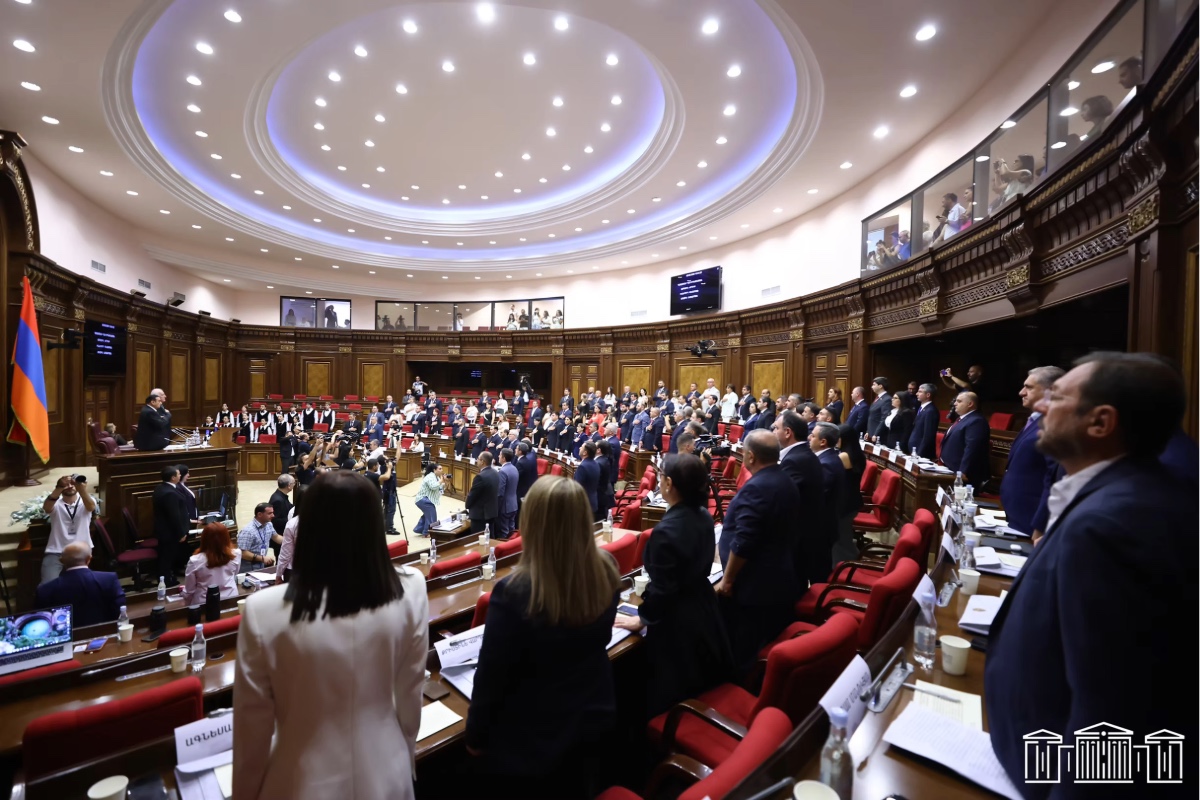
The opposition’s criticism is not that Armenia must never reform its Constitution. It is that a sovereign constitution cannot be rewritten according to conditions announced by a foreign government. On Aug. 4, Strong Armenia parliamentary faction leader Narek Karapetyan said a Constitution effectively proposed by Azerbaijan would not receive the opposition’s support. He emphasized that Baku cannot determine the content of Armenia’s fundamental law and argued that any peace agreement must protect Armenia from future threats rather than merely satisfy current Azerbaijani demands.
Artsakh is not closed
While Armenia’s authorities attempt to remove Artsakh from the state’s constitutional and political vocabulary, individuals, advocacy organizations and foreign institutions continue to raise the rights of Artsakh Armenians.
On Aug. 3, Lebanese American author and statistician Nassim Nicholas Taleb disclosed that he had rejected an increasingly lucrative invitation to deliver a lecture in Azerbaijan. Taleb said he would not enter the country while former Artsakh State Minister Ruben Vardanyan remained imprisoned there. His refusal exposed the weakness of the Armenian government’s claim that the Artsakh chapter is simply over. A foreign intellectual with no electoral obligation to Armenians was prepared to reject a substantial personal payment on an ethical principle that Armenia’s own authorities increasingly avoid articulating.
Civil society pressure has also produced tangible results. According to the Armenian National Committee of America, Marriott Bonvoy removed a tourism package promoting visits to Azerbaijani-controlled Shushi and Stepanakert after an international advocacy campaign. The package reportedly presented Armenian cultural sites as generic regional attractions while omitting the Armenian history of Artsakh and the forced displacement of its population. Its removal demonstrated that organized public pressure can still challenge attempts to normalize the erasure and commercial repackaging of Artsakh.
European institutions have also continued to address issues that Yerevan increasingly treats as inconvenient remnants of the past. In February, the French National Assembly unanimously adopted a resolution calling for the release of Armenian political prisoners and detainees held by Azerbaijan. European initiatives have separately raised the right of return, the protection of Armenian cultural heritage and accountability for the treatment of the population of Artsakh.
The Artsakh Union has reported that European Parliament member Marina Mesure raised the right of return with the European Commission after meeting an Artsakh delegation in Yerevan. Armenian organizations have likewise welcomed a decision by the Corsican Assembly reaffirming the right of the people of Artsakh to return and calling for the release of Armenian prisoners.
These actions disprove the government’s assertion that the issue can be legally and politically extinguished by deleting a constitutional reference.
Peace requires compromise, but compromise must be reciprocal. Instead, Armenia is being asked to make an irreversible constitutional concession in exchange for another Azerbaijani assurance that peace may follow.
The same pattern is visible in the transport negotiations. Azerbaijani Foreign Minister Jeyhun Bayramov now says Azerbaijan has largely completed its part of the work connected with the TRIPP project and is waiting for Armenia to begin construction and take additional steps on its territory. Again, the political pressure falls on Armenia to demonstrate compliance.

The Turks shout : “Jump!”
Pashinyan replies : “How high, Pasha?”