


‘We trust that you will understand us and stretch out your brotherly and helping hand’
Editor’s note: This article appeared in the Armenian Weekly’s March 2026 special magazine issue, “America at 250: An Armenian American Retrospective,” guest edited by former Weekly editor Dr. Khatchig Mouradian and dedicated to the 250th anniversary of Declaration of Independence and the history of Armenian American life.
The power of images to tell stories and connect us with past events is well known to the point of being a cliché: a picture is worth a thousand words and so forth. But sometimes a cliché endures because it expresses a deep truth: and sometimes a photograph is all that remains to inform us about and to evoke a moment that has long since passed into history.
I was reminded of this last October, when NAASR held its 70th anniversary gala in the ballroom of the Copley Plaza Hotel in Boston. Of course, such a room, in one of Boston’s most famous venues, has seen its share of historic gatherings; but as I stood at the lectern and gazed across the ballroom, I was reminded of one other event in particular, one that I know through a photograph documenting a bittersweet moment for the Republic of Armenia and for the Armenian community in general.1This article draws on a NAASR Library Treasures Feature co-authored with NAASR Mardigian Library Director Ani Babaian, as well as my article “‘Armenia Will Call Upon Us in Vain’: U.S. Relations with the First Republic of Armenia,” Armenian Review, Vol. 56, nos. 3-4 (Fall-Winter 2019, pp. 81-96. In addition to Ani Babaian, I wish to acknowledge the assistance of the late Prof. Richard Hovannisian and former Project SAVE Executive Director Tsoleen Sarian for their assistance in the preparation of the original NAASR feature; and, in general, to acknowledge the great importance and value of the work done by Project SAVE to archive and document not only this photo but also thousands of others.
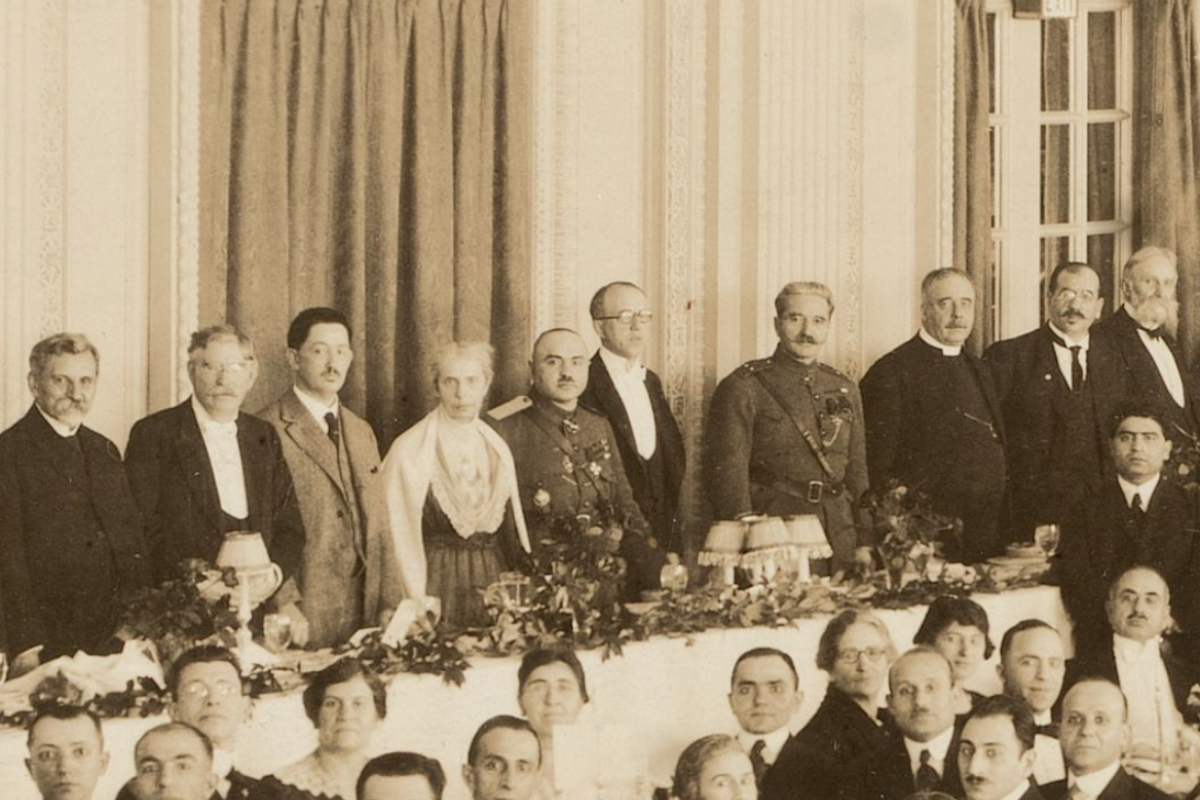
The photograph is one of those great panoramic banquet photos of days gone by, taken on December 14, 1919, at a gala event in honor of members of the Armenian civil and military missions to the United States. A framed original copy of the photograph is in NAASR’s collection and formerly belonged to NAASR’s late founding chairman, Manoog S. Young. Young’s parents, Soghomon (Malyemezian) Young and Aghavni (Der Kazarian) Young, are visible in the photo; undoubtedly, they obtained a copy of the photo as a remembrance of the occasion, and probably like many others, they hung it in a prominent place in their home.
The photograph was taken by Glines Photo of Boston, then located at 919 Washington Street. Project SAVE Armenian Photograph Archives also has the photo and has digitized it.2https://www.digitalcommonwealth.org/search/commonwealth:cr56n885g By clicking on the image one can zoom in and get an up-close look at the audience, many of whom were likely immigrants who, like the parents of Manoog Young, had arrived in America within the past 10-20 years.


Along the left side of the photo stretches the head table at which dignitaries including Gen. Andranik Ozanian, Garegin Pasdermadjian (Armen Garo) and other members of Armenia’s civil and military missions and American friends of Armenia such as Alice Stone Blackwell.
Other than the luminaries who will be discussed in this piece, the only other individuals I know to be present are Eliza Sachaklian at table 34, the mother of author Arpena S. Mesrobian, grandmother of author Marian Mesrobian MacCurdy and wife of Aaron Sachaklian, one of the leaders of Operation Nemesis and Nishan Vartanian, father of Watertown attorney Walter Vartanian, near the far right side of the photo.3The photo appears in Arpena S. Mesrobian’s “Like One Family”: The Armenians of Syracuse (Reading, UK: Taderon Press, 2000, p. 72 and in Marian Mesrobian MacCurdy, Sacred Justice: The Voices and Legacy of Armenian Operation Nemesis (New Brunswick, NJ: Transaction Publishers, 2015), p. 371. I thank Mr. Walter Vartanian for the identification of his father.
Marian MacCurdy writes that her grandmother Eliza “had a photograph of the event framed and hung over the buffet in her dining room, where it remained for the rest of her life” and “wrote a note attached to the photograph that the soloist Zabel Aram, who, with the flag of the Republic in her hand, sang Groonk [Crane] to ‘thunderous applause.’”4Sacred Justice, p. 131 Zabel Aram, also known as Zabelle Panosian, was perhaps then and perhaps still today best known for her stirring recording of Groong issued by Columbia in 1917; she may be the woman standing, hands folded, on a lower step to the left of the orchestra.5 Her presence and participation is also noted in Harout Arakelian, Harry Kezelian and Ian Nagoski, Zabelle Panosian: I Am Servant of Your Voice (Baltimore: Canary Books and Records, 2022), p. 45.
Although as Arpena Mesrobian notes, Aaron Sachaklian was unable to attend the Boston event, given the presence of Armen Garo and the fact that Shahan Natalie, who would become the operational coordinator of Nemesis, was, if not there in the room, then likely nearby, one wonders whether there was any whispered discussion of Operation Nemesis during the gala.6I have not been able to locate Natalie in the crowd. As Eric Bogosian writes, Garo and Natalie had presented a plan for the extra-legal punishment of perpetrators of the Armenian Genocide at the recent General Congress of the Armenian Revolutionary Federation, held in Yerevan in September-October 1919, and “prevailed upon the General Congress to approve a secret resolution titled the ‘Special Mission’ (Hadug Kordz),” with Garo as “the executive in charge.”7Eric Bogosian, Operation Nemesis: The Assassination Plot That Avenged the Armenian Genocide (New York: Little, Brown and Co., 2015), p. 135-36
Whether or not there was any Hadug Kordz conversation over hors d’oeuvres, it was undeniably a heady occasion, and one would like to have been a fly on the wall that evening, which came near the end of a year filled with high hopes and deep disappointments. No doubt the tenor of the evening was to emphasize the high hopes — including, perhaps, the possibility of a U.S. mandate for Armenia, thus committing America to the security of an Armenian state — but the reality of the situation was rather grim.
During the summer of 1919, a petition in support of the Armenians bearing the names of eight prominent Americans was addressed to President Wilson. Signed by Charles Evans Hughes, former Secretary of State Elihu Root, Senators Henry Cabot Lodge and John Sharp Williams, former ambassadors James W. Gerard and Frederic Courtland Penfield, New York Governor Al Smith and former Harvard University president Prof. Charles W. Eliot, it read in part:
“We believe without regard to party or creed the American people are deeply interested in the welfare of the Armenian people and expect to see the restoration of the independence of Armenia. … We now believe that prevailing insecurity of life and intense want in the major portion of Armenia make immediate action imperative and sacred duty. We therefore respectfully urge that as a first step in that direction and without waiting for the conclusion of Peace either the Allies or America or both should at once send to Caucasus Armenia requisite food, munitions and supplies for 50,000 men, and such other help as they may require to occupy the non-occupied parts of Armenia, within the boundaries defined in the memorandum of the delegation of Integral Armenia. We trust that it may be possible to secure prompt and full justice for Armenia.”
On Sept. 8, 1919, Sen. John Sharp Williams of Mississippi introduced S. J. Res. 106, “For the Maintenance of Peace in Armenia.” The Williams resolution expressed American sympathy “with the aspirations of the Armenian people for liberty and peace and progress,” and recommended that an independent Armenian Republic should be established, “including the six vilayets of Turkish Armenia and Cilicia, Russian Armenia and the northern part of the Province of Azerbaijan and Trebizond.”
The resolution authorized the President “to use such military and naval forces of the United States as in his opinion may seem expedient for the maintenance of peace and tranquility in Armenia,” “to suspend the foreign enlistment act to the extent necessary to enable Armenians in the United States to raise money and arm and equip themselves as an armed force to go to the aid of their countrymen,” and allowed for the appropriation of sufficient funds for these purposes. The Williams resolution was referred to a subcommittee of the Senate Foreign Relations Committee under the chairmanship of Warren G. Harding of Ohio and hearings on the bill began on Sept. 27. Members of the Armenian civil mission, which arrived in the U.S. in early October 1919, would offer testimony at the hearings.
However, between the introduction of the Williams resolution and the December 14 banquet in Boston, the prospects for America to become the champion of independent Armenia rapidly went into eclipse.
On Oct. 2, 1919, President Woodrow Wilson suffered a stroke and became severely incapacitated; thus, any impetus Wilson might have provided in support of Armenia was removed. On Nov. 2, isolationist Republican Warren G. Harding trounced James M. Cox in the presidential election. On Nov. 19, the Senate repudiated the League of Nations. Whatever momentum had once existed for the U.S. to involve itself directly with securing Armenia’s future had been lost, and it was clear that no substantial support from the U.S. government for independent Armenia would be forthcoming. As an ironic twist (or knife in the back), Sen. Lodge of Massachusetts, who had been among the most vocal champions of Armenia in 1919 and a board member of the American Committee for the Independence of Armenia, in 1920 would effectively extinguish any hope of an American mandate.
Nevertheless, the Armenian mission continued their advocacy. Richard Hovannisian describes a “mass rally at the New York Hippodrome on Dec. 7” and “the same excitement prevailed a week later in Boston where, after requiem services in Trinity Episcopal Church, nearly 8,000 people marched from the Commons to Mechanics Hall to honor the civil and military missions. This largest gathering in the history of the Armenian-American community accepted resolutions, read by Harvard Professor Albert Bushnell Hart and addressed to President Wilson, Senator Lodge and the Foreign Relations Committee, urging recognition of the Armenian government and enactment of the supportive measures proposed by Senator Williams.”8Richard G. Hovannisian, The Republic of Armenia, Volume II: 1919-1920 (Berkeley & Los Angeles: University of California Press, 1982), p. 387. Mechanics Hall formerly stood on Huntington Avenue at West Newton Street in Boston. Various descriptions of this building indicate that it could, indeed, have accommodated a large crowd of 8,000 people. The account in the Boston Globe, cited below, set the crowd at 10,000. Interestingly, I have not seen any photographs of this event.
The Boston Globe described the scene at Mechanics Hall thus:
“A cheering, shrieking, laughing, flag-waving mass of men and women jammed Mechanics Hall yesterday afternoon for a mass meeting held to do honor to the Armenian Military and Civil Mission and urge the recognition of the Republic of Armenia by the United States Government.”
“Every reference to Armenian independence and to the gratitude of all Armenians to this country was greeted with a veritable storm of cheers, and shorts made the punctuation points for almost every sentence. The floor of the hall was a sea of small red, blue, and orange flags. On the stage five huge Armenian flags alternated with the American colors. The galleries were draped with blue and white bunting.”9“Armenian Mission Honored in Boston,” The Boston Globe, Monday Morning, Dec. 15, 1919, p. 1
Another photograph, a copy of which resides in the Project SAVE archive, taken the same day on the steps of Trinity Church in Copley Square, mere footsteps from the Copley Plaza Hotel, shows some of the same individuals who appear at the head table of the banquet, with the notable addition of Hovhannes Kachaznuni, who was doubtless present at the banquet but yet is not visible in the photograph.10The photograph on the steps of Trinity Church in Copley Square can be accessed at: https://projectsave.catalogaccess.com/photos/44351. While in the area, the delegation was also photographed during a visit to Harvard University and in the studio of John Garo in Boston.
The Boston Globe again provides details on the proceedings at the Copley Plaza:
“The dinner was in the large ballroom. At the head table sat the members of the mission, the Armenian reception committee and the guests of honor. Miss Alice Stone Blackwell introduced the speakers.
“Dr. Pasdermadan [sic], Armenian envoy at Washington, made a formal statement of the aims of the mission. He outlined the history of the country, saying that for years it was the bulwark of Europe, and declared that it saved the Eastern front for the Allies.
“‘We have come,’ he said, ‘to ask you to help us in whatever manner you deem proper in the organization of our newborn Republic and the defense of our just rights in order to secure the freedom and independence of integral Armenia. We trust that you will understand us and stretch out your brotherly and helping hand. I assure you that you will not regret the sacrifices you are going to make for us.’
“Dr Der-Hagopian thanked America for help already given and outlined the present troubles of Armenia.
“Mrs Bertha Papasian [sic], chairman of the Armenian women’s reception committee, declared that America had pledged her honor for the freedom of Armenia and must redeem it.
“Lieut Gov Channing Cox extended the greetings of Massachusetts. He spoke of the contributions to the country’s welfare, industrial, intellectual and moral, made by citizens of Armenian blood and declared that America must repay them.
“Arthur D. Hill spoke as representative of Mayor Peters. Other speakers were Sec of State Albert P. Langtry, Rev Dr Alexander Mann of Trinity Church, Dr George Washburn, former president of Roberts College; Hovhannes Katchazooni [sic], Rev Edward Cummings of the South Congregational Society, Gen Jaques Pagradooni [sic] and Gen Andranig [sic]. Mrs Rose Zulalian and Mrs Zabelle Panosian sang.”11“Armenian Mission Honored in Boston,” The Boston Globe, Monday Morning, December 15, 1919, p. 4. I am puzzled by the reference to Dr. George Washburn, who died in 1915. A good idea of Pasdermadjian’s (Armen Garo) remarks can probably be gleaned from his short publication Why Armenia Should Be Free: Armenia’s Role in the Present War (Boston: Hairenik Publishing Co., 1918).
Notwithstanding the dark clouds gathering on the American political horizon, the efforts of the Armenian civil and military missions in the U.S. continued, with General Andranik especially active in his efforts to raise money for and awareness about the Armenian Republic. The campaign that Andranik spearheaded raised more than $500,000 by the start of 1920. A detailed report was published in Boston by Yeran Press in 1921 under the title Batuoy Kirk‘ (Book of Honor), listing each donor, community by community, often giving not just the amount of the donation but which village or city the donor came from in the old country, and stands, more than a century later, as a little-studied document attesting to what Armenians in America gave to save their nation.12Some of the difficulties and challenges faced by Andranik in this effort, which were exacerbated by political divisions both in the Armenian and the American realms, are discussed in Patuoy Girk‘, in Hovannisian’s The Republic of Armenia and in Armenuhi V. Gambaryan, “The Military Mission of the First Republic of Armenia in the USA and Commander Andranik,” Journal of Armenian Studies (2022).
However, in May 1920, a toothless resolution would be passed that offered “the sincere congratulations of the Senate of the United States… to the people of Armenia on the recognition of the independence of the Republic of Armenia,” and expressed “the hope that stable government, proper protection of individual liberties and rights, and the full realization of nationalistic aspirations may soon be attained by the Armenian people,” but took no action toward these ends.
Such a dim outcome casts its backward shadow over the festivity of Dec. 14, 1919, but it cannot entirely blot out the hope and excitement visible in that remarkable photograph, when hope was still alive.
Editor’s note: The feature image shows members of Armenia’s civil and military missions to the United States gathered in Boston on Dec. 14, 1919. Standing behind the head table, from left, are Abraham Der Hagopian, representative of the Armenian National Delegation; Albert P. Langtry, Massachusetts secretary of the commonwealth; an unidentified man; Alice Stone Blackwell; Gen. Hakob Bagratuni; an unidentified man; Gen. Andranik Ozanian; the Rev. Alexander Mann, rector of Trinity Church in Boston; Garegin Pasdermadjian, also known as Armen Garo, ambassador to the United States; and Albert Bushnell Hart of Harvard University.