




The situation in the Caucasus remains critical as the war between Iran, the United States and Israel continue to expand and draw numerous regional actors into the confrontation. For Armenia, a landlocked Caucasian state, maintaining a balance between the sides remains crucial to ensuring its security. One of the primary concerns has become the fate of TRIPP, as regional escalation may hinder the implementation of the project, which is of significant interest to the governments of Armenia and Azerbaijan.
On March 2, Armenian authorities informed Iran’s ambassador to Armenia, Khalil Shirgholami, that TRIPP would not be used in a manner that would pose a security threat to Iran. In response, Shirgholami highlighted Tehran’s foreign policy priorities toward Yerevan, including the security, territorial integrity and sovereignty of Armenia in the event of any peace treaty with Azerbaijan or during the implementation of TRIPP. In this context, Azerbaijan also adopted an early balanced stance toward the war. Iranian Ambassador to Azerbaijan Mujtaba Demirchilu praised the position, noting the high level of coordination between Iran and Azerbaijan.
War expands across the Middle East
On the fourth day of the war, March 3, Tehran continued attacks against American and Israeli targets throughout the Middle East. The U.S. Embassy and the port of Fujairah in the United Arab Emirates were targeted by Iran, while the building of the Assembly of Experts in Qom was targeted by U.S.-Israeli forces. The Assembly of Experts is an elected body composed exclusively of mujtahids — Islamic scholars with authority over Islamic law — and is responsible for electing the next supreme leader of Iran. Several Gulf states also declared their willingness to defend against Iran if the war continues to escalate regionally.
The theater of war also expanded to Lebanon, where Israel bombed the southern suburbs of Beirut, southern Lebanon and the Beqaa Valley, areas where Hezbollah maintains significant military infrastructure. In Lebanon, the situation has escalated significantly following repeated Israeli airstrikes. More than 83,000 people have been displaced, with 102 killed and 638 wounded. So far, there have been no reported casualties among Lebanese Armenians.
Armenia-Iran border and trade disruptions
Regarding the Armenia-Iran border, Armenia’s State Revenue Committee said the Agarak customs checkpoint was operating normally and there had been no change in the volume of cargo transportation between Armenia and Iran. However, the crossing closed on March 4 after Iranian authorities reported technical problems with control systems, affecting cargo transportation. Approximately 400 to 450 trucks cross the Agarak checkpoint daily.


Armenia and Iran recorded about $770 million in annual trade in 2025. On March 5, the Armenia-Iran border crossing reopened for passenger traffic, although cargo transportation remained limited. The State Revenue Committee said 180 to 200 trucks were waiting for the restoration of communication and control systems on the Iranian side before entering Armenia. Economic conditions in Armenia may be affected by disruptions in trade with Iran, which supplies about 440 million cubic meters of gas annually, roughly 20% of Armenia’s imports.
Rising costs of evacuation flights
The first plane evacuating Armenian citizens from Oman landed in Yerevan. Meanwhile, the Armenian Embassy in the United Arab Emirates offered free transportation for Armenian citizens to Muscat to board subsequent special flights to Yerevan. In light of these developments, Foreign Minister Ararat Mirzoyan spoke by phone with his Omani counterpart Badr bin Hamad Al Busaidi, expressing gratitude for facilitating the evacuation of Armenian citizens from the United Arab Emirates through Oman to Armenia.
On March 4, another plane from Muscat carrying 115 passengers — more than 90 of them Armenian citizens — landed in Yerevan. However, the need to evacuate people from increasingly unsafe Gulf states has driven up demand for flights to Armenia. Some passengers reported paying close to $1,400 for a plane ticket. By March 5, ticket prices had risen to around $1,500. One Armenian citizen said the government had encouraged citizens to return via Oman, while flights operated by flydubai — which resumed operations March 3 — cost around $560 per ticket.
Evacuees flee Iran through Armenia
By March 4, sources reported that approximately 1,500 evacuees had left Iran through Armenia and Azerbaijan, with Yerevan responsible for around 400. Among them, Dashkhin Sofiev, a Georgian national, described his experience fleeing Iran: “At 4 a.m. I saw a massive bomb from the hotel window for the first time. I think it was the day of the hospital bombing. That morning we went to Takestan, and then from Takestan to the Armenian border.” When asked about the number of Iranians crossing the border into Armenia, he said: “No, not many — 40 people at most, and not all of them were Iranian. There were foreigners. There were Chinese.” Yerevan also fulfilled its emerging role as an evacuation corridor for Kazakh and Russian citizens.
Drone strikes on Nakhichevan
On the Caucasus front, tensions escalated March 5 when a drone struck the “Nakhcivan Autonomous Republic” of Azerbaijan. Azerbaijani President Ilham Aliyev said: “The Azerbaijani state strongly condemns this ugly terrorist act, and those who committed it must be immediately held accountable.” The Azerbaijani Foreign Ministry added: “We strongly condemn these drone attacks launched from the territory of the Islamic Republic of Iran.” Iran denied involvement. However, Azerbaijan’s defense minister said Iran had launched four drones toward Azerbaijan, one of which fell near a school. Following the incident, Aliyev announced the mobilization of armed forces, saying Baku must be ready to conduct any necessary operation. Armenian Foreign Minister Ararat Mirzoyan later spoke by phone with his Azerbaijani counterpart Jeyhun Bayramov to discuss the situation and emphasize the need for stability and security.
Azerbaijan’s Foreign Ministry also released a statement thanking international partners and states for their messages of support following the attack. Among the countries mentioned was Armenia. The ministry also announced the withdrawal of its entire ambassadorial staff from Iran.
Alarmingly, on March 3, unconfirmed reports also surfaced indicating that Azerbaijan had begun a military buildup along its border with Iran. In the context of border security, additional developments were reported during the past week, including reports indicating the withdrawal of Russian border guards from the Armenia-Turkey and Armenia-Iran borders. However, Russian military presence remains through its base in Gyumri and border checkpoints with Georgia.
Uncertainty amid rising tensions
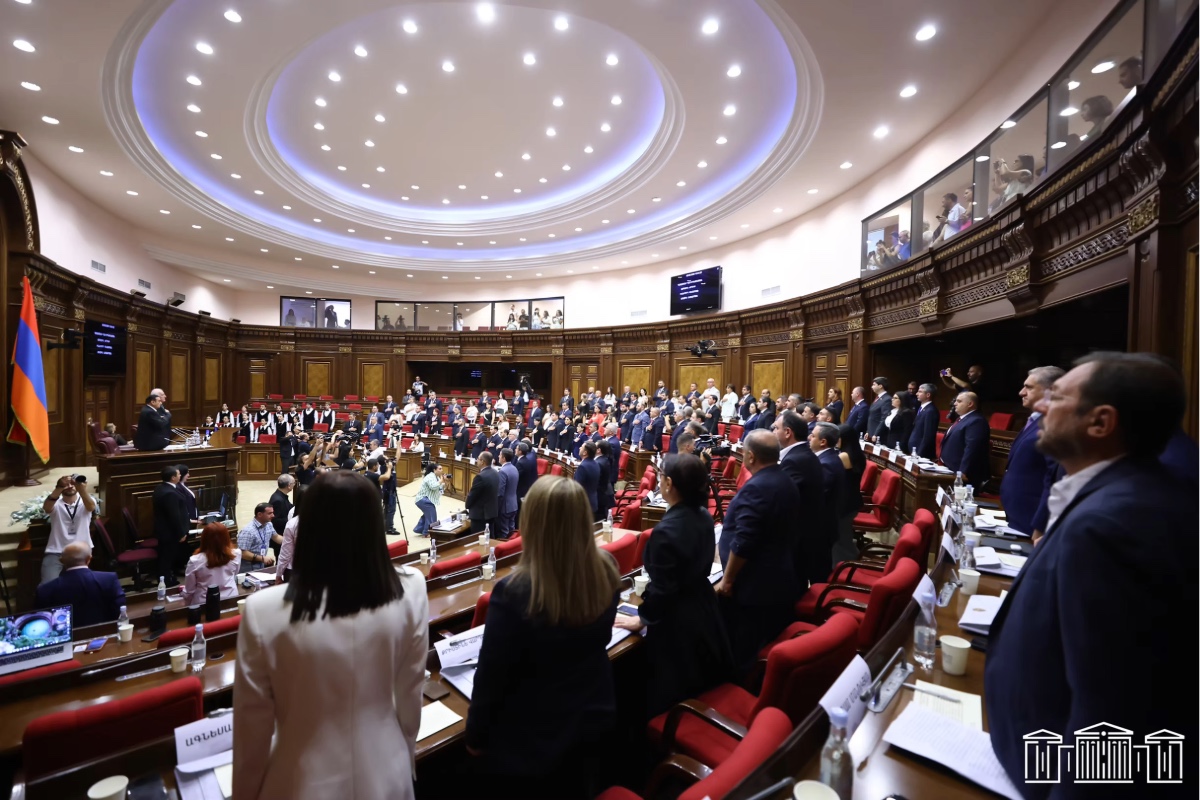
Armenian Prime Minister Nikol Pashinyan said repeatedly that Yerevan is prepared for any potential fallout from the war with Iran and that there will be no shortages of goods in Armenia. The prime minister and other senior officials also said the TRIPP project would not pose an obstacle for any state nor face obstacles as a result of the war in Iran. Pashinyan also convened a second meeting of Armenia’s Security Council since the start of hostilities in Iran to discuss security and transportation issues. President Vahagn Khachatryan and National Assembly Speaker Alen Simonyan were also present.
Meanwhile, the Iranian Embassy in Yerevan continued receiving visitors offering condolences for the loss of life in Iran. Among them were representatives of the Armenian Revolutionary Federation, who expressed hope that the situation would stabilize quickly and that Armenia’s neighbor Iran would overcome the crisis. Catholicos of All Armenians Karekin II also sent condolences to Iranian President Masoud Pezeshkian.
Armenians worldwide remain concerned for diaspora communities in the region, particularly Armenian Iranians. Ara Nazarian, a member of the Armenian National Committee of America who grew up in Iran and now lives in Massachusetts, told CBS News that “[Armenians] in Iran face the same challenges as other citizens — danger. Fortunately, none of our infrastructure has been hit, even though explosions have occurred very close.”
The potential entry of Azerbaijan into the war could further complicate Armenia’s geopolitical situation. The war continues and its outcome remains uncertain. In the event of the collapse of the Islamic Republic of Iran, Azerbaijan and Turkey could potentially establish a direct link through Iranian territory. Such a development could invalidate the TRIPP project or the Zangezur Corridor debate raised by the Turkish-Azerbaijani side and further encircle Armenia. These possibilities, however, remain speculative amid ongoing uncertainty.

Nothing Armenia can do except take a defensive posture to shoot down any Iranian drones and missiles aimed at Yerevan.
The trouble with the Iranians is that their attacks are clumsy and inaccurate.
They lack pinpoint accuracy.
Although their target would be the American embassy, it is more than likely that they would miss and instead hit residential areas and cause Armenian deaths and wounded.
They should be shot down before they hit Yerevan but thanks to Pashinyan’s incompetence, I don’t know if the Armenian military can do that.
You are so right! I am an Armenian who lives in Australia and I see it coming!
Thanks, Alicia!
Absolutely, spot on! The Second Artsakh War showed how vulnerable and unprepared Armenia is to drones and missiles, and to this new type of warfare. Armenia has no effective defences against them, as the last war showed, and I fear that Armenia could become an even bigger target, when the Americans start to increase their presence in Armenia beyond the US embassy in Yerevan, across Armenia, especially in the so-called TRIPP corridor in Syunik, which was leased by the idiot Pashinyan to the US, who could use it as a listening post and secret base.
Robert, Iran has the means to strike targets accurately enough as shown by it’s recent retailition, of course not all projectiles find their target due to malfunction and counter measures. Clearly checking various media will show this fact. There’s even the Kremlin aligned South Front to check if wary of western MSM. Such as when Armenia recognised Palestine so no need to claim Armenia ought to when it already had clearly the Kremlin gremlins liars keep one in a deep state of Soviet ignorance whilst muttering “Turk” and fantasisng aloud about trying to cause a tectonic plate upheaval with devices presumably similar to what is Iran’s possession in Istanbul . Besides as it stands Armenia hasn’t been targeted so the ability of defences remains conjecture although given Armenia moving away from Soviet and Russian parameters since 2020 there might be some improvement. Indeed it was that conflict which brutally exposed how backward Armenia s Russian linked military had become compared to the more outward looking Azerbaijan.
Iran has announced that it will stop attacking its neighbours.
However, this doesn’t apply to those Arab states that house American bases that are used to attack Iran.
Armenia should be vigilant in case the Persians break their promise.
The Iranian president’s apology and assurances are meaningless, because the president, cabinet ministers and the government of Iran never held real power, and decided domestic and foreign policy; it was the Supreme Leader who held ultimate power and decided domestic and foreign policy. After the elimination of Khamenei, this role has passed to the Islamic Revolutionary Guard Corps (IRGC), the Supreme Leader’s and the Islamic Republic’s pretorian guard who enforces the regime with brutality. It is obvious that the IRGC now rules Iran, and fires these drones and missiles to neighboring countries on its own volition. Even the Iranian foreign minister indicated that. Iran’s president, foreign minister and other ministers are mere figureheads who have no influence over the IRGC. Iran is attacking like a wounded, cornered animal, and hopefully Armenia is not attacked and dragged into this dreadful war. If this war drags on and becomes more brutal, the threat to Armenia will grow.
@Steve
Yes, you are right!
Armenia has bitter memories of when the Turks and the Persians ruled Armenia and neither can be trusted.
Armenia has no choice but to invest in missile and drone technology but before that can happen Armenia must be ruthlessly purged of corruption otherwise the money will simply be stolen.
Armenia should remain neutral and stay out of the war. Reading the comments below shows how stupid and out of touch many of the readers here are. To even think that Iran would strike Armenia is beyond pathetic and delusional and very r****d to even entertain such nonsense. Unfortunately, the war will have a negative impact on us as Iran is our southern access to the world and will have to navigate through and look out for their own interest. Hopefully, Armenia can help relocate some of the remaining Armenian community of 40-50k despite having to resolve the 100k NK Armenian refugee crisis.
There is no logical reason for Iran to attack Armenia. Iran has attacked US bases in neighboring gulf states which launch attacks against them. They have also targeted hotels which house US servicemen. Armenia has no US military bases.
The drone attacks at Nakhichevan may or may not have been from Iran. If they were from Iran it could be a message to Azerbaijan to refrain from helping Israel as a place from which to launch fighter jets.
These drone strikes at Nakhichevan must be a warning from Iran to Azerbaijan not to allow the country to be used as a launching pad for Israeli and US attacks against Iran. It is an open secret that Azerbaijan is a listening post and a secret military base for Israel.
Iran has denied they had anything to do with nakhijevan airport. it’s a tiny airport anyway. but strangely we are still discussing this non-issue.
The promises made by the Persians have proven to be worthless.
He has been fiercely denounced in the Iranian Parliament and throughout Iranian society.
He is, as Steve said, nothing more than a powerless figurehead.
The old Ayatollah’s son has become the new Ayatollah.
He is out for revenge.
As the Iranians want war, Armenia should take precautions.
I hope to God that the Armenian High Command doubles or even trebles the number of troops in Syunik.
The Persians have to be kept out, the only ones who should be allowed to cross into Syunik are the Iranian Armenians.
It’s time for them to come home.
I don’t believe Iran was behind the attack on our enemy-occupied Armenian province of Nakhichevan. I think Israel was behind the attack. The idea was to drag Turkey into this conflict to open another front against Iran. Recently, the former Israeli prime minister Naftali characterized Turkey under Er-dog-an as a growing threat similar to Iran and labeled it as an “axis of evil” similar to Iran. More importantly, even if we assume Iran was behind the attack as a warning to Azerbaijan, then why didn’t Iran hit targets inside Azerbaijan itself and instead hit targets in Nakhichevan? According to 1921 Treaty of Kars, former Treaty of Moscow, Turkey acts as a guarantor of the territorial integrity and political autonomy of the Nakhichevan Autonomous Republic which is recognized as an autonomous territory under the protection of Azerbaijan. Turkey has a legal obligation to defend the territorial integrity of Nakhichevan and that it can’t be ceded to a third party, meaning Armenia without naming it of course, without Turkey’s consent. By attacking Nakhichevan, not Azerbaijan proper, therefore common sense dictates that the intention was to drag Turkey into this conflict. Iran most certainly would not want to do that because that would have caused major instability inside Iran given the makeup of the Iranian population in northwestern Iran by Nakhichevan border, not to mention the pan-Turkic separatist movements there, and even drag NATO into this conflict against Iran!
P.S. The fact that Armenia is among the list of states mentioned in the Azerbaijan’s foreign ministry’s statement of appreciation for support is utterly disgusting. That is like speaking in support of your abuser. Those who speak like that in support of our racist anti-Armenian enemy, turning a blind-eye and ignoring all the recent evil and ethnic-cleaning done against our nation, have got to be delusional with no morals and backbone. This treasonous Armenian regime seems to be suffering from the Stockholm Syndrome. The elections can’t come any sooner when we hopefully get to wave them goodbye from power and straight into the slammer. These incompetent imbeciles are truly a disgrace to our nation. Needless to say, the Armenian foreign minister Ararat Mirzoyan is definitely not worthy of the name he carries!
Absolutely.
The cowardice, subservience and sycophancy of the treacherous butt-kissing duo Pashinyan and Mirzoyan towards the genocidal Turkic archenemies Azerbaijan and Turkey are nauseating and revolting. Armenia has never been so sabotaged and humiliated like today – and worse, from quislings and satraps like them.
There is also the very real risk that the dictator-wannabe Pashinyan will rig the upcoming elections, proclaim himself the “winner” and declare a fait acompli. If the war drags on and is not over by election time in June, he could use that as an excuse to postpone or even cancel the elections.
The stakes couldn’t be higher, and all hell will break loose if Pashinyan hijacks the elections in his quest to become a full dictator.