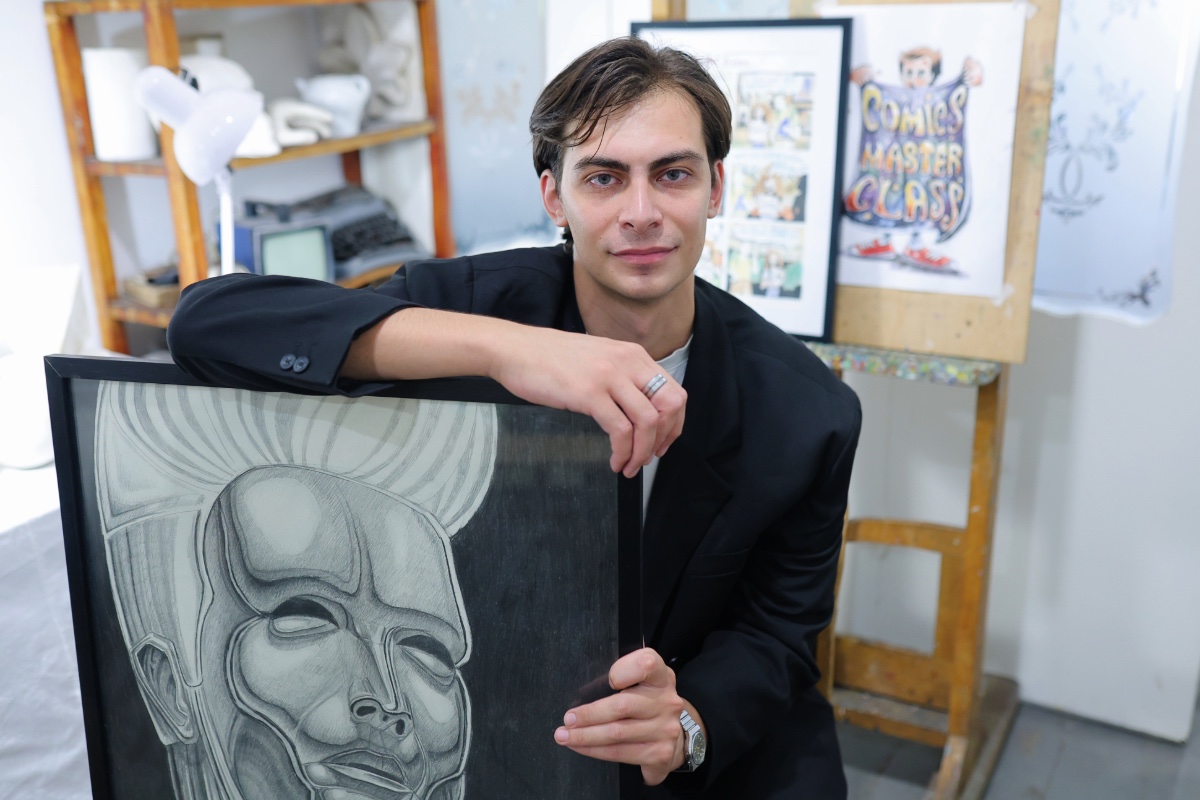



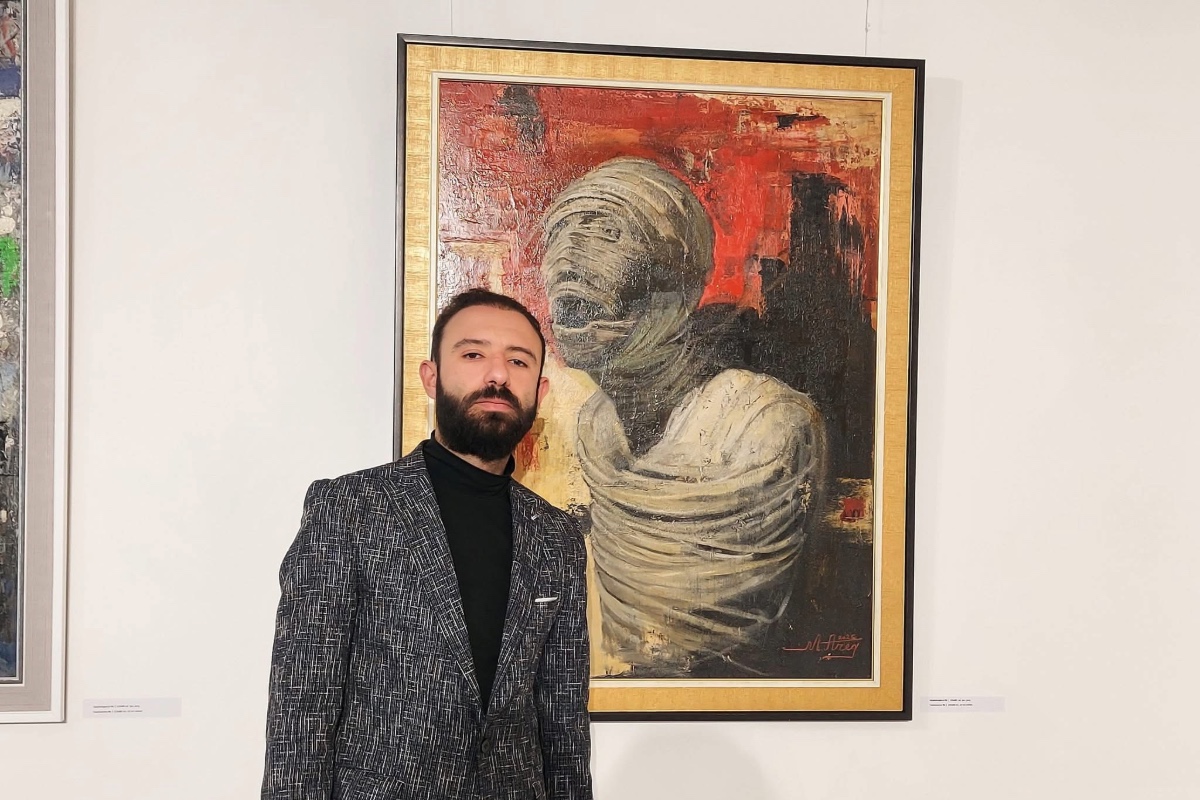
In the evocative exhibition “Faceless Game,” artist Areg Mirijanyan presents a visual meditation on the preservation of the self. Much of the collection is dedicated to portraits of prominent figures in Armenian theater and art, captured through his distinct lens. To the viewer, these subjects often seem to have stepped out of the Renaissance era — their attire, the calculated angles of their poses and rich color palettes converging to evoke a sense of classical mastery that transcends time.
The road to the canvas
As a child, Mirijanyan did not dream of becoming a painter, though art was an omnipresent force in his upbringing. The son of actors, he spent his formative years behind theater curtains, immersed in the creative world of performers. While he drew, his early ambitions leaned toward the digital precision of computer graphics.
It was only after graduating high school, when he was not admitted to a computer graphics program — a moment he now considers the greatest success of his life — that he pivoted toward fine arts and scenography. Had those initial plans succeeded, he might never have discovered the intersection of theater and visual art where he now thrives.
At the conceptual heart of the exhibition are three works bearing the same symbolic title: “Facelessness 1, 2 and 3.” This ongoing series serves as a central pillar for the artist, representing those who have surrendered their identity and individuality to become indistinguishable parts of the crowd.
Mirijanyan juxtaposes these anonymous figures with portraits of creators — actors, directors and musicians — who fight to preserve their unique internal “quality.” This tension is fueled by the artist’s personal fear of losing his own essence. He believes each canvas is, above all, a dialogue with the self, echoing the idea that poets speak aloud to themselves while the world listens.

The creative process for this series was long in its gestation and explosive in its execution, as if an inner buildup of ideas had finally burst out. For Mirijanyan, creating is self-preservation. His work is driven by a profound concern: the possibility of drifting into “facelessness” himself.
To guard against this, he follows a philosophy of constant movement, development and self-education. Invoking Friedrich Nietzsche’s assertion that “man is something that must be overcome,” Mirijanyan sees his art as a necessary means of moving forward, ensuring his identity remains vivid against the backdrop of an increasingly generic society.
The soul behind the likeness
Mirijanyan speaks with infectious enthusiasm about the figures who inhabit his canvases. Among them is Jacqueline, an actress whose presence radiates from the frame, and the late, remarkable director Hrachya Ghazaryan. As the founder of the Constantinople Theater, Ghazaryan left an indelible mark on the arts through a fiercely distinct identity — a quality Mirijanyan sought to immortalize. Having known him personally, the artist attempted to capture the sharp contrast of his individuality against a modern society where many have ceased to truly create or produce.
When asked if a subject requires public recognition to become a model, Mirijanyan’s answer is a definitive no. For him, inspiration can come from anyone who possesses an interesting internal quality. Through interaction with the model, he searches for the “essential line” that defines the work. He maintains that portraiture is a deceptively complex genre: while physical resemblance is a technical requirement, the true objective is a delicate psychological excavation. To Mirijanyan, the goal is to feel and translate the subject’s inner world — a path on which his primary source of inspiration remains the master of light and shadow, the 17th-century Dutch master Rembrandt.


The balancing act: Canvas and stage
Though painting and scenography share a visual arts lineage and a common vocabulary, Mirijanyan sees them as distinct worlds requiring different creative temperaments. He moves between them by detaching from one to enter the other, preserving his inner creative balance. Scenography is inherently tied to external factors: a specific production, the director’s vision and the collaborative friction of teamwork. In contrast, the canvas offers unlimited freedom, with no deadlines or compromises, and he remains master of his time and creative flight.
Reflecting on this duality, Mirijanyan notes that scenography cannot exist in a vacuum—it is born when a project or performance calls it into being. Painting, however, is a constant and autonomous state. “You can place your canvas and work on it as much as you like,” he said. For him, that distinction comes down to a single idea: the presence of absolute freedom..
At the same time, he acknowledges that scenography demands a different discipline. “As a scenographer, I cannot be guided only by my own desires,” he said. “Limitations are not only present but natural. My vision must enter into a dialogue with the director’s perspective; only through that synthesis can a successful performance emerge.”
From theatrical explorations to teaching
Mirijanyan’s recent theatrical portfolio reflects the collaborative depth required of the craft. At the Drama Theatre, he designed the landscape for the performance Kin, while his work on Shakesperiment at the Stanislavski Russian Drama Theatre showcased his ability to translate classical themes into modern scenographic language. While several new projects are underway, Mirijanyan does not share their specifics, noting only that each work is unique and fueled by its literary source material. This diversity is what keeps the process perpetually engaging.
Parallel to his creative output, Mirijanyan is also a lecturer. Presenting academic material to a generation accustomed to the rapid rhythms of modern information requires a subtle, innovative approach. Since becoming a lecturer, he has gained a newfound reverence for his senior colleagues, referring to teaching as a “heroic task.”
When addressing the challenge of engaging students with “slower” media, such as black-and-white films or dense literature, Mirijanyan rejects the idea of force. “Forcing is the wrong approach — nothing works under compulsion,” he said. “The greatest task of a teacher is to ‘infect’ the student with the ‘disease’ called art. If you manage to infect them, they will continue on that path independently. My role is simply to guide them and identify the specific points that will spark their curiosity.”
A legacy in the making
Mirijanyan’s career is already marked by significant milestones, with “Faceless Game” serving as his fifth solo exhibition. This follows four state exhibitions and participation in around 30 group shows across the globe. Whether working within the structured constraints of a theatrical production or exploring the freedom of a blank canvas, Mirijanyan remains a vital figure in the contemporary art scene — an artist whose work serves as a reminder that the preservation of identity is a lifelong, creative act.
A significant milestone in Mirijanyan’s career was his participation in a prestigious international exhibition in France. Selected under rigorous criteria, his work served as a distinctive ambassador for contemporary Armenian painting on a global stage. This platform, which hosted his international premiere in 2025, opened new doors for the artist, integrating his vision into the global art discourse.
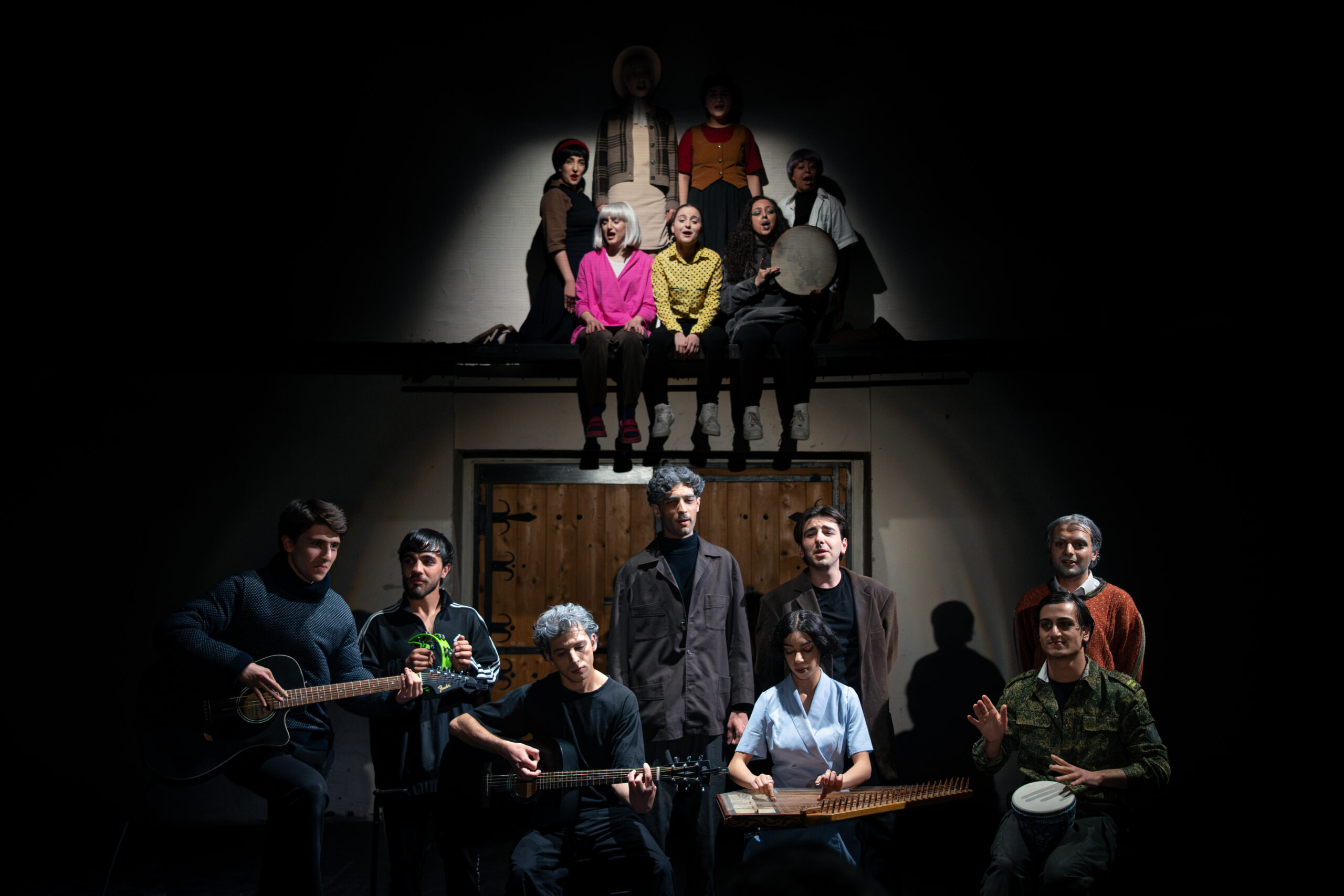
However, the “Faceless Game” exhibition represents a departure from his previous showcases in both scale and format. Moving beyond a traditional gallery display, it emerged as a synthesis of diverse art forms, incorporating music and dance alongside visual art. Mirijanyan credits this experiment to a collaboration with producer Emira Sogoyan and a dedicated professional team. For him, this interdisciplinary approach marked a significant step forward, transforming the viewing experience into a multisensory exploration of identity.
The studio within the theater
Mirijanyan’s art is inextricably linked to the theater. Since 2015, he has been a pillar of the Hrachya Ghazlanyan Drama Theatre in Yerevan, evolving from a second artist to his current role as the head of the production department. Within the theater’s walls sits his studio — a small sanctuary where his paintings are born. He describes himself as completely absorbed in this world, joking that his friends suggest he should simply move his bed into the theater.
Far from the stereotypical image of a silent, isolated studio, Mirijanyan’s workspace is defined by creative hustle. It is an environment of constant movement, shaped by a clash of personalities and ways of thinking. The daily atmosphere — marked by debate and philosophical discussion — serves as a primary source of inspiration.
These multilayered human interactions form the bedrock of “Faceless Game.” In the theater, Mirijanyan observes the full spectrum of the human condition, from strong personalities to the fear of losing one’s individuality. For him, people are the influence behind his work; his paintings are not just portraits of others, but reflections on the preservation of the self.
Mirijanyan’s creative life is an ongoing cycle of observation and translation. Through “Faceless Game,” he invites viewers to look into the eyes of his subjects and, by extension, into themselves. In a world trending toward the generic, the most radical act, his work suggests, is to remain authentic.