The Rug Wizard
Those who have attended one of Hratch Kozibeyokian’s lectures know the depth of knowledge he shares with the audience. Christened “The Rug Wizard” by the Los Angeles Times, Kozibeyokian has spent countless hours researching and educating people not only about the symbolism of Armenian rugs but also about the importance of preserving Armenian history through embroidery, symbols and traditional Armenian costumes.
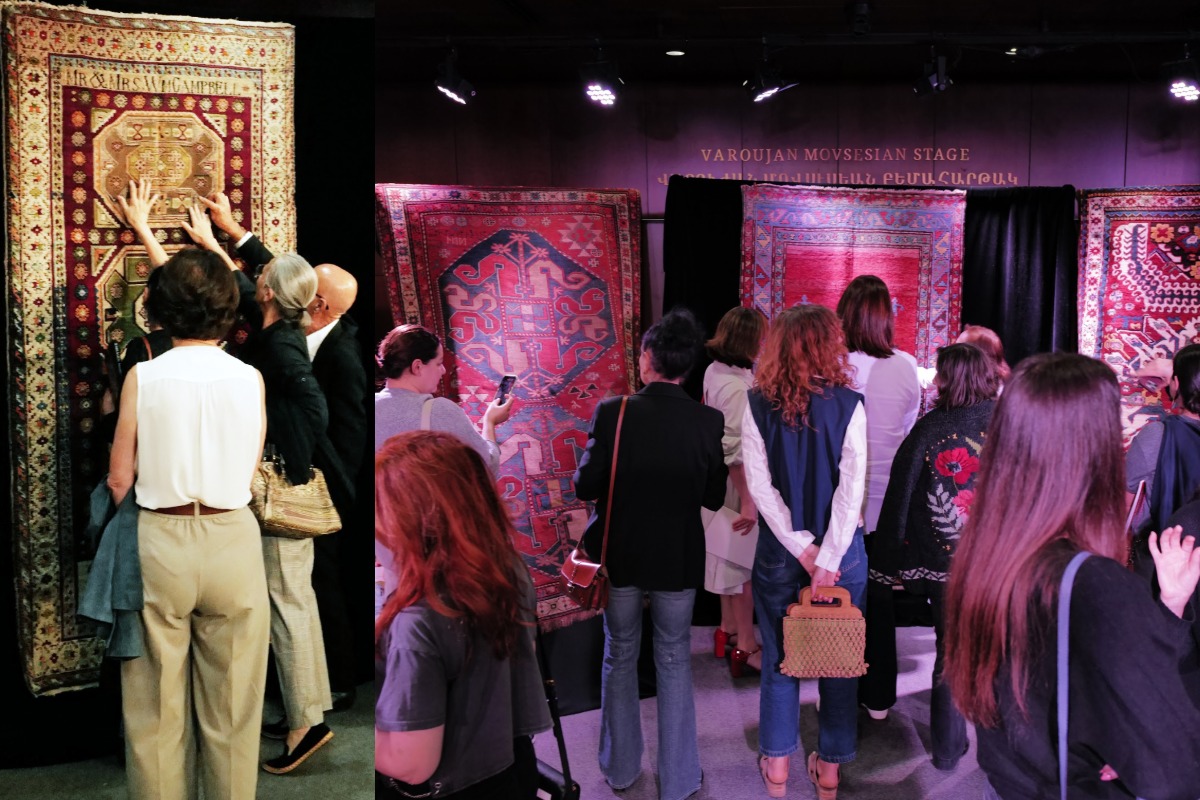
Kozibeyokian’s presentations serve as a traveling museum of Armenian cultural heritage. He recently gave a series of six lectures at the Lark Musical Society.
Born in Aleppo, Syria, to descendants of Armenian Genocide survivors and raised in Lebanon, he continued his family’s legacy of Armenian carpet weaving. He moved to the United States in 1977 and earned a bachelor’s degree in cultural anthropology from Chapman University.

He founded KO ‘Z’ Craft in 1990 to restore and preserve antique carpets and handwoven textiles. Kozibeyokian has also curated exhibitions and delivered lectures to promote Armenian weaving heritage and legacy. He introduced the first academic course on the history of Armenian rugs at California State University, Northridge. He is known for his expertise in rug restoration and has written extensively on the subject. He has served on the board of the Armenian Rugs Society and has been its president since 2015.
In 2014, Kozibeyokian participated in the exhibition of President Calvin Coolidge’s Armenian Orphan Rug at the White House Visitor Center. He was also invited to speak about Armenian carpet weaving at the 2018 Smithsonian Folklife Festival in Washington, D.C..
“Whether I am restoring a carpet, researching an ancient motif, writing an article or presenting a lecture, my goal remains the same: to preserve and share the cultural memory woven into these traditions,” said Kozibeyokian.
For Kozibeyokian, what began as a profession gradually turned into a passion and eventually a mission.
“As a young man, I was attracted to the beauty and craftsmanship of antique rugs. But the more I studied them, the more I realized they were much more than decorative objects,” he said. “Over the years, I noticed that many Armenian rugs and textiles were either misunderstood, disconnected from their cultural origins, or simply overlooked.”
This realization led to a growing sense of responsibility to research and document these cultural objects and traditions.
For Kozibeyokian, what began as a profession gradually turned into a passion and eventually a mission.
During his most recent lectures at the Lark, Kozibeyokian spoke extensively about traditional Armenian costumes. He explained that historic Armenia was so vast and that each region had its own attire. The attire a person wore reflected their status in society, whether as a government official, religious leader or layperson.
“Van or Vaspuragan was a region that hardly changed. The attire focused on red and green. The costumes were markers of their identity,” said Kozibeyokian.

When asked why it is important for Armenians to learn about rugs, embroidery and costumes, Hratch responded:
“Rugs, embroideries, and costumes are among the most enduring expressions of Armenian civilization. They preserve symbols, beliefs, regional traditions and cultural memories passed from generation to generation.”
According to Kozibeyokian, Armenian rugs, embroidery, costumes, manuscripts, architecture, khachkars and other artistic traditions should be studied together because they form a continuous visual language of Armenian history and creativity. “Armenian culture is an interconnected whole, and each surviving artifact helps tell a chapter of our collective story,” he said. “When cultural traditions are forgotten, erased, or detached from their origins, people risk losing part of their historical memory. Equally concerning is the appropriation of cultural expressions, which can obscure their true origins and weaken the connection between a people and their heritage,” he said.
Kozibeyokian is the chief visionary of ARATAMUS, which stands for Armenian Rugs and Textiles Academy Museum, a project that has grown out of decades of research, collecting and teaching. He aims to create a virtual educational museum that visitors can explore and learn about Armenian material culture online. Aside from woven arts, ARATAMUS hopes to shed light on symbols and artistic traditions found in ancient Armenian monuments, petroglyphs, dragon stones, manuscripts and architecture.
“Armenian culture is an interconnected whole, and each surviving artifact helps tell a chapter of our collective story,”
“I hope that ARATAMUS will become a living educational resource for students, researchers, collectors and anyone interested in Armenian heritage,” he said. “Families can share photographs of heirloom rugs, costumes, and embroideries. Researchers can contribute information and documentation. Collectors and institutions can assist by making objects available for study…By sharing and documenting them, we can help preserve a more complete picture of our cultural heritage,” explained Kozibeyokian.
“I plan to continue developing new lectures, exhibitions, publications, and educational programs. There is still much to explore, and I believe that sharing this knowledge is one of the most meaningful ways we can preserve and strengthen our cultural legacy.”
“These objects connect us to the lives, experiences, and creativity of those who came before us,” he said. “I believe every Armenian family possesses pieces of history that deserve to be documented and remembered.”
He added that preserving Armenian heritage “is the gift we give our future generations.”