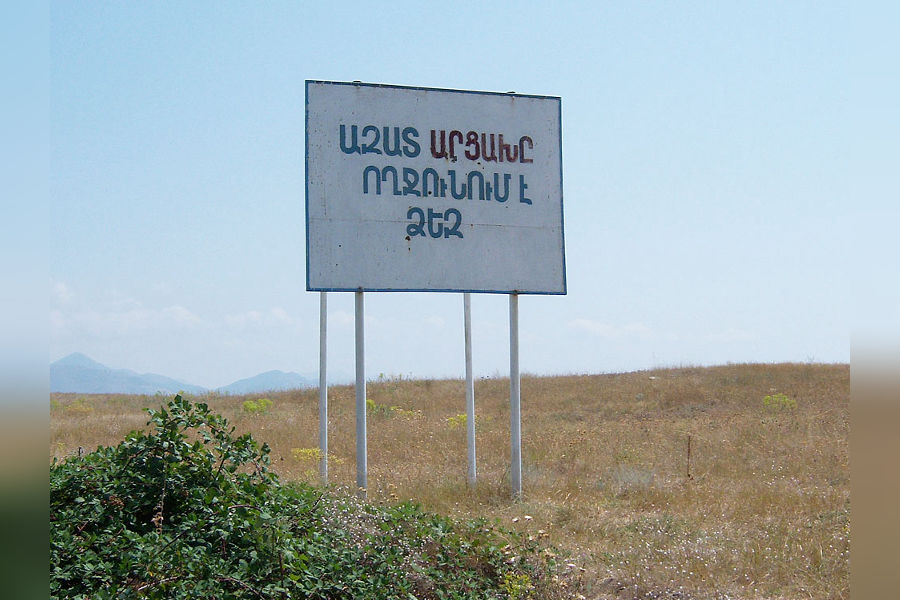
"Free Artsakh welcomes you" sign (Photo: 517design/Wikimedia Commons)
After the 44-Day War, Azerbaijan’s President Ilham Aliyev faced a serious problem. Despite enormous expenditures, large-scale construction projects and the building of mosques in Artsakh and adjacent territories, Azerbaijanis avoided moving to those occupied territories. Speaking to The Armenian Weekly, Yerevan-based regional security analyst and
Anzhela Sedrakyan is a journalist and master’s student in journalism at Khachatur Abovian Armenian State Pedagogical University. She writes on cultural, social and political topics, combining research and analytical approaches. Alongside her studies, she continuously deepens her professional knowledge and participates in trainings to further develop her skills in the field of journalism.
2 Comments
It is irrelevant that Artsakh is not attractive or economically viable for Azeris; what matters is that Azeris have turned Artsakh into a dystopian land by destroying almost all Armenian heritage after ethnically cleansing all Armenians. According to their twisted “logic,” the Azerbaijani regime would rather turn Artsakh into a toxic wasteland unsuitable for human habitation, including for Azeris, than allow Armenians to live there, which they never will, and no Armenian would ever consider living in a totalitarian, fascist, Armenophobic Azerbaijan. Artsakh has become Nakhichevan 2.0.
The author fails to answer the question posed in the article’s headline – “Why Azerbaijanis won’t live in occupied Artsakh”. Is she claiming that no Azerbaijanis have moved to Artsakh? I don’t understand the focus of the article.







It is irrelevant that Artsakh is not attractive or economically viable for Azeris; what matters is that Azeris have turned Artsakh into a dystopian land by destroying almost all Armenian heritage after ethnically cleansing all Armenians. According to their twisted “logic,” the Azerbaijani regime would rather turn Artsakh into a toxic wasteland unsuitable for human habitation, including for Azeris, than allow Armenians to live there, which they never will, and no Armenian would ever consider living in a totalitarian, fascist, Armenophobic Azerbaijan. Artsakh has become Nakhichevan 2.0.
The author fails to answer the question posed in the article’s headline – “Why Azerbaijanis won’t live in occupied Artsakh”. Is she claiming that no Azerbaijanis have moved to Artsakh? I don’t understand the focus of the article.