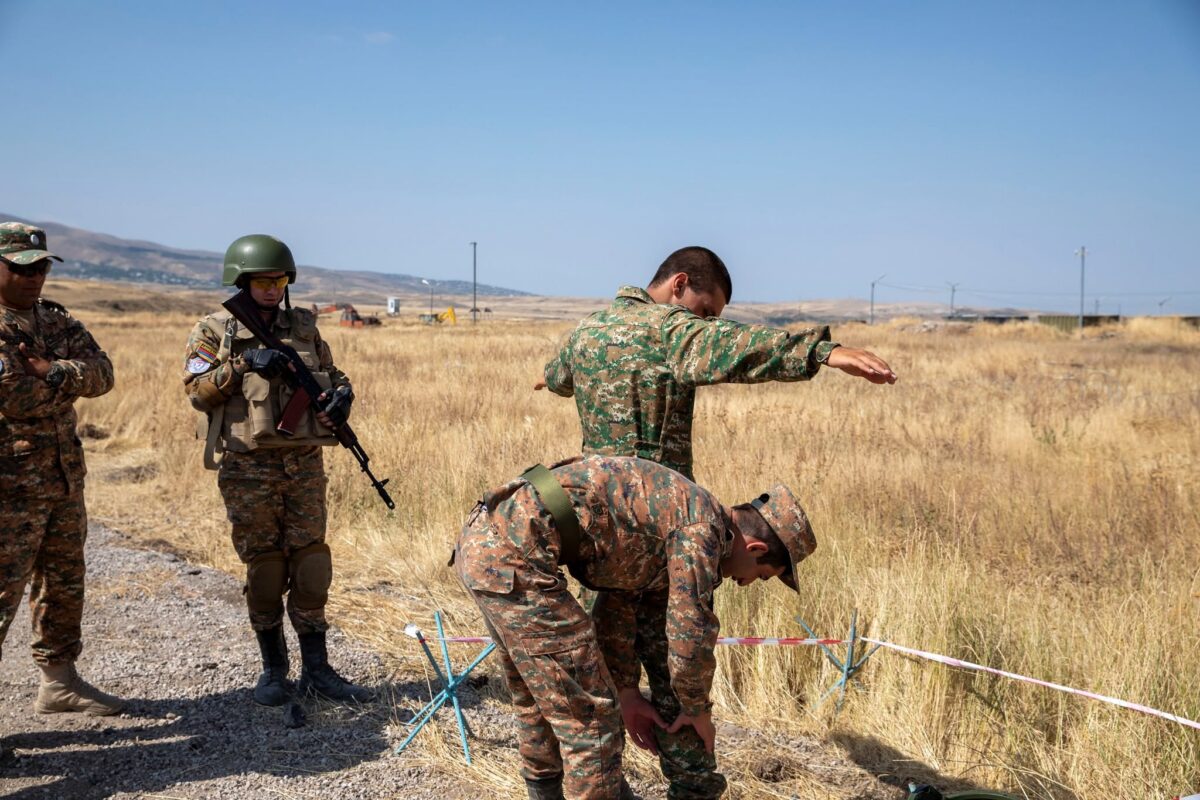
In the evolving landscape of Armenia’s foreign and security policy, the State Partnership Program between the Kansas National Guard and Armenia occupies a distinctive place. Established in 2003, it has delivered more than two decades of consistent engagement in professional military education, peacekeeping skills, medical procedures, emergency management and limited interoperability. Annual exercises such as Eagle Partner have become its most visible expression. For many in the Armenian diaspora and segments of Armenian media in the United States, the longevity of this relationship and the optics of American soldiers training on Armenian soil are frequently presented as evidence of a deepening strategic commitment.
Having followed U.S.-Armenian security cooperation for years, both as an observer and through service in a state military structure, the gap between institutional reality and public narrative has become increasingly clear. The risk is not that the partnership lacks value. The risk is that its symbolic weight is routinely overstated relative to its material contribution — creating inflated expectations about Western willingness to underwrite Armenian security. Those expectations have repeatedly proven unrealistic.
The partnership versus the narrative
Official American and Armenian descriptions of the program remain carefully bounded. Statements from the U.S. Embassy, the National Guard Bureau and the Armenian Ministry of Defense consistently frame Eagle Partner and related activities as efforts to improve interoperability for international peacekeeping missions, exchange best practices and support partner capacity. Personnel numbers involved have typically remained modest. The program does not transfer major combat systems, conduct large-scale offensive training, or carry any mutual defense obligation.
Yet in diaspora commentary the same activities are often elevated. Continuity since 2003 is cited as proof of reliability. The presence of Kansas Guardsmen is read as a signal of American strategic interest. The expansion of exercises to include partners such as France and Greece is treated as evidence of an accumulating Western security architecture. Longevity and visibility become proxies for commitment of a different order.
This interpretive leap is understandable. In a region where sustained great-power attention is scarce, consistent engagement matters. The problem arises when visibility is treated as trajectory — when a capacity-building relationship is presented as a foundation for security guarantees it was never designed to provide.
A familiar pattern
Armenian historical experience is marked by repeated gaps between external rhetorical support and practical security outcomes. The limited Western response during the 2020 war, the 2021-2022 border incursions and the 2023 offensive that ended Armenian control of the remaining parts of Nagorno-Karabakh followed a recognizable sequence: statements of concern, humanitarian measures, diplomatic initiatives and constrained military assistance that fell well short of deterrence or intervention. Each episode left segments of the public and diaspora with a sense of abandonment.
In that context, any sustained Western military presence — even a training-focused one — acquires heightened emotional significance. Celebrating the Kansas partnership becomes both an affirmation of advocacy efforts and a source of hope that incremental steps will compound into something more substantial. The pattern is familiar: limited tools are invested with expansive meaning and disappointment follows when crises expose the distance between symbolism and capability.
The counterargument and its limits
Supporters of a more optimistic reading argue that consistent visibility and institutional continuity themselves constitute strategic value, especially in a contested region. They contend that understatement risks discouraging further Western engagement and that relationships built over decades create political capital that can be drawn upon in future contingencies. There is some truth here. Optics and enduring personal and institutional ties matter. Low-profile, long-term programs can open doors that more formal alliances cannot.
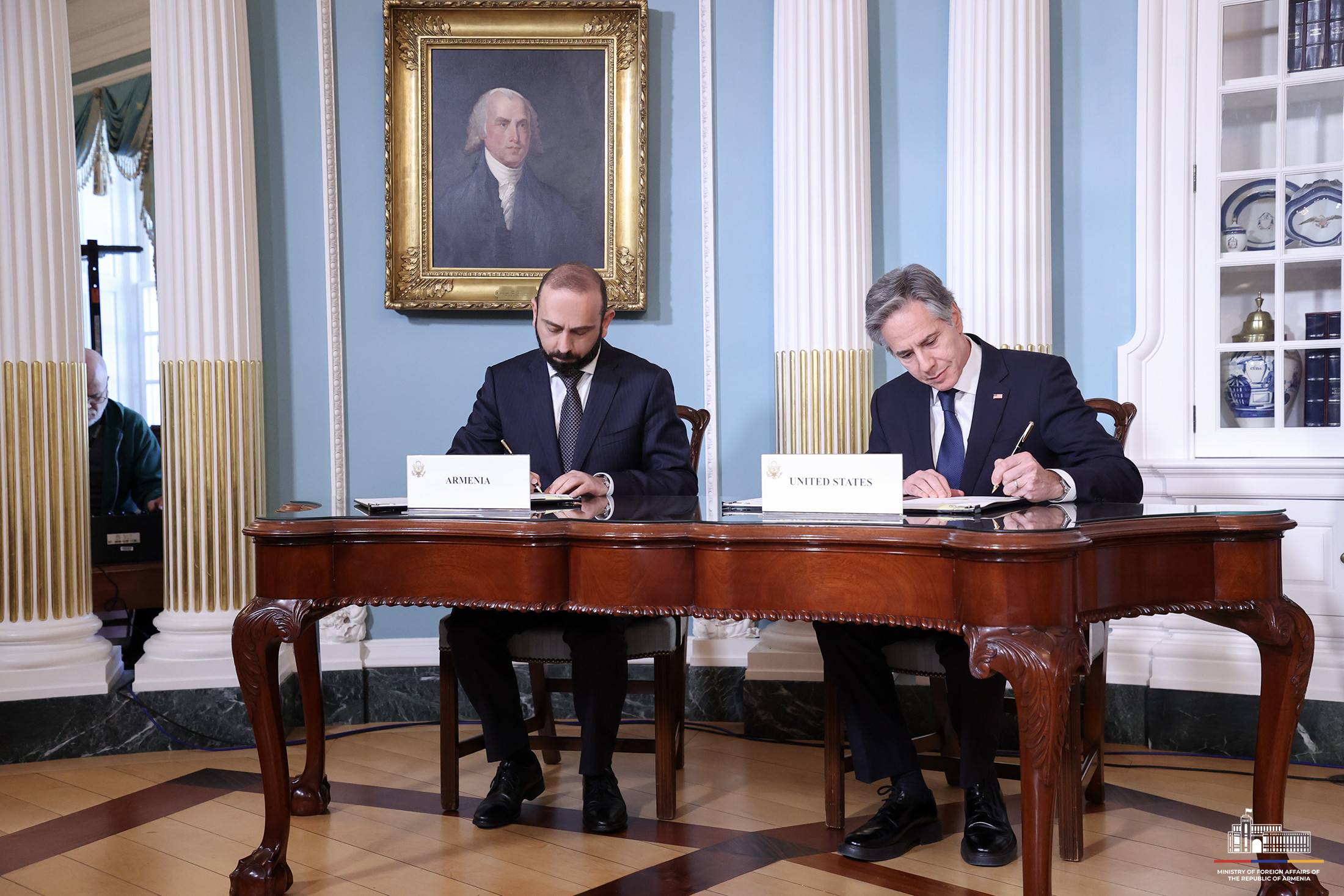
Yet this argument does not erase the distinction between capacity-building and security commitment. The United States has maintained the Kansas partnership while carefully calibrating its broader policy toward Azerbaijan, Turkey and residual Russian influence. The 2025 Strategic Partnership Charter expanded the bilateral agenda into defense cooperation, border security and cybersecurity without introducing mutual defense obligations. Armenia’s most consequential recent force modernization has come through large-scale procurement from India and France, not through National Guard exchanges. Continuity is real; transformation is not.
Consequences of overstatement
When political and emotional capital is invested in elevating limited programs, three related costs follow.
First, expectations become misaligned with policy realities. Communities that read training exercises as markers of strategic reassurance are poorly prepared for the constrained nature of actual American responses in a crisis. The resulting cycle of hope and disillusionment erodes confidence in both Armenian leadership and Western partners.
Second, attention is diverted. Advocacy energy that might focus on sustaining multi-source rearmament, strengthening domestic defense production, hardening border security or supporting a realistic diplomatic track with Azerbaijan is instead directed toward amplifying the symbolic value of familiar exercises. Pride in longevity can obscure more decisive shifts in Armenia’s actual military posture.
Third, the overstatement complicates Armenia’s “balanced and balancing” foreign policy. Projecting the partnership as evidence of a Western strategic pivot risks reinforcing Russian narratives of encroachment while raising domestic expectations that Yerevan cannot control. The program’s greatest operational strength — its modesty and non-provocative character — is precisely what makes it sustainable. Inflating its meaning undermines that advantage and can be exploited by adversarial information campaigns.
Clarity as responsibility
None of this argues against the Kansas partnership. As a durable mechanism for professionalization, civil-military relations and people-to-people ties, it retains genuine utility within a multi-vector strategy. Continuity has value. Incremental capacity-building has value. Visible, low-risk cooperation with the United States has value in signaling sovereignty and alternatives.
What is required is precision. A disciplined narrative would describe the partnership accurately: a long-standing, limited instrument of capacity-building and institutional development that supports diversification without substituting for it. It is neither a security umbrella nor a reliable trajectory toward one. Treating it as such confuses process with outcome and symbolism with substance.
For Armenian media and diaspora discourse in the United States, the responsibility is particularly acute. Communities with deep emotional investment in Armenia’s survival naturally seek signs of external solidarity. The most useful form of solidarity, however, is clarity. Honest appraisal of the boundaries of programs like the State Partnership Program strengthens rather than weakens the case for sustained engagement, because it aligns public understanding with the actual structure of cooperation. It also directs attention toward the harder work of rearmament, diplomacy, economic resilience and domestic reform on which Armenia’s long-range security ultimately depends.
The Kansas National Guard partnership remains a constructive element of Armenia’s evolving security architecture. Its contribution is real, but it is bounded. Recognizing those boundaries is not pessimism, nor is it a lack of faith in Armenia’s cause. It is an act of national responsibility. In a region where the costs of misjudgment have been paid in lost territory, lost lives and the displacement of our people, clarity is not a luxury — it is a duty. Sustainable expectations, grounded in reality rather than symbolism, are essential if we are to strengthen Armenia’s sovereignty, preserve what remains and build the genuine capacity our nation requires.
The views expressed by the author are his own and not those of the Los Angeles County District Attorney’s Office or the California Military Department.