


Meet Vahe Kotanyan, the designer documenting the (un)vanishing flavors and fabrics of Armenia
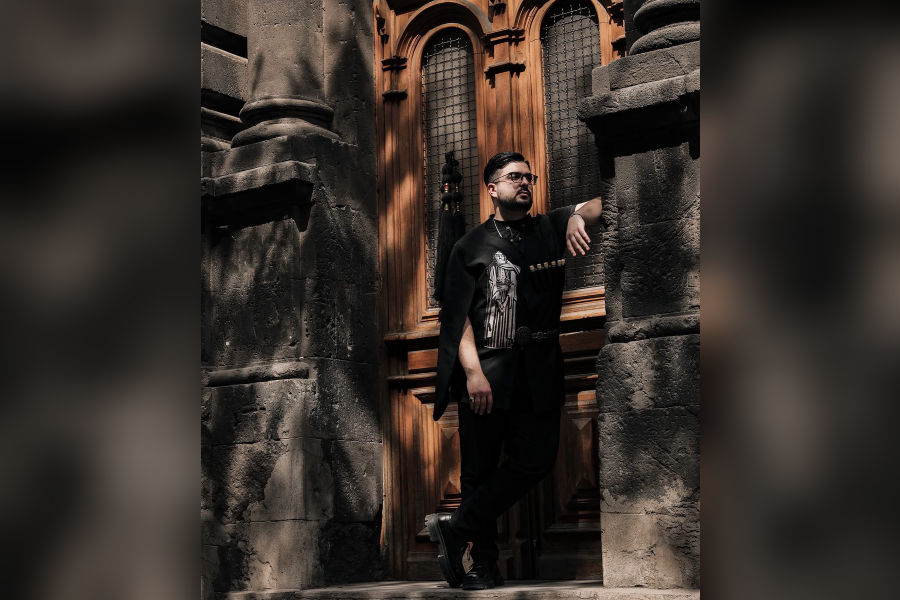
Vahe Kotanyan’s childhood unfolded in a village, surrounded by nature — an environment that quite literally shaped the way he sees the world. “If I hadn’t been born in a village, I’d be a different Vahe,” he told the Weekly. The colors of the fields, the sounds of the mountains and the harmony of the landscape became the foundations of his professional identity.
Vahe’s childhood was peaceful, without strict discipline. His parents never raised their voices or demanded things by force, he explained. Vahe simply knew what was not allowed and avoided it. That self-discipline has accompanied him ever since.
He enjoyed almost every school subject. Interdisciplinary thinking, he believes, is one of the most important skills a person can have. “A person should be multifaceted,” he said. Mathematics was the only subject that interested him less, yet throughout life, he often had to return to it. That is why he is convinced that no subject is secondary in shaping a person.
Vahe’s choice of design, he recalls, was somewhat accidental. As a child, he loved making handmade gifts. On March 8, International Women’s Day, he would create compositions from candles, which became some of the most cherished gifts for his mother. One day, he and his father decided to draw his mother’s dresses. His father was not a professional artist, but he drew beautifully. That moment became the first spark that eventually grew into a professional path.
Vahe entered the environmental design faculty but worked in various directions for a long time until he eventually specialized in interior design. Today, he also designs clothing, convinced that the two fields not only coexist but complement one another.


Although there were no artists in his family — most were teachers, economists or mathematicians — the genetic inclination toward art was always present. His grandfather and uncle had exceptional craftsmanship and excelled at delicate, detailed work. That skill, Vahe believes, has passed down to him. And the love for teaching, as he jokingly said, is “a family trait.” Pedagogy in his family has always been more tradition than profession.
Five years of Vahe’s career were spent at a development center, where he worked as an art therapist with children who had speech or behavioral difficulties. Clay and drawing therapy were particularly effective for children with autism, Down syndrome and behavioral disorders. “The love for medicine is also familial,” he added. His grandmother was a well-known healer, and his interest in medicine comes from her. In fact, when applying to university, he initially intended to study medicine but didn’t have enough time to prepare for the entrance exams.
Still, medicine and design, different as they may seem, share one essential commonality for Vahe: precision. Just as medicine has its rules and logic, art too is built on structural principles — linework, proportions, relationships, the golden ratio. That is why Vahe often takes a critical stance toward some contemporary art, which, he believes, sometimes drift so far from professional foundations that it loses its artistic substance. “Art is not absolute freedom; even freedom has its boundaries,” he explained.
For Vahe, Armenian traditional costume (taraz) is not simply an interest; it is a way of living. With roots in Sassoun, he has seen many things firsthand — not just read or watched. National heritage has been preserved in his family, too. That is why, when he encounters distorted or inaccurately represented taraz patterns, he feels a deep emotional pain. He advises, corrects, explains — never for material gain, but because he considers it his duty to present things accurately. At first, he said with a smile, people often resist such remarks, but later, they return seeking advice.
Vahe has been engaged in ethnography for more than a decade. Starting in university, he collected stories in villages, recording and photographing elderly residents, convinced that entire layers of knowledge could disappear with them. The materials he collected became not only his personal archive but also the foundation of his later professional work. Based on this material, he has also made films, serving as director and emphasizing the importance of preserving national culture.
In the professional field, however, Vahe sees one major problem: the lack of solidarity between generations. “The elders don’t want to let go, and the younger ones don’t manage to take over,” he said. Yet, the real strength lies in collaboration — in merging experience with new knowledge.
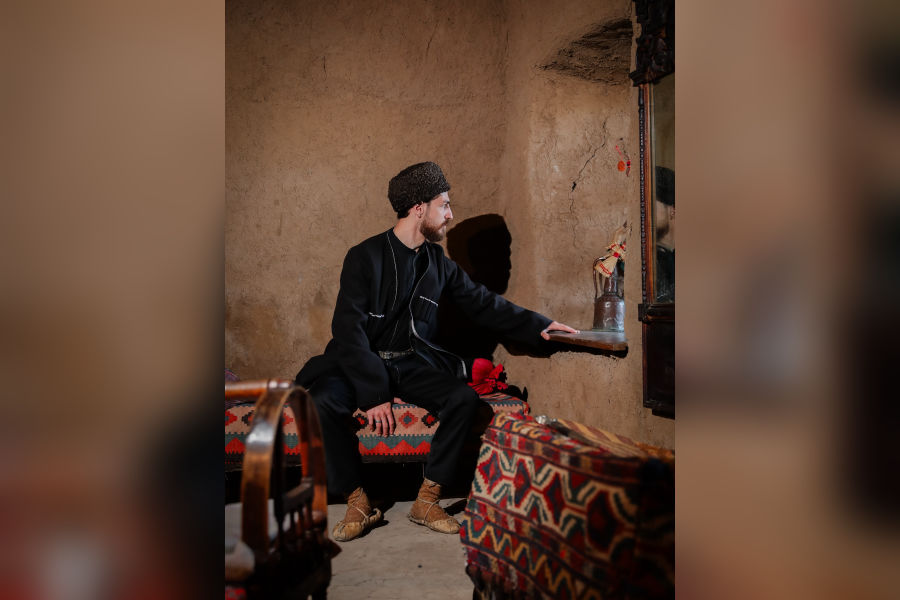
When discussing Armenian taraz, Vahe always references historical losses. After the genocide, many elements of traditional Armenian clothing disappeared from everyday life. While in India or China, traditional dress still remains part of daily culture, in Armenia, only clerical garments survived consistently. In the Syunik–Artsakh region, taraz was worn until the 1990s, then completely went out of use. Today, it is making a comeback, especially in weddings and family photo sessions. “Wearing it is a way of preserving culture,” Vahe emphasized.
A person’s national identity, he said, lives even in the simplest actions — in the way one walks, sits or eats. Colors, too, are perceived differently by different nations, and this is not a matter of taste but of cultural thinking. Foundations of Armenian color perception, according to Vahe, lie in ancient beliefs and religio-philosophical ideas that over centuries have become cultural codes.
Vahe’s brand, SEMA Armenian Fashion Design Studio, is a continuation of these codes. It combines the scientific restoration of traditional Armenian clothing with a modern approach. The brand creates stage and dance costumes, as well as wedding taraz. “The trend grows every year — couples not only wear traditional wedding taraz but also organize their weddings according to Armenian customs.”
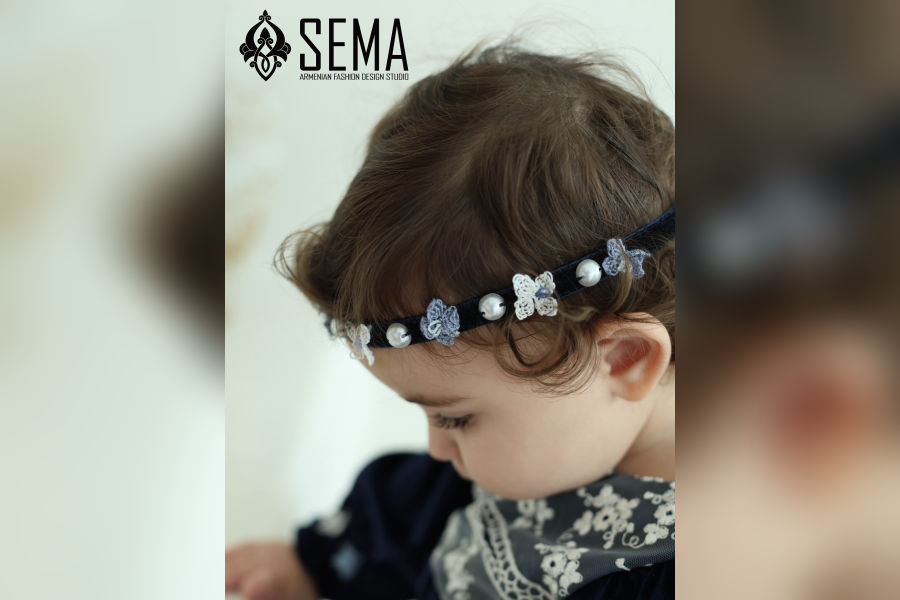
In recent years, international interest has grown significantly. Armenian diaspora communities around the world often reach out for scientifically accurate taraz. Vahe is currently working on Tigranakert-style bridal and groom costumes for a couple in Austria. His connections with Armenian communities abroad are constant: he is invited to give lectures from Belgium to Paris, from Moscow to the United Arab Emirates. For him, transmitting knowledge is a duty, not just a job.
Recently, he began working on a new book that unites two seemingly different but deeply interconnected fields: Armenian cuisine and regional taraz. The book presents dishes of the Armenian Highlands, region by region, and each chapter features the corresponding traditional costume. Vahe prepared all the recipes himself, and the photographs are also his own. “Cuisine is not just food — it is the memory of a nation,” he stated.
His culinary shows, “Taste of the Homeland” and “Flavors of the Armenian Mountains,” aimed to uncover forgotten and little-known dishes. Walnut harissa, fruit-based dolma and other rare recipes — many of which have nearly vanished — are now being revived through his efforts. “We often don’t recognize our own cuisine,” Vahe said. “But once you do, you see how delicate and rich it really is.”
At the core of Vahe’s work is one simple idea: no matter how the world changes or how global it becomes, national identity lives within people: in their colors, movements, tastes and sensory world. “If we understand ourselves, we will not only preserve our culture but also recreate it in new ways.”
For more of Vahe Kostanyan’s work, follow him on Facebook and Instagram.