For artist Davit Mirzoyan, weaving this rug was not merely a hobby — it was an act of resurrection. For 10 years, his mind and hands worked tirelessly, guided by an inner voice and the weight of a mission he felt chosen to carry out. On June 15, 2025 — his elder son’s birthday — he finished weaving a monumental Dragon (Vishap) rug, marking not just the end of a project but a sacred delivery: a gift from ancestors, a bridge across centuries of loss and the passing of a tradition on the brink of disappearance.
Mirzoyan’s rug is the latest incarnation of an ancestral flat-woven Dragon rug, rescued from the ashes of the Armenian Genocide and brought to present-day Armenia in the early 1920s.
From early childhood, Mirzoyan listened to his grandmother’s stories about the atrocities she witnessed during the genocide. Yet, he could not have imagined the important task fate had prepared for him.
As a student in the Art Department of the Armenian State Pedagogical University, Mirzoyan realized that the rug was not just a utilitarian object or antique tapestry but a core part of his identity, passed down through generations. Over time, this understanding ignited a powerful, almost genetic urge to continue the cycle, eventually solidifying into a mission: to recreate the Dragon rug, which by then was dangerously close to disintegration.
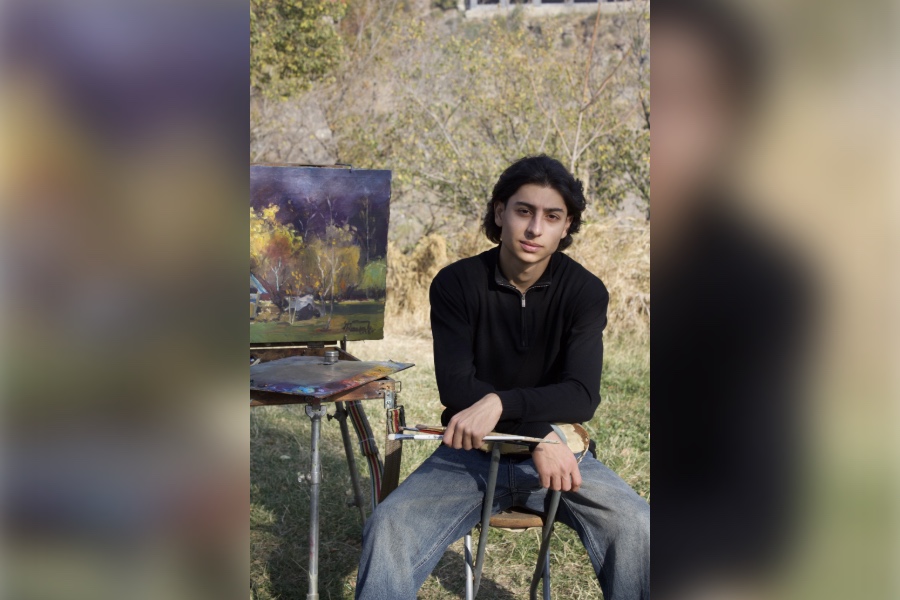
From his first years at university, Mirzoyan had been drawn to Armenian folk art and carpet weaving. His research revealed nothing similar to his ancestral rug, leading him to conclude he had inherited something unique. Comparing available designs and historical data, he determined it had ancient origins, stemming from knowledge possessed by temple priests at least 3,500 years ago — a time when dragon worship was violently suppressed. He theorized that these priests must have gone underground, keeping the weaving alive in secret, passing the designs and skills to their descendants.
Mirzoyan also discovered that, since wool rugs are perishable, each generation would weave an exact copy of their ancestral rug and then retire the worn-out original, thus preserving its design for the future. This act of recreation was essential for safeguarding the rug’s iconography. Recognizing the age, uniqueness and significance of this iconography, Mirzoyan understood the immense mission placed upon him.
This rug now stands as a witness to the most recent performance, in 2025, of a millennia-old sacred ritual. It keeps the design alive and passes it on. It is both a contemporary masterpiece and an ancient artifact — the latest link in an unbroken chain nearly snapped in 1915.
Dragon worship in Armenia was violently suppressed approximately 3,500 years ago, but the tradition of Dragon rug weaving survived. Temple priests kept it alive in secret, and descendants continued the practice into the 20th century. The tradition survived empires, the rise and fall of religions and countless wars. But it faced its greatest test in 1915 during the Armenian Genocide. Almost all of Western Armenia was annihilated, and few bearers of this tradition survived, carrying with them their most precious possessions — not gold or jewels, but their stories and symbols. This Dragon rug was among the treasures saved, a survivor of our stolen heritage.
At first glance, one sees a legion of dragons, woven in rows based on the sacred proportions of 5, 6 and 11. These are not random numbers, but a coded language — a sacred geometry from the cosmology of our prehistoric ancestors. Looking closer, one will see that each dragon is a guardian, cradling a unique ‘Tree of Life’ symbol within its form. Each tree, with its distinct shape and colors, represents a different facet of creation and wisdom. Between the dragons, rows of vibrant fertility symbols create a tapestry of life protected by dragon power. The composition stems from vishap worship in Armenia — a spiritual tradition central to Armenia long before empires rose and fell.
Woven with pure sheep’s wool on a cotton warp (330 cm x 130 cm), the rug is a map of ancient spirituality. The weaving is executed with such mastery that it would make our ancestral weavers proud.
The rug’s value lies not only in its craftsmanship or visual impact, but in its unbroken lineage.
It is one of the last physical ties to Armenia’s oldest spiritual tradition — a dragon’s echo that refused to be silenced.
Davit Mirzoyan is an artist with a master’s degree in Art and Art Theory from Brigham Young University. His work can be viewed at www.davitmirzoyan.com.