

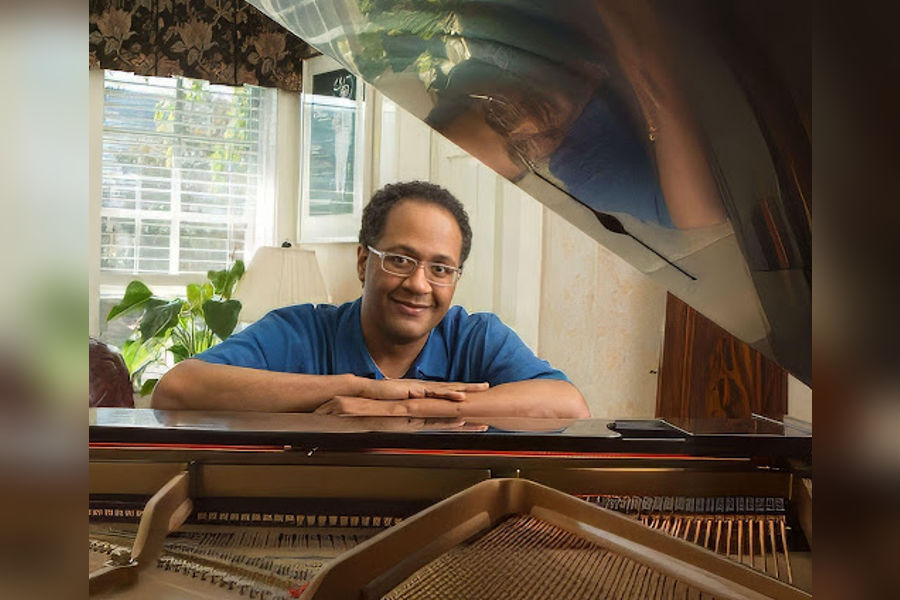
Joel A. Martin is a Connecticut-based pianist, producer, composer and arranger who has worked with countless GRAMMY® Award-winners, Rock and Roll Hall of Famers and other musical visionaries, in addition to serving as Musical Director of The Cab Calloway Orchestra.
A self-described “Armenian By Choice,” Martin has dedicated the last six years of his life to Jazzical® Komitas — a creative fusion of jazz, classical and the iconic music of Komitas. The music of Komitas, though well-known by Armenians, is virtually unknown to most non-Armenian audiences, and Martin has taken on the mission of bringing this tradition and history to the world, with upcoming performances in Los Angeles, New York City, Yerevan and beyond.
We caught up with Martin ahead of his October 4 concert at St. Vartan Cathedral in New York City to talk about his musical journey, the magic of Komitas and his experiences in Armenia.
This interview has been edited for length and clarity.
Rosie Nisanyan (R.N.): How did you get started in music?
Joel A. Martin (J.A.M.): I was seven when I started playing piano; I learned from my mother and my father. My mother was a choir director for middle and high schools. And my father, besides being a Baptist minister, was an educator and music teacher for several colleges over the years. My mother was playing organ at a local church in Worcester, Massachusetts. I asked to start learning organ, but my feet couldn’t reach the pedals, so they put me on piano and that’s kind of where it all started.
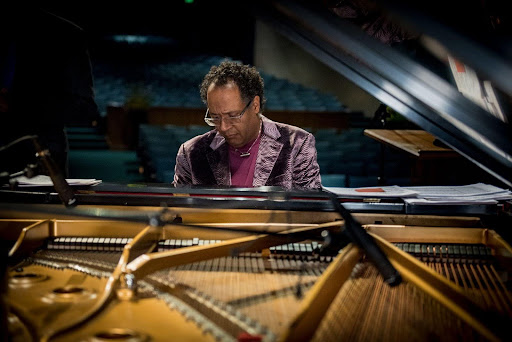
R.N.: Can you tell me more about your Jazzical® style?
J.A.M.: Jazzical® is a marriage of two genres that I love and am intimately connected to: classical and jazz. The hallmark of Jazzical® is that you can do whatever you want to do, but you may not, under any circumstances, destroy the tune. This is what separates Jazzical® from everybody else. Some people will just take music, put some jazz chords to it and say, “Oh, now we’ll just do whatever we want.” And to me, that’s absolutely wrong, because if a person listens to Komitas or Brahms or Bach and they go, “I don’t even understand where the song is,” then it doesn’t make sense. It means that you took someone’s music and, for all intents and purposes, bastardized it and made it something that it’s not. Jazzical® affirms the song, the actual melody and the structure of it, without destroying it. That’s where I get to use the 40-some years that I’ve been doing classical and jazz and musical theater and pop and funk and rock and rap. I get to put all that back into the music in order to make whatever it is I’m playing come alive.
R.N.: What drew you to the music of Komitas?
J.A.M.: The truth of the matter is that I was not expecting it at all. I met a woman here in New York, Emma Arakelyan, at a Russian, Greek and Armenian dinner party. There was a small piano there and I started playing Jazzical® music. They said, “Oh, you play this music so well, you should be playing Komitas.” And I said, “Well, what’s Komitas?” Then, Emma said, “It’s not a what; it’s a he!” She proceeded to tell me a story about this very interesting man. We had a wonderful time at that dinner party and I went home to my regularly scheduled life.
Three months later, I played at Merkin Hall in New York during a Central Asian themed concert. I have a very deep love for Central Asia because my wife is Russian and Chechen, but was born and raised in Kyrgyzstan; her family is still there. At the concert, everybody was doing all these very large works and this one Armenian opera singer, a mezzo-soprano named Alvard Mayilyan, sang a two-minute piece of Komitas. I sat in the back of the room, going, “What is this? I’ve never heard anything like this.” It was so beautiful, simple and yet elegant. I ended up talking with her about that, and as a result, our families became intertwined. And then, I went back to my regularly scheduled life.
But three months after that, I was still hearing the word “Komitas.” On the one day that I was not working, I said, “Let me listen to this man and see what it’s all about.” I was prepared not to like it because a lot of people tell me a lot of things. I had a healthy skepticism that what I was going to listen to, I wouldn’t really like. I went to listen to Komitas on YouTube, and I thought it would just be 15 minutes — and I’ve told this story before, but I will flesh this one out just a little bit.
When I first listened, the first thing that came to mind was, “Well, this is a little different.” And then, as I listened, 15 minutes turned into 30 and my field of scope turned towards Armenian folk songs, as well as Komitas. I just kept thinking, “Wow, this is really very interesting to me.”
I never heard anything like Armenian music and Komitas, which is big for a musician to say.
A couple of hours passed, and all these images came to mind — things that I just never even thought about when it came to music. I was imagining what it would be like to be in Armenia or to be in a situation where this was all I listened to. My girls came home from school and I pulled them aside and said, “Okay, now you all know what your father does, but you must listen to this.” And that’s when I sat them down and played about 30 minutes of this music that I had found on YouTube. My girls listened to this and said, “I think you’re going to be doing a record on this.” I wasn’t sure about that, but I really liked it.
So, I started setting some works of Komitas in Armenian to this Jazzical® thing. And I wrote to Alvard and said, “I want you to listen to some of the things that I’ve come up with and tell me if I’m in the right ballpark or if I’m completely out of my head and don’t know what I’m doing.” And Alvard said, “Do you know what the meaning of these songs is?” I said, “No. Everything’s in Armenian. I don’t speak any Armenian. I don’t know anything about Armenia.” And she said, “Well, for someone who doesn’t know what these songs mean, you sound like you’ve known them all of your life.” And I said, “Well, that’s because the music really touches me in a way that very few things do. It hits me in the core of my being, as though I’ve always had this in my life, and yet this is completely brand new to me.”
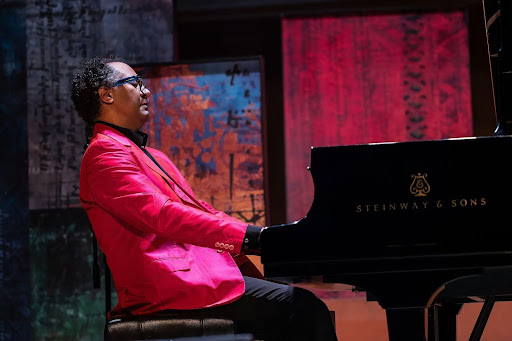
R.N.: Can you tell me more about the process of creating Jazzical® Komitas music?
J.A.M.: Basically, I open up a book of Komitas songs — it’s a 14-volume collection that I found online — and I would say, “Huh, this song sounds kind of interesting.” And I’ll just look at it and the underpinnings of what Komitas wrote as a setting. Then, I try to understand what it is that was written, before I start moving away from it.
With “Gakavi Yerk,” I ended up finding a way to keep that song, but when I got to the middle section of it, I actually slowed that down to half. And then, I started reharmonizing. Along the way, as I was working through this, I realized I wanted to find a connective tissue so that I could solo in the jazz form. At that moment, I thought about The Cab Calloway Orchestra because I was the music director there for 11 years. There’s a certain thing that they do, which kind of gets us into that big band flavor and then the solo starts. I put that in there, revamped and reworked it a little bit and I was all set. Then, after all of that soloing, I came back to the happiness of the song and I found a good way to end it.
You have to take the song from beginning to end — you basically have to tell a story. And that’s pretty much the secret to how I look at everything. But that form, that structure, may be different for every piece. I want to find the specialness of a song first and then take everything that I’ve learned and put it back into that song, so it basically creates something new out of something very old. And no matter what, I’m going to use everything in my toolkit, as long as it upholds the song.
R.N.: I know you’ve been to Armenia a few times now. How did the first trip come about?
J.A.M.: When I was finishing what would be the first album, “Jazzical® Komitas: Passion of Fire,” I came across a major problem: I could not finish it because I didn’t know anything about Armenia. So far, the only thing I’ve done is open up a book and work on it; it was just a really creative and cool thing to do. But there was no context for it.
I called up Emma and said, “I can’t finish this record because I need to go to Armenia. But I know no one in Armenia except for you.” She thought about it for a couple of minutes and then said, “Ah, you know, there’s the World Congress of Innovation and Technology in Yerevan. Why don’t you come?” I went home and told my family, “I’m going to Yerevan for a week and I’m leaving in a couple of weeks.” They looked at me like I was crazy. I said, “I have to go. I can’t finish this record unless I go. I have to sit on Armenian soil, and I have to take in the air and see what this is all about.” A couple of weeks later, I went to Yerevan, and the moment that I walked off the plane, I thought, I’m home.
R.N.: What was your experience like in Armenia?
J.A.M.: What struck me as truly amazing was that everybody knew who Komitas was. There was an institute, a museum, that required students in grades K-12 to learn this music. They must be able to sing the songs and know what they mean. They must participate in the ethnic dances and learn them. That’s very unusual. I’ve never seen anything like this.
And then I loved the language, I loved hearing people speaking. When I learned Russian in Kyrgyzstan, I was happy not to speak. I just enjoyed listening to the music of the language. The music of the Armenian language is very similar. It stands by itself, and yet I feel perfectly at home, even though I may not understand a single word. Now, I have no choice: I must learn Armenian because you can’t become an expert if you don’t understand the very basics of the language and how it is expressed in the music.
I’ve been to Armenia maybe 12 or 13 times now. I was just there in June doing a concert at Khachaturian Hall. You would think that after a while, the magic would wear off. No, the magic is intensifying. It is definitely expanding. It’s getting better every time I go. And every time I sit down and play, which seems to be pretty often these days, and not just for Armenian audiences, the music feels like it’s brand new. When I go to Armenia, I feel the magic — I see it, I hear it, I witness it.
R.N.: You have a performance being scheduled at the iconic Alex Theatre in Glendale, California, as part of their 100th anniversary celebration. And then, you’re also performing at New York’s St. Vartan Cathedral on October 4, which will showcase not only Jazzical® Komitas, but also Classical Aznavour. What can audiences expect?
J.A.M.: The Alex Theatre concert was initially scheduled for September 27, but I had a death in the family. As such, the concert will be rescheduled for later this year. Of course, I will let you know when the new date is decided. It will be a very special Jazzical® Komitas event, but it’s not just with me; it’s with my piano trio (piano, bass and drums) and also with a very brilliant Armenian singer from Glendale, Tamara Lalayan. She is a really spectacular jazz singer; she loves Armenian music. I’ve actually seen her in a performance, which is how we met. This will be an incredible evening where we explore Komitas and Armenian folk songs with artists I really love. I really love Tamara’s singing, and my trio has been with me for the last 20 years and has been playing Jazzical® since the very beginning, which is six years now.
The October 4th concert is Jazzical® Komitas paired with the National Chamber Orchestra of Armenia, which is doing its first-ever American tour. It’s sponsored by the Hi-Am Charity Foundation in California, as well as the Cultural Committee of St. Vartan Cathedral in New York. This came about through my friend Emma Arakelyan, who’s now chairman of our board and was also advising the National Chamber Orchestra. Emma reached out to the cathedral, and it just so happened that they were looking to do a Komitas or Aznavour-inspired concert in October. I truly believe that this is God’s work here — that everything lined up. After this concert, the National Chamber Orchestra will continue on the rest of their tour to Boston and Montreal, and I, in turn, will leave for Yerevan.
The first half of the concert is Jazzical® Komitas with my trio. But the last two pieces, I’m bringing the Orchestra on stage with me and we’re going to do two orchestral Jazzical® Komitas pieces. Then, the second half will just be the National Chamber Orchestra doing Classical Aznavour. Normally, when you think of Aznavour, you think of beautiful pop songs and that kind of aesthetic. But now, the conductor, Sipan Olah, is creating a lush orchestral tableau in a very classical setting of Aznavour’s music and I’m definitely looking forward to hearing this. I am hopeful that this will be the beginning of a collaboration between Jazzical® Komitas and the National Chamber Orchestra, and possibly even a world tour next year. So, it’s a very special, very unusual thing and I’m very excited about it!
R.N.: What do you hope to achieve with Jazzical® Komitas?
J.A.M.: The goal of Jazzical® Komitas is to bring this music to the rest of the world. I want them to know what it is that I know, and the only way you can do that is by presenting it to them. It’s not just for Armenians; it’s for everyone else like me, who is virtually an ignoramus (smile now, everyone!). At the time I discovered this amazing music, I certainly didn’t know anything about Armenia except for the word Khachaturian. If there’s one of me, there’s a million of me and there are millions of me — that’s who we should be speaking to. It makes me want to look deeper inside and share what I come across with the rest of the world.
One of the major goals of this is a world tour because it builds legitimacy — not only for the art form, but also for the people who are going to come in contact with this. This is a humanitarian issue, it’s a social issue, it’s a spiritual issue. It opens Armenian culture to the world and helps establish Armenia in a different kind of way. The Genocide is a very important thing, but it is not the sum total of what Armenians are in this world. Armenian folk music, Komitas and Jazzical® Komitas can and will bring the hearts and minds of a global audience together to do great things in the world for its citizens.
Tickets are now available for the October 4 Jazzical® Komitas and Classical Aznavour concert at St. Vartan Cathedral in New York City. Stay tuned for a new date for the concert at the Alex Theatre in Glendale. Tickets are not yet available for the January 13 Jazzical® Komitas: Passion of Fire concert at Carnegie Hall in New York City.
You can listen to “Jazzical® Komitas: Passion of Fire” on Apple Music and Spotify and follow Joel A. Martin on Instagram @joelmartin_jazzicalkomitas to stay up-to-date on future projects and performances.