Weaving history: AHA collective’s “Warp and Variations” exhibition

A series of vertically striped carpets welcomes you into AHA Collective’s Yerevan gallery space. For the second summer in a row, AHA collective developed its work as an edition house presenting a new series of contemporary carpets woven especially for the 22nd Golden Apricot Yerevan International Film Festival (GAIFF). Following its previous collaboration with GAIFF in 2024, the curatorial practice was commissioned to oversee the research, design, production and curation of GAIFF’s 2025 red carpets.
For this year’s edition, Nairi Khatchadourian, director of the curatorial practice AHA collective, invited Paris-based designers Jean-François Dingjian and Eloi Chafaï of Normal Studio, an almost 20-year-long collaboration between the professor-student pair, to design the new collection. The resulting eight carpets are part of a mirror project of the 13th International Design Biennale in Saint-Etienne in France, where Nairi Khatchadourian has co-curated the exhibition In Relief: Design in Armenia together with Normal Studio, and where last year’s red carpets — designed by David Kochunts — are currently on display among other mixed-media works. The mirror project was made possible with the support of the French Embassy/Institut Français in Armenia, the Chambre de Commerce et d’Industrie France-Arménie and Arm.Wool project.

As part of the research and design process, AHA collective hosted Dingjian and Chafaï to conduct fieldwork in Armenia, collaborating with local weavers and exploring natural dyeing techniques.
“It was a deeply enriching experience. Despite the geographical distance, a strong cultural and emotional bond was formed,” the pair said about their time in Armenia. “The Armenian weavers brought incredible craftsmanship, care and writing to the project. We were very curious to see how the weavers would translate our rigorous design into a sensitive surface and the personal vision they could bring to it.”
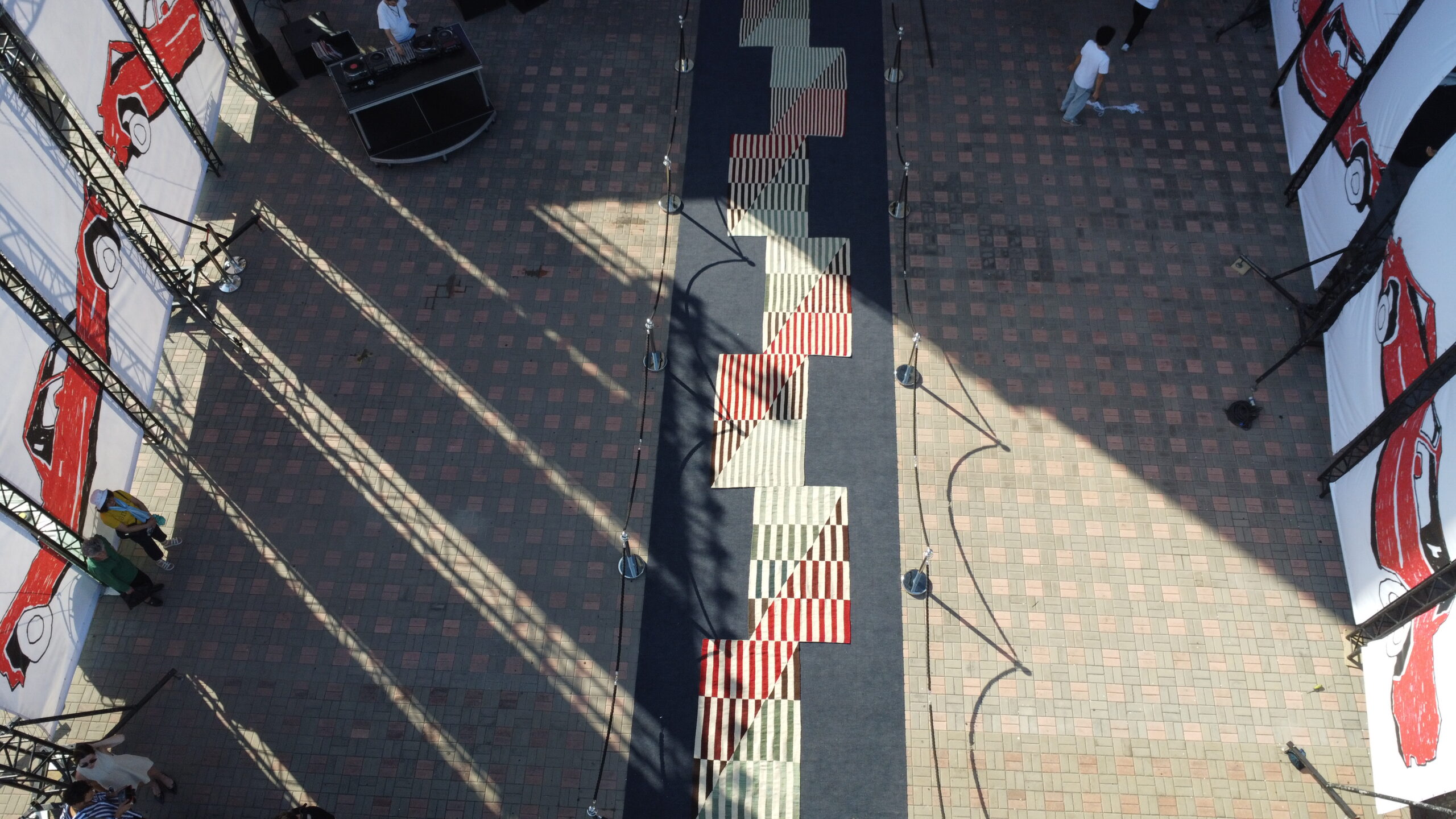
The results of this research are eight unique carpets of 115cmx200cm each, forming the “Warp and Variations” collection, inspired by the carpet’s foundational structure, the warp or grid that a carpet is made on top of. The collection of carpets is 100% handmade in Armenia, in collaboration with the Arm.Wool Project, Woolway Studio and mother-daughter artisans Milena and Galina Ordyants, a displaced family from Artsakh, who also worked on the 2024 carpets. In fact, after the Ordyants’ continued collaboration with AHA collective and other partners, they have registered as a business, demonstrating the economic impact of such projects.


Moreover, everything from the sourcing of the wool in the Shirak region, to the natural dyeing at Woolway studio in Argavand and hand-weaving by four women weavers, has been carried out by local craftspeople in Armenia.
“‘Warp and Variations’ is a play on the musical expression, referring to a theme and its developments, but it also directly evokes the weaving process, where the warp is the set of vertical threads that form the basis of a textile,” Dingjian and Chafaï elucidated. “The title reflects both the structure and the freedom of the project: anchored in traditional techniques (the warp), with space for experimentation, improvisation and evolution along the 16-meter length.”
Khatchadourian, the curator of the collection, highlighted the musical quality behind the collection: “When the weaver’s fingers interlace and pinch the vertically stretched warp on the loom, the natural-fiber stringed instrument vibrates. Like a musical staff, the composition of the carpet builds itself on this warp, revealing itself line by line as the weaving progresses. This internal vibration, imperceptible yet ever-present, hidden within every carpet, has become the focus of research for the designers.”
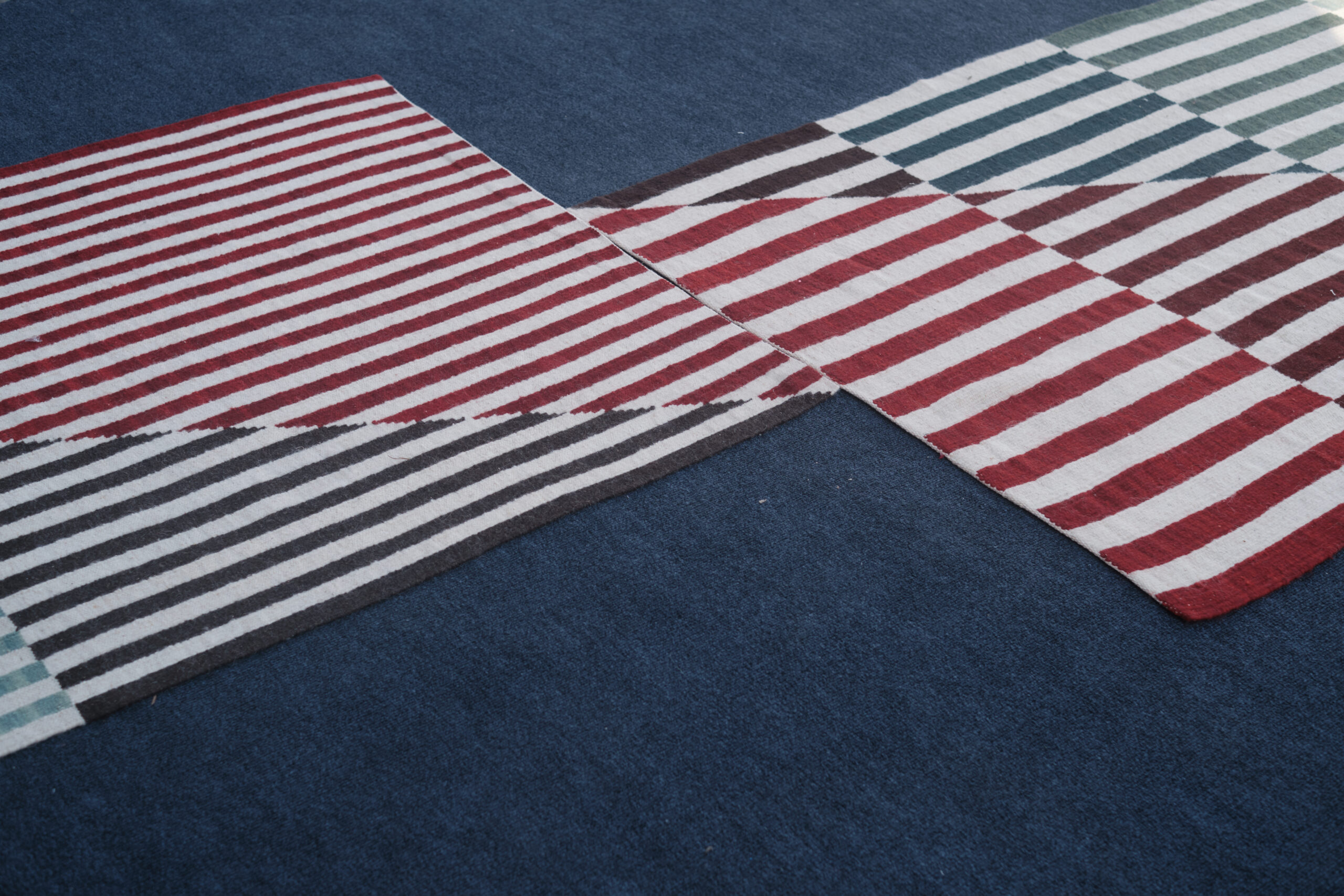
The carpets comprise geometric patterns of red and green hues, creating shifting subdivisions that evolve in density. “The inspiration came from a desire to explore the blend of tradition and a contemporary vision,” Dingjian and Chafaï explained. “We wanted to work with the beautiful craftsmanship of color and what it conveys through the material, which is profound and emotional. The patterns are abstract but evoke fragmentation and reconstruction, almost like a visual story woven into the weave.”
The carpets feature white and various colored vertical stripes in various widths, lengths and pattern combinations. Another surprising variation was also formed as a result of a different weaving technique used by Milena Ordyants, where in one of the pieces, we see small steps moving vertically across the stripes — something the team decided to keep in the collection.
Interestingly, as most Armenian rugs are made horizontally, the stripes in the collection — which were woven vertically — were then stitched together. The colors — reds and greens — are taken from those usually seen in traditional Armenian carpets, each colored from dyes made from cochineal, madder root and Armenian flowers. The resulting stripes ripple into different shades and hues of each color as a result of the natural dyes they are made up of, an illustration that the colors themselves are alive. Patterns are repeated in different variations to create the effect of vibration or artistically capture light.
“The stripes interact with the movements, and it was very interesting to see at the festival opening,” the designers explicated. “We were very curious to see people walking on these rugs, which form a sequence. The installation was not limited to visual beauty, but invited visitors to reflect on heritage, displacement and transformation.”
Visually, the way the carpets are hung vertically across AHA collective’s gallery transforms them from functional design objects — the red carpet — to visual art pieces. Khatchadourian also explained that during her own research in Khnzdoresk, in Armenia’s southern Syunik region — famous for the caves in which its residents once lived — she learned that villagers not only displayed carpets on the floors and walls, but also used them as separation walls to divide private spaces, almost like curtains. It seems fitting then that these carpets were used to separate the film sphere, the red carpet, from the floor, the non-cinematic world.
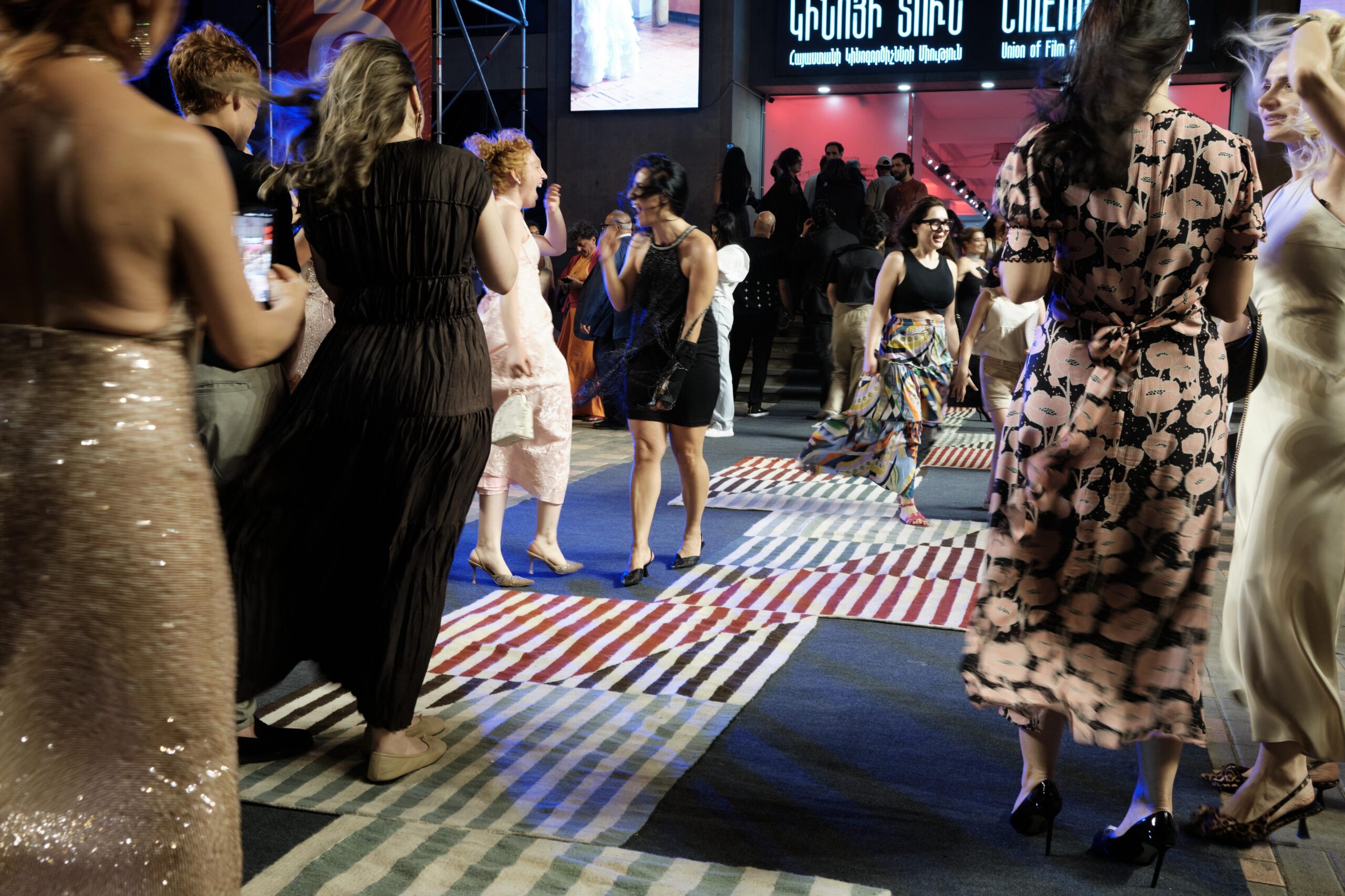
The 2025 GAIFF red carpet collaboration with AHA collective continues a burgeoning tradition, where the exclusivity of the red carpet is replaced with a space for contemporary expression, cultural dialogue and local empowerment. In addition, AHA collective’s collaboration with Normal Studio supports the revival of traditional Armenian carpet-making, contributing to the development of a contemporary visual language in the art of carpet while also championing sustainability and fostering tangible social impact.
The exhibition “Warp and Variations” is on view until November 21, 2025, at AHA collective.