



Arman Akopian: Spineless diplomacy

In a recent appearance on ILTV News Podcast, the Armenian Ambassador to Israel, Arman Akopian, accomplished what has become the norm for Armenian diplomats in 2025: he unburdened his conscience by handing it off entirely. With all the passivity of a man excusing a war crime as a scheduling inconvenience, he declared that Israeli weapons—used by Azerbaijan to disfigure Artsakh and pulverize 5,000 Armenian soldiers, most of them barely 18—were part of a “sad page” that has now been “turned.”
Let us pause to appreciate the theater of the grotesque. The systematic ethnic cleansing of Artsakh’s Armenian population, enabled by Israeli drones, cluster munitions and silent applause, has not even faded from memory. In Ashtarak, a town about 20 minutes from Yerevan, I heard a harrowing account from the 44-Day War: three Armenian soldiers stationed at an outpost heard the ominous buzzing of a drone, followed by an explosion that killed one and buried another under rubble. The third, without regard for his own safety, ran to dig out his friend—his fingers torn and dangling from his hands by shrapnel-hot metal that sliced through flesh.
An indubitable act of courage in the face of death. And yet, in our hut of diplomacy, where courage is needed in speech—not sacrifice—it is nowhere to be found.
An estimated 120,000 Armenians fled Artsakh in the span of days. Churches were defiled, graveyards bulldozed and a 3,000-year-old Christian enclave annihilated in 4K—on our phones and social feeds. The banality of evil, raised high on the shoulders of fleeting guilt, is diluted by the next content—and the next—until it is reduced to a historical footnote.
It gets worse.

When asked—almost with embarrassment by the host—about Israel’s ongoing refusal to recognize the Armenian Genocide, Akopyan rushed to assure his host that it is not a priority. That the Armenian state makes no such demands. That it is really up to “each country” to decide what to do with the extermination of a people.
In other words, we will not pain you with the memory of our dead.
This is not diplomacy. It is submission with a polite smile.
Here is the question posed by the interviewer. The more you read it, the more you wonder how a softball pitch could be so horrendously mishit:
“You mentioned how we both experienced genocides—the Jewish people and the Armenian people—but Israel has not formally recognized the Armenian Genocide, and that’s despite the United States finally recognizing it under the Biden administration. What are Armenia’s thoughts on this and do you think there is anything that can be done to encourage Israel to take that move? Why have we not done it?”
This raises the ultimate question: What, exactly, is Armenia’s submissiveness protecting?
There is no military cooperation—as proven by Israel’s complicity in the ethnic cleansing of Artsakh.
The ambassador may suggest possible cooperation in agriculture, healthcare or IT, but there is no substantial economic exchange. In 2024, Armenia imported approximately $13.4 million from Israel and exported $9.3 million—peanuts, in the context of national trade.
The interviewer then proceeds to ask, point-blank, the following:
“I do want to ask about the Armenian Quarter here, in Jerusalem. You mentioned it is one of the keepers of the Christian faith. Talk about how many Armenians live here, in Israel—and I know there’s been some controversy on some of the lands and other things in the area, so maybe just brief us on that real fast.”
Not. A. Word.
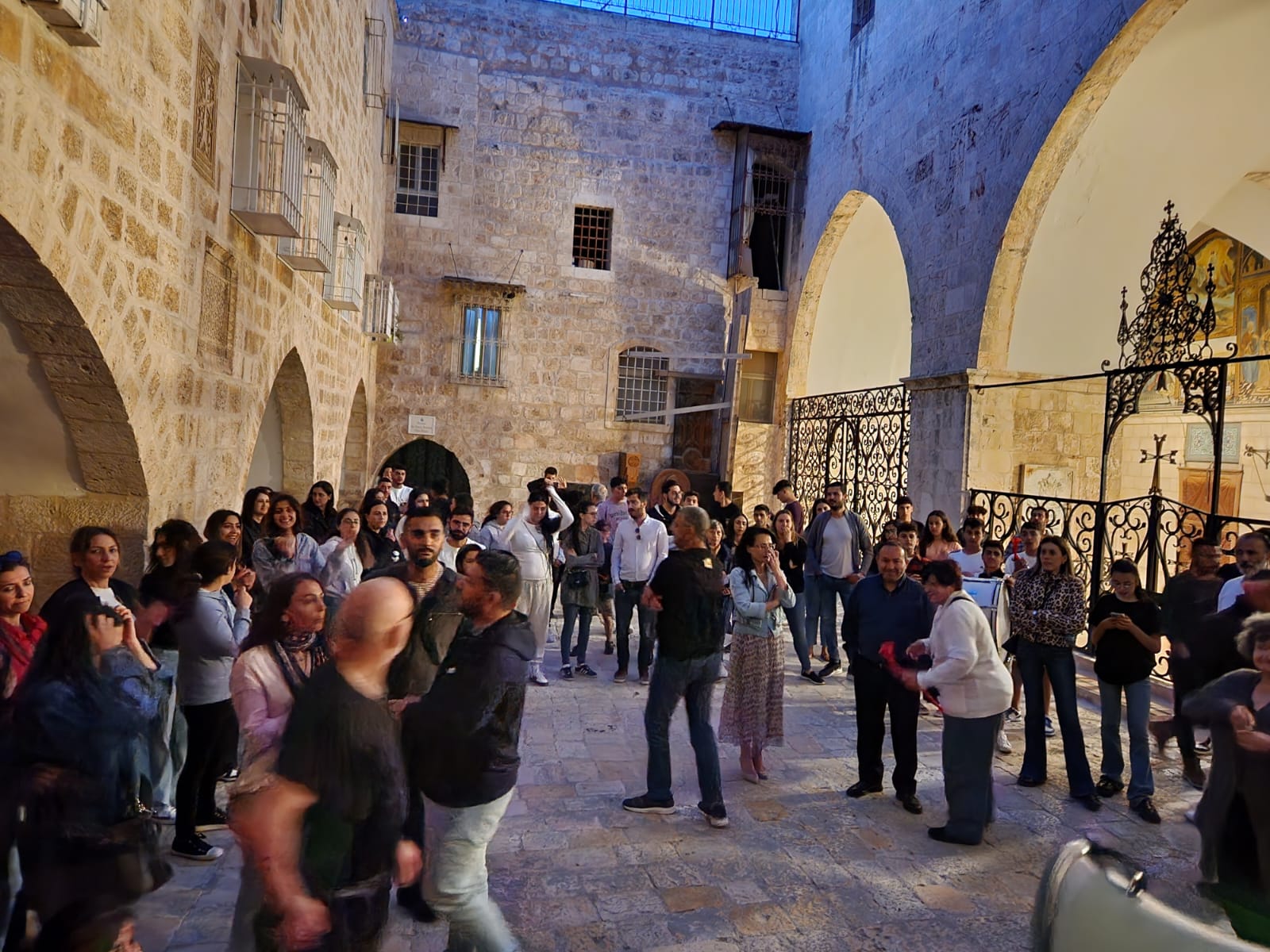
For 600 days, the Armenian community of Jerusalem has been struggling against a land deal that, as the Armenian Patriarchate put it, represents “the greatest existential threat in the history of the Armenian presence in the Holy Land.” They have fended off aggressors with automatic weapons, attack dogs, fence cutters and pepper-sprays—in what has now amounted to more than a dozen attacks on our beleaguered community.
Israel has turned a blind eye—if not, a complicit nod—to the attempted theft of the Cows’ Garden, a vital cultural heritage under the custodianship of the Armenian Patriarchate for more than 500 years. The illegal lease was brokered in the dark with, allegedly, a private settler-backed developer, blessed by nothing but intimidation, backroom signatures and the systemic disempowerment of a native Christian community.
And where is the Armenian ambassador?
Nowhere to be seen. Not even in rhetoric—and certainly not at the protests or during the attacks.
The ambassador, and more broadly, the entire apparatus of the Armenian Foreign Ministry, have not just failed in their duty to protect Armenian interests—they have betrayed them.
Mr. Akopyan stands in the presence of a state that arms those who would erase Armenians from their land, that denies the very genocide it should understand best and that threatens the Christian character of Jerusalem itself—and he offers no condemnation nor resistance, but reverence.
Courage—even political courage, which takes on a different form when exercised in service of one’s government and its directives abroad—is not rooted in personal preference, but in the responsibilities inherent to the office. It is a quality that always reveals itself in the face of risk and danger.
But I ask you, Mr. Ambassador: What do we call the absence of courage when there is no risk and no danger?



Armenia has no real means of pressuring Israel. It’s recognition of Palestine in 2024 is about as much as it can do, notwithstanding that Azerbaijan and Georgia did the same in 1992 with no consequences, was symbolic and genuinely seems to have surprised Israel who it seems thought Armenia would be holding out hope for better relations by not recognising Palestine and perhaps eventually the Armenians realised Israel was stringing them along in that regard. As for the Armenian genocide and despite the recognition by the USA that Armenia has given up on the issue. Whilst the holocaust seems onipotent. It’s not as simple as this in Europe people are fed up with the Jewish guilt tripping generational and demographic changes are accelerating this and within Israel itself it no longer bonds as in previous decades as demonstrated by the Hamas attack on 7 October 2023.
Yes, indeed. Thank you, Charles. However, in the end, realities and geopolitics often don’t seem to factor in. After all, much of this was set in motion by the Church, which made a deal with the devil out of sheer greed.
I clearly understood that there were only two choices for Artsakh, either voting to become a constituent republic of the Russian Federation or being foreceably taken by Azerbaijan. I even stated this to my late former wife’s first cousin, a top official at ANCA. Yes, a slippery slope as enosis with Russia for Artsakh could lead to Russia swallowing the Republic of Armenia. We Armenians should not operate in a dream world. When there is no vision, the people perish.
Thank you, Tigranaketsi. You are absolutely right: even before the people of Artsakh were driven from their homeland, its leadership acted as a satellite of Moscow, often working against Armenia’s new democratic elected government.
Right after the war, when Armenia was forced to withdraw some of its people from the border areas, the Artsakh authorities would not even take calls from Yerevan. When Pashinyan’s government sent soldiers and trucks anyway to help with the evacuations, Artsakh’s leadership refused their assistance, insisting instead on Russian troops (still believing they would protect them because a Russian general told them so)—even though Russia had just betrayed them during the war. And after accepting that help, they turned around and said, “See, the Russians helped us while Pashinyan didn’t lift a finger,” which I know firsthand from a trusted friend who was in the room at the time as part of Pashinyan’s staff.
These same people, together with the short-sighted “Bragrart” movement (all noise, no plan or vision), are now the loudest voices demanding Pashinyan’s resignation and threatening to storm Parliament—even though this government has been democratically elected twice, including immediately after the war. If they don’t like the government, there are always elections coming up. Why not put forward a credible candidate who isn’t disqualified from holding office, and who is not tied to Kocharyan or Sargsyan—leaders who, as polls and recent elections show, are widely rejected by Armenian citizens? For them, however, “democratically elected” doesn’t count; they would rather look to Moscow and the church to tell them what to do.
The Armenian Ambassador to Israel, Arman Akopian, is basically parroting the views of his boss Nikol Pashinyan, and refraining from upsetting the delicate relationship Pashinyan forged with Israel, and the Jewish lobby in The United States.
First week of February 2025, Pashinyan attended the International Religious Freedom gathering in the United States. He intentionally developed ties with a group known as “Zionist Evangelists” strongly supported by the Jewish lobby in The U.S. Followers of the group believe that certain cataclysmic events must be precipitated by humans to be ready for the second coming of Christ, which will happen in Israel. Thus the preservation of Israel is of utmost importance for “Zionist Evangelists.”
Beside promising Pashinyan access to the Trump Administration, “Zionist Evangelists” promised Pashinyan financial support, via the Jewish lobby, for his party and massive propaganda efforts to swing votes in Pashinyan’s favour during the June 2026 elections.
“Armenian Zionist Evangelists” (AZE) are convinced that Nikol’s re-election in 2026 will pave the way for a “Peace Treaty” with Azerbaijan and strengthen Israel’s position in the South Caucasus, while amplifying Mossad’s capabilities to gather intelligence on Iran’s vulnerabilities.
Many US evangelical groups have dispatched already activists to Armenia following Pashinyan’s US Visit. Now, unless the Armenian opposition takes draconian steps to neutralize the activities of “Zionist Evangelists” and all the other cults/sects operating under the brand of “Evangelism” the disaster of 2021 will repeat itself.
The message we need to reinforce is simple: Nikol is a bad tree who gave Armenia nothing but disasters since 2020. He must be banished from the political landscape of Armenia following the elections of June 2026 to prevent the total collapse of The Third Republic.
For more details read:
Can A Bad Tree Like Pashinyan Give Armenia Good Fruits?
https://artsakhtheinadequateresponse.blogspot.com/2025/07/can-bad-tree-like-pashinyan-give.html
Interesting I couldn’t find any credible sources indicating that Prime Minister Nikol Pashinyan specifically met with or cultivated relationships with a group called “Zionist Evangelists.” While he did attend the International Religious Freedom Summit and related events, there’s no documentation of him meeting such a group or receiving overt support from a Jewish lobby tied to that agenda.
During his February 3–7, 2025 working visit to the United States, Pashinyan participated in the 5th Annual International Religious Freedom Summit, the National Prayer Breakfast, and a reception organized by Save Armenia, which brings together Christian leaders and supporters of Armenia. These gatherings did not mention any particular affiliation with “Zionist Evangelists.”
He also met with Armenian-American community representatives, World Council of Churches–Vatican officials, and other Christian and civic leaders—but again no publicly available report ties these encounters to a Zionist Evangelist network or Jewish lobby.
In short: while Pashinyan did engage with a diverse array of religious and diaspora actors during that visit, there is no evidence he deliberately aligned himself with a Zionist Evangelical group or received backing from Jewish-affiliated funders.
This article—while emotionally charged and beautifully written in parts—is ultimately a melodramatic, self-righteous broadside that collapses under the weight of its own hyperbole. It doesn’t just critique Armenian diplomacy; it seeks to annihilate it with rhetorical napalm. But in doing so, it fails to offer a realistic alternative or even a coherent understanding of the delicate, often thankless work of diplomacy in a post-war, post-genocide, realpolitik-driven region.
Let’s closely review the article.
1. Romanticizing Martyrdom, Demonizing Diplomacy.
The author draws a false binary: heroism equals death on the battlefield; diplomacy equals cowardice. This is not just simplistic—it’s dangerous. The ambassador is accused of “submission with a polite smile” for engaging in standard diplomatic speech, but what exactly is the alternative being proposed? Public condemnation? Severing ties with Israel? Righteous fury? That’s not diplomacy—that’s theatrical self-immolation.
Armenia is a small, landlocked country with virtually no geopolitical leverage, surrounded by hostile or indifferent neighbors, and trying to recover from catastrophic losses. In that context, diplomatic restraint is not cowardice—it’s necessity. Vilifying a diplomat for not throwing verbal Molotovs on an Israeli podcast is as absurd as expecting a firefighter to take a flamethrower to a burning building.
2. Emotional Manipulation Masquerading as Argument.
The story of the wounded soldier digging through rubble is tragic. But using it as a blunt weapon against a diplomat is intellectually dishonest. The anecdote, powerful as it is, is a straw man—a rhetorical trap designed to make any act short of open defiance look like betrayal. Emotion is not policy. Trauma should be remembered and honored, yes—but not used to morally blackmail public servants working within the narrow, brutal confines of international relations.
3. The Genocide Recognition Straw Man.
The ambassador is lambasted for not pushing the issue of Armenian Genocide recognition. The reality? No Armenian official—especially in a junior diplomatic post—can force Israel to recognize the genocide. Israel’s refusal is rooted in its own complex geopolitical priorities, particularly its relationship with Turkey and Azerbaijan.
Criticizing the ambassador for acknowledging reality—that genocide recognition by Israel is unlikely in the short term—isn’t a critique. It’s wishful thinking disguised as principle. What is Akopyan supposed to do—storm out of interviews until the Knesset passes a resolution?
4. Selective Outrage and Omitted Context.
The article implies that Armenia’s ambassador is derelict in his duty because he hasn’t publicly joined protests about the Cows’ Garden controversy in Jerusalem. Yet it offers zero evidence that the ambassador hasn’t worked behind the scenes. Diplomats don’t always carry public protest signs—and they’re not supposed to.
Moreover, it ignores the risk of real consequences. If the Armenian ambassador did start publicly denouncing Israel over real estate disputes, it could derail the already tenuous relationship between the two countries. Would that help the Armenian community in Jerusalem—or just leave them more vulnerable?
5. Trade and Realpolitik.
The author scoffs at the low trade figures between Armenia and Israel as proof that the relationship is worthless. This shows a laughable misunderstanding of diplomacy. Small nations don’t build relationships solely on trade volume—they build them to hedge against isolation, to open future doors, to stay relevant in shifting alliances.
If Armenia can maintain channels with a technologically advanced, globally influential state like Israel—even after everything—it’s not “submission.” It’s long-term strategic thinking and alignment.
6. Reckless Absolutism.
At its core, this piece is a screed against moderation, compromise, and realism. It calls for moral absolutism in a world that rarely allows it. The ambassador is condemned not for doing something wrong, but for not being sufficiently angry in public. That’s a juvenile standard of leadership—better suited for Twitter activists than seasoned diplomats.
Final Thought: The Real Betrayal.
The article purports to defend Armenian dignity and honor. But in attacking its diplomats with such venom, it undermines Armenia’s real, hard-earned effort to maintain what little stability it can in the region. In calling for political kamikaze missions in the name of purity, it shows little understanding of how nations function and survive.
Courage is not always about confrontation. Sometimes, it’s about endurance, restraint, and facing criticism from your own people while quietly defending their interests. The real betrayal would be letting rage dictate strategy—because rage, however justified, doesn’t win wars. And it certainly doesn’t win peace.
Easy on the Chatgpt, buddy.