



Amid church disputes, let’s recenter on national security
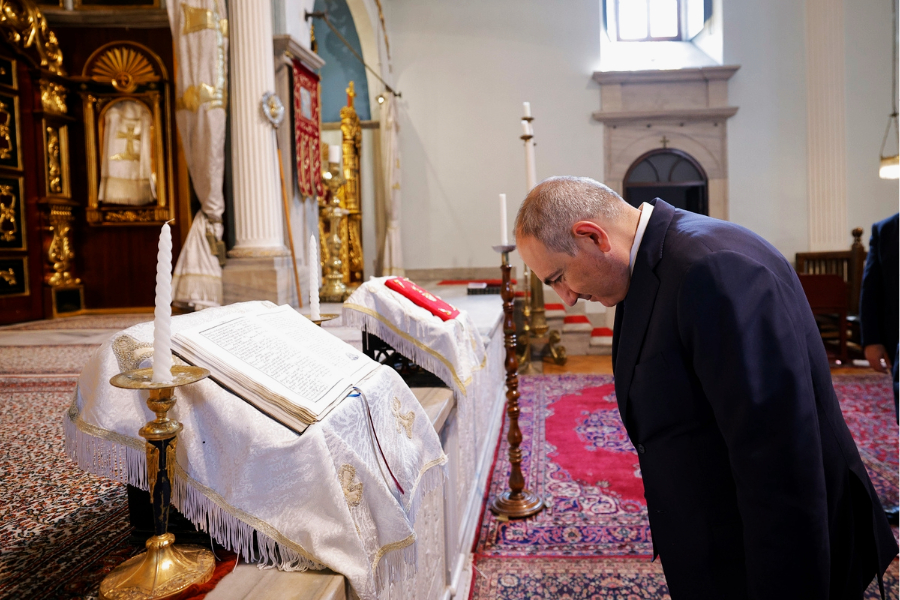
The Armenian nation, encompassing citizens of the Republic of Armenia and the Diaspora, has found itself in the middle of a conversation regarding the Church. This conversation has created a division between Armenians, as a people, and Prime Minister Nikol Pashinyan’s views. It is crucial to note that this church-state relationship has long not been at its best, especially when the Artsakh matter was still on Armenia’s political desk. Pashinyan’s vision of the church is widely seen as vulgar, while the church (as a sacred value) has become distinct from Pashinyan’s attack on values. But what are the citizens of Armenia and the Diaspora, collectively, trying to say about the prime minister’s rhetoric toward the church? Are we solely worried about the church, or are there similar critical values that we should aim to protect?
While Armenians can agree or disagree with Pashinyan’s rhetoric about the church, I suggest we revisit the “Real Armenia” ideological booklet presented by the prime minister. The ideological message included positive connotations, such as references to the motherland and Armenianness. The Pashinyan regime is attempting to re-make Armenia and Armenianness. The “Real Armenia” project is a morally driven message to Armenians to be aware of who they are, as humans, but it lacks references to nourish Armenian identity in terms of politics. While the element of the church was mentioned in Pashinyan’s newly framed view of a “Real Armenia,” the military was never mentioned—or, perhaps, emphasized as it should be. “Real Armenia” also gave an understanding of a strong state—here, the need for a military component should have been mentioned. Rather, the importance of a developed economy was defined as a key factor. I am not opposed to the idea of a developed economy. The very notion of a “Real Armenia” is not just a doctrine to serve statehood, but also a tool to conceptualize Armenianness. Economic development can be idealized for any state, but particularly for this ideological message, Armenians need something that speaks to their identity.
I emphasize a strong military—not to incite enmity in the South Caucasus, nor to escalate tensions between neighboring countries—but because Armenia is a state. It functions through the existence of the peoplehood of the territory, and the security of its people should be the key concept in ideological documents like “Real Armenia.” Throughout the years, Armenians, specifically Armenian citizens, have joined wars to defend their fellow people in Artsakh. Under the Pashinyan government, Armenia clearly has no intention to open the closed book of the fate of Armenians who faced exodus from their homes in Artsakh. Yet we still have an unaddressed, unguaranteed and carelessly neglected issue—the security of Armenians. This topic is not addressed on a daily basis in Armenian politics, and while a possible reconciliation between Armenia and Azerbaijan or attempts to join the EU might boost Armenia’s political image in the international arena, no such alliance or agreement will guarantee Armenian security, unless we equate a strong state with having well-formed security paradigms.
When discussing security, I refer to the safety of the Armenian people and the Republic of Armenia’s borders, territories and military—technical and strategic resources. Two topics serve as a starting point for crucial security discussions among the Armenian people.
Firstly, the border issue is always on the agenda—whether there is an active risk or not, Armenia still is not free of its problems. Secondly, there are the so-called peace talks with Azerbaijan. The case of border delimitation has its political and economic implications, but also touches on security. According to the government’s framing, the border delimitation will strengthen Armenia’s sovereignty.


Perhaps, in the short term, it will provide symbolic privileges—making a great mark on the region, ending years of conflict and paving the way for diplomatic relations—but in the long term, we cannot claim that it will provide absolute security for Armenia, or that a possible reconciliation will only impact Armenia positively.
The lessons learned from the forcibly expelled Artsakh Armenians and the long-lasting detention of figures like Ruben Vardanyan should be additional keys to a “Real Armenia,” as reminders of how to be vigilant as a nation. That being said, Armenia says it is fully committed to signing a treaty with Azerbaijan; meanwhile, Azerbaijan is reluctant to reciprocate, conditionalizing the document and framing Armenians as not trustworthy partners in peace.
As we debate the church, framing the peace treaty as the only hope for the development of the Republic of Armenia and the future of Armenians is another way of ignoring Armenia’s security. That single document may theoretically advocate for peace, but practically, no one should remain confident enough to devalue the military and security talks.
Honest talks with the public should not only include criticizing or supporting the church, or the way people practice their beliefs, but also relevant critical discussions on how state representatives are accountable for guaranteeing Armenians’ security. How has the state secured and taken necessary measures to protect its citizens?
It is the utmost privilege of the Armenian people to disagree or not with Pashinyan’s statements on the church and its role in the republic. Surely we can only call Armenia a democratic state when the people have free speech, are value-oriented and demand the right to be conscious of their Armenianness.
But while doing all this, Armenians should not simply engage in abstract topics, but also be included in complex matters that have a costly effect on the lives of the Armenian people and the validity of the state itself. Are we, as a group, weighing equal value and protection to security matters as much as we are weighing and protecting church affairs?

A self-proclaimed incompetent leader Pasha Pashin who is unable and unsuccessful to defend his country against foreign enemies, creates enemies within his countrymen, to further demoralize and enslave the nation.
And there are still many Armenians, who claim that Pashinyan is a democrat and a patriot(!), and they shamelessly continue to defend him, also a few here in the comment sections of Armenian Weekly. He is an autocrat and a traitor, pure and simple.
Dear Steve , your type of mentality ie ” calling 52% of Armenian citizen who have elected and support present government as shameless Armenian citizens whose elected country leader you call it traitor” is a dream for our close and distant enemies. your mentality makes an ordinary citizen of Armenia sad and disillusioned, I am compelled to say your type of mentality and similar ones ” from sea to sea Armenia ” , “death to Turkey until infinity” serves only the destruction of Armenian statehood
Great reflection on what’s going on. Hope to read more of Kyourk’s analyses. Pashinyan and his administration are truly doing a devastating job…
Dear Kyourk , It is encouraging to see what a young Armenian from diaspora, thinks about his/her ancestral homeland .
Kyuork It is universal belief that Armenia needs strong army, but question is what type of army ” should and can ” Armenia have , an army to fight Turkey with population of close to 100 million and a GDP of close to 1 trillion or Iran ?
How should Armenia protect against Azerbaijan, with much stronger economy, very valuable energy sources which is very much in demand for European countries and USA and and a brotherly ally such as Turkey ?
Kyourk look back on our last 100 year history and also last 30 years one, a fact is obvious , the salvation of Armenia will not come from our traditional parties leaderships , far from it, we should think from totally new angle. it seems you are very close to one of our traditional party. Don’t betrayal you dream