Do we envision a prosperous and thriving Christ-centered church that overcomes the obstacles of the diaspora, or are we embracing the status quo while waiting for assimilation and secularism to engulf us? There is very little that is static about being an Armenian Christian in the Western Hemisphere. Change is a constant, and the question centers on adaptation. Adaptation is a term most Armenians fear because it suggests losing something. Ironically, Armenians throughout their history have survived through adaptation.
With a history of conquest by others, our nation would not have survived without adjustments. The critical factor is not resisting change but understanding how to survive and benefit from it. For example, the Armenian Church is an ethnic denomination. The question before us is: How can the church thrive in the diaspora when intermarriage is significant?
Bringing the Good News of the Holy Gospels and salvation to believers remains the primary function of our church. If an increasing number of people in our community are intermarried, the actions of the church should reflect an embrace of all. Is it enough to offer transliterated copies of the Badarak, or is the challenge of welcoming non-Armenians more fundamental? An argument can be made that the working knowledge of the church is similar among non-Armenian congregants and those who are born Armenian. This strongly suggests that our educational processes should include adult education and become more substantive with each succeeding generation. We can either confront challenges or simply play victim to their impact. Identity is always a choice we make, consciously or unconsciously, in the diaspora.
Two weeks ago, this column was devoted to the impact of geographic dispersion and dilution on our churches in America. Prosperity and security have led many to move farther from many of our parishes. When combined with the impact of intermarriage, without strong identity programs, and secularism, it has had a negative impact on many parishes.
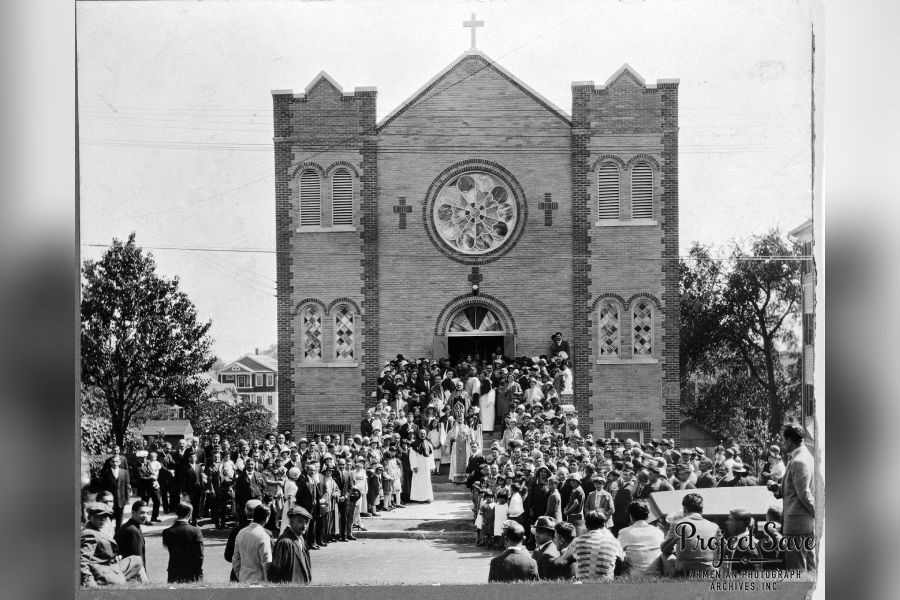
Historically, our churches in the Armenian Highlands were physically and behaviorally the center of the community. People walked to church, and it was the epicenter of community life. That model was initially successful in America when our churches began in neighborhoods heavily populated with Armenians. Our churches have been vibrant institutions, but they have one essential requirement of the faithful: You must go to the institution. Very few of the church’s many programs are offered outside its property. As it became more difficult for people to go to the church complex, especially during the week, one would expect an increase in remote programming to offset the geographic challenge. That has not been the case. There have been attempts at satellite Bible studies and youth programming, but by and large, activities are centered in the facilities.

Identity is always a choice we make, consciously or unconsciously, in the diaspora.
Many advocates and critics of this form of outreach point to the streaming Badarak offerings, which generally began during COVID-19, when public gatherings were constrained. Many churches have continued streaming services amid controversy. While streaming has significant value for those unable to travel or leave their homes, it has also been perceived as an excuse not to attend Badarak. Is this truly outreach, or is it creating unintended bad habits? If the church values the opportunity to reach our greater flock, then it must address how to connect with those unable to attend because of distance. Wedged between permanent parishes and mission parishes may be one of the answers to our struggles.
Streaming Badarak has significant limitations. For those unable to physically attend, it offers an opportunity to hear our beautiful Badarak and engage in group worship. However, the inability to partake in the Eucharist remains a limitation. I know many dedicated priests who address this issue through home visitations, offering Holy Communion to those unable to travel. The parish experience, however, goes beyond Sunday worship. What if we employed a hybrid model of outreach? How would this approach offset the impact of dispersion? It would use a model focused on both inward activity at the church center and methods that use technology and new ministries for true outreach.
I find it helpful to view the sustainability of the church and community in the diaspora as establishing and nurturing a foundation. Each generation that assumes responsibility is a product of the quality of home and communal engagement. The level of matriculation into community responsibility is, in large part, a reflection of how we raised that emerging generation.
The American diaspora has relied on immigration for several decades to replenish losses and remain vibrant. Many of those losses are a reflection of geographic patterns and other factors. Immigration fulfillment cannot be considered a long-term rescue. We have already experienced major migration from the Middle East, Baku and Yerevan. While immigrants will always be welcome, we must also confront the patterns of dispersion.
An area of major impact on parish life has been our Sunday and Armenian schools. These institutions are the major feeders for taking on responsibility as young adults. They are also a fairly accurate forecast of downstream activity levels in parishes.
According to reports from both the Prelacy and the Diocese, the trend in participation has been down for many years. Parishes that once had large, vibrant Sunday schools are operating with a fraction of that high-water mark. There are many causes, but generally irregular or no attendance is the biggest symptom. Tragically, more than a few parishes do not have parish schools. Our tolerance of this new reality is shocking. Most parishes have conducted surveys to understand this problem, and usually the largest deterrent is described as the church being too far away or conflicting activities on Sunday. We have a choice to consider.
We can begin innovative outreach models, or we can enjoy our front-row seat to decline. If a church once had 75 students a generation ago and now has barely 30 to 35, we can predict the impact on the community in 15 years, when the current students are establishing families of their own. We can blame economic patterns, apathy, assimilation or intermarriage while maintaining a victim posture, or we can choose to change our approach to serve the same goal: to bring our greater community in the diaspora into communion with our Lord for our salvation, according to the teachings of the Holy Armenian Apostolic Church.
One idea that has been discussed involves the use of technology to engage more students in our schools. Aside from lower registration in our Sunday schools, our schools are plagued with sporadic week-to-week attendance. This has a significant impact on the quality of education. An alternative approach would be to livestream classroom activity, allowing children in remote locations to join from their homes. The content and process could be adjusted for different grades. Our children today are comfortable with digital learning. Video learning and the use of other technologies are an integral part of their public education. Why not with their Christian Armenian education? Another option would be to record classroom lessons on Sundays and offer a replay on a YouTube channel for those unable to attend on a particular Sunday. Parents could participate with their children during the week in their homes. It would also contribute to more home-based Armenian Christian education, which has declined.
We can blame economic patterns, apathy, assimilation or intermarriage while maintaining a victim posture, or we can choose to change our approach to serve the same goal.
Instead of a classroom where inconsistent attendance affects the quality of teaching and learning, we would give ourselves the opportunity to increase overall attendance and quality. Animated content could be developed for lower grade levels. Just as children enjoy their favorite animated shows, they would tune in to watch animated programming teaching our heritage, language and faith. What would this require?
The first change would be to have the will to accept new ideas to address our struggles. In my view, this is the biggest obstacle. Most of our energy is devoted to welcoming people to the church facility. This is a noble concept and should not be abandoned but rather supplemented to address a changing reality. We also might find that as children become remotely engaged, they urge their parents to bring them to church more often. Funding for program content development would be significant but well within our means. The return on investment is our future. Strong leadership can easily overcome both matters. We should ask ourselves: How close to these issues are the authorities, both lay and clergy, in our church today?
A parallel effort could bring the word of our Lord to the greater community through Bible studies. In addition to local Bible studies and educational sessions in the church, we can host such programs on digital platforms such as Zoom or hold them in homes. These are not new ideas, but they need a more concerted effort for broader implementation. One concern is the limit of how much a single priest can accomplish. This is an opportunity for our deacons and even qualified laypeople to lead such efforts. In addition to directly leading these activities, our priests can empower small networks of others to increase capabilities.
In the diaspora, change is a constant in the challenge of sustainable identity. If our common purpose is to ensure our spiritual and ethnic identity, then we must embrace change and not resist it. Adaptation has been a hallmark of survival and regeneration among Armenians for centuries during periods of darkness. Knowing what can change to retain what is critical should always be our priority. Our methods may change, but our sense of purpose must remain intact.
We must embrace change and not resist it.