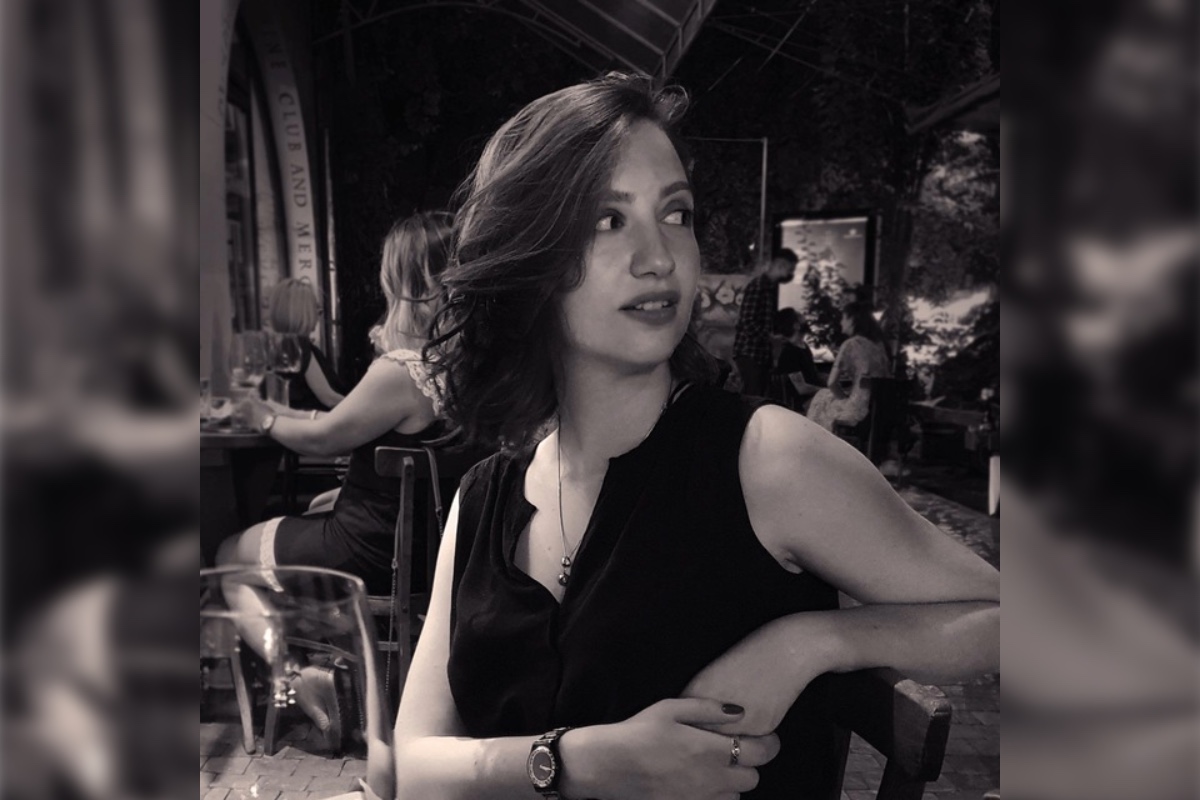
Art rarely follows a smooth and predictable path. It often requires exploration, courage to make tough decisions and the ability to sense one’s calling. Artist Diana Yeghikyan’s creative journey has been precisely that — full of zigzags, yet ultimately leading to self-discovery. Yeghikyan spoke with The Armenian Weekly about art, the vast world of animation and her inner creative impulses.
From biology to animation
For Yeghikyan, who was born and raised in Yerevan, painting and a love for beauty have been inseparable since childhood. Nevertheless, she did not initially consider painting as a profession. Her interest in science led her to the Faculty of Biology at Yerevan State University. However, the years spent at the TUMO Center for Creative Technologies proved to be pivotal.
Before turning 18, Yeghikyan met art specialists from the United States, Germany, and other countries at TUMO. By participating in numerous workshops, she realized that art is not merely a hobby but a major industry and a profession with immense potential. The knowledge and inspiration gained from TUMO became the turning point that prompted her decision after one year of studying at the Faculty of Biology to transfer to the National University of Architecture and Construction of Armenia.
Between two worlds
Yeghikyan’s creative language is multifaceted, encompassing environments, landscapes, as well as fine, delicate drawings with black pen on white paper. Speaking about her workflow, she emphasizes the stark difference between personal art and creating characters and environments in the field of animation.
In fine art, she says she is completely free: “I am free; I can draw what I want, what is important to me… It’s more about art and is open.”
In animation, her approach is different. Here, there are strictly defined requirements. “When I draw a specific character, I do it strictly for the job… For example, if I am drawing a character for a children’s cartoon, everything — the psychology, the colors, the shapes — must be thought out according to the audience,” she says.
In animated projects, Yeghikyan primarily works on creating locations, backgrounds and atmosphere. She pays close attention to light and color, as they directly dictate the mood of the scene: a sad script requires subdued tones, while a happy one demands brightness and warmth.
Path to her own exhibition
Yeghikyan’s art has already managed to achieve significant success. Her first group exhibition and competition took place in Berlin, where she won first place. This was followed by a series of group exhibitions in Armenia.
In May, Yeghikyan’s first solo exhibition titled “The Observer” took place at the Pyunik Development Center in Yerevan. This was an important milestone for her. She presented around 30 works executed in a wide variety of techniques: ink drawings, acrylics and digital art.
One of the central and symbolic works of the exhibition was the painting titled “7 Years of Silence.”
“Since I hadn’t been drawing by hand for a very long time — I was mostly painting in animation and video games — with this painting, the second phase of my hand drawing began, which is why it is very important to me,” she says. This work marked the beginning of a new phase of hand drawing in her creative life.
Future vision and mission
Yeghikyan is open to opinions and critique on her work. “I am always open to opinions; it is always interesting to see how people view things through their own prism,” she says.
Soon, she plans to expand her activities both in animation projects and in the educational field. Resuming the courses that were paused due to a lack of time is one of her priorities. She wants to once again pass on her experience and knowledge to younger artists, teaching them the art of character and environment creation.
As an Armenian creator, Yeghikyan proves through her work that contemporary Armenian art can align with global trends, competitive and at the same time deeply personal and original. She creates environments that tell stories, convey emotions and invite the audience to become not just viewers, but insightful observers.
You can follow Yeghikyan’s art on Instagram.


Dear Anzhela,
I just read your article in The Armenian Weekly, “From Biology to Animation: Diana Yeghikyan’s Universe of Color,” and wanted to congratulate you. I enjoyed the way you introduced the artist and her creative journey while giving readers a deeper understanding of the person and ideas behind the work.
Your article prompted me to reach out because I have just published a project that I thought might interest you.
Eternal Armenia: Khatchkars – The CrossStones of Noratus is the culmination of nearly three years of photography, research, writing, and design. It is a 264-page, large-format bilingual English-Armenian book featuring nearly 200 photographs, from sweeping panoramas of the ancient cemetery of Noratus to detailed studies of individual khatchkars.
Beyond the photography, the book explores the history of Christianity in Armenia, the evolution and symbolism of the khatchkar tradition, the master artisans who created these extraordinary stones, and the larger themes of faith, memory, identity, and cultural preservation.
The preservation aspect is particularly important to me. Following the deliberate destruction of the historic Armenian cemetery of Julfa and the loss of thousands of irreplaceable khatchkars, Noratus—home to the world’s largest surviving collection—has assumed even greater significance. Yet this extraordinary Armenian treasure remains surprisingly little known, even within our own community.
If the subject interests you, I would be delighted to send you a copy and would be honored if you might consider reviewing the book for The Armenian Weekly, or perhaps approaching the story in whatever way you find most compelling as a journalist.
I would very much value your perspective and hope to hear from you.
Warm regards,
David Karamian
Author & Photographer
davidkaramian@gmail.com