


The catastrophic 44-day war of 2020 and the subsequent 10-month blockade of Artsakh, culminating in the forced displacement and ethnic cleansing of its population in September 2023, stand as one of the most painful humanitarian crises of the 21st century. Yet, this tragedy did not end with the physical removal of the indigenous population from their ancestral lands. Today, Artsakh is undergoing a second phase of this process: cultural genocide. This is a state-sponsored policy aimed at erasing the traces of an entire civilization from the stage of history.
The thousands of monuments scattered across the mountains and gorges of Artsakh — monasteries, churches, fortresses and khachkars (cross-stones) spanning from the pagan era to the late Middle Ages — are not merely inanimate historical relics. They are the living, stone witnesses of Armenian identity, cultural philosophy and centuries-long presence. Every ornament on a khachkar and every foundation stone of a church bears the name and imprint of its creator: the Armenian peasant, prince and clergyman.
Today, with the region stripped of its indigenous Armenian community, these monuments stand defenseless and alone against a tide that seeks to strip them of their language, history and authorship. Stones cannot speak up for their rights, which is precisely why the Azerbaijani regime actively reattributes, alters or simply obliterates them. This article is an attempt to give voice to these silenced stone witnesses on the international stage, because silence in the face of cultural vandalism is equivalent to complicity.
The false thesis of “Albanization” and its refutation
To appropriate the Armenian historical and cultural heritage of Artsakh, Azerbaijan has fabricated the “Albanization” (Caucasian Albanian) thesis, advancing it at the state level. According to this narrative, all Christian monasteries and churches in Artsakh belong to a non-Armenian Caucasian Albanian state, which existed in the early Middle Ages, while claiming Armenians arrived in the region later and “Armenianized” them. This is done to legitimize the erasure of the Armenian cultural footprint in the eyes of the international community.
This concept is easily debunked by independent academic consensus and source-critical facts:
The ecclesiastical connection: As documented in primary sources like Movses Kaghankatvatsi’s “History of the Country of Albania and the Book of Armenian Canons” (Kanonagirk Hayots), from the early Middle Ages onward, the Church of Caucasian Albania functioned within the structural and hierarchical jurisdiction of the Armenian Apostolic Church as its northeastern see (the Catholicosate of Caucasian Albania). Its medieval liturgies, canons, church laws, and literature were in Armenian and adhered to the doctrinal theology of the Armenian Church. This organic historical synthesis is corroborated by modern academic scholarship, notably in the historical and geographical treatises of Robert H. Hewsen (“Armenia: A Historical Atlas”, 2001) and the specialized studies of Jean-Pierre Mahé (“L’Eglise albanaise et ses rapports avec l’Eglise arménienne,” in Revue des Études Arméniennes, 1996–1997), both of whom confirm that the Albanian Church operated for centuries as an integral, Armenian-led ecclesiastical subdivision.
Ethnic composition of the population: Classical historical sources — including the accounts of ancient Greek and Roman historians like Strabo, Pliny the Elder and Claudius Ptolemy, as well as later medieval Arabic geographical treatises — document that the indigenous tribes of Caucasian Albania lived north of the Kura River. Meanwhile, these primary sources confirm that the provinces of Artsakh and Utik, located south of the Kura, were integral parts of Greater Armenia (Mets Hayk) and were populated by Armenians. To place these dynamics in a precise historical timeframe, modern historical reconstructions, particularly by Hewsen (“The Meliks of Eastern Armenia,” 1972; “Armenia: A Historical Atlas”), demonstrate that since the Artaxiad period (beginning in the 2nd century BC), the Kura River served as the ethnic and political boundary between Armenia and Albania, meaning the right bank (Artsakh) was characterized by an overwhelmingly Armenian ethnic composition throughout the ancient and medieval periods.
The Udi argument: Today, Azerbaijan attempts to hand over the monasteries of Artsakh to the small Udi community living within its borders, presenting them as the direct descendants of the Caucasian Albanians. Historically, however, as documented in the systematic satellite monitoring and field reports of Caucasus Heritage Watch (CHW, “Special Report on Artsakh Heritage,” 2021-2024), the Udis never possessed a tradition of monumental stone architecture, khachkar art or written literature in the Mesropian alphabet on the scale found in Artsakh. Furthermore, linguistic and paleographic studies by Jost Gippert et al. (“The Caucasian Albanian Palimpsests of Mount Sinai,” Brepols, 2008) have proven that the Caucasian Albanian written language had completely ceased to exist as a literary medium by the 10th century. Consequently, objective architectural analyses demonstrate that the style, ornamentation, structural composition and internal logic of Artsakh’s monuments share nothing in common with the early Christian, Albanian brick or simple clay structures found within the actual historical, flatlands territory of Albania (located in modern-day northern Azerbaijan, north of the Kura). Instead, these monuments are documented by international experts as an organic and inseparable branch of the medieval Armenian school of architecture.
Epigraphy: Stone passports that cannot be forged

While historical narratives can be distorted through political rhetoric, history carved into stone cannot be erased without the physical destruction of the monument itself. In this regard, epigraphy (lapidary inscriptions) stands as the most undeniable, scientifically sound and material proof of Armenian authenticity, documented and analyzed through standardized academic methodologies in Armenian studies.
Epigraphy refers to the texts carved onto stone surfaces — church walls, lintels, columns and khachkars. Thousands of such inscriptions are documented across Artsakh, serving as unique “stone passports.”
Undeniable arguments and their significance:
Organic structural bond: As established by epigraphists and lithic conservation specialists, medieval inscriptions were generally carved during the construction process, directly onto the foundation stones or load-bearing blocks of the walls. Methodological corpora, specifically the monumental multi-volume series “Corpus of Armenian Inscriptions” (“Divan Hay Vimagrutyan,” volume 5: “Artsakh,” compiled by Suren Barkhudaryan and published by the Armenian SSR Academy of Sciences, 1982), demonstrate that these texts cannot simply be “added” centuries later or forged; the depth of the carving, the weathering patterns of the stone and the specific medieval masonry techniques correspond to the construction era of the building.
The linguistic argument: Azerbaijan’s geopolitical thesis claims that the monuments of Artsakh belong to a distinct, non-Armenian Caucasian Albanian heritage. However, this assertion is discredited by linguistic reality. As cataloged in the 5th volume of Barkhudaryan’s “Corpus of Armenian Inscriptions,” every surviving lapidary inscription in Artsakh, dating from the 5th to the 19th centuries, is written exclusively in the Armenian Mesropian script and in Classical Armenian (Grabar). Had these sanctuaries been built by a separate ethno-linguistic community independent of the Armenian cultural sphere, the epigraphic record would reflect that distinct identity; instead, the stones speak solely in Armenian.
“History carved into stone cannot be erased without the physical destruction of the monument itself.”
Factual Clarity: These inscriptions are not abstract texts. They are precise documentary evidence containing:
- Exact dates of construction or renovation calculated and recorded according to the medieval Armenian calendar system.
- Epigraphic records of prominent indigenous Armenian princely dynasties — including the Hasan-Jalalans of Khachen, the Dophyans of Tsar and the Proshians — alongside consecutive generations of Armenian clergymen.
- Explicit historical toponyms carved in stone that geography-wise and politically integrate Artsakh into the broader cultural landscape of Greater Armenia.
Azerbaijan’s state policy, which currently attempts to present the Christian monuments of Artsakh stripped of their Armenian identity, crashes directly into this epigraphic barrier. It is no coincidence that international monitoring missions, such as Caucasus Heritage Watch and various UNESCO-related appeals, have documented state-sponsored practices in the occupied territories where Azerbaijani crews prioritize scraping off, plastering over or mechanically erasing these Armenian inscriptions from monastic walls to eliminate the material epigraphic barrier. A stone inscribed with Mesropian script is a silent but irrefutable argument against any historical falsification.
Three symbols: Amaras, Dadivank, Gandzasar
Among the hundreds of monuments in Artsakh, three monastic complexes stand out as the spiritual, educational and political pillars of the region. Each encapsulates an entire era of Armenian history.
Amaras Monastery (4th Century): The cradle of Armenian literacy
As recorded by early medieval historians like Faustus Byzand and Movses Khorenatsi, Amaras stands as one of the oldest attested Armenian spiritual and educational centers. Founded in the early 4th century by Saint Gregory the Illuminator, who proclaimed Christianity as the state religion of Armenia, the complex securely houses the 5th-century underground mausoleum of his grandson, Saint Grigoris, preserved directly beneath the main altar of the church.
Historical fact: Immediately following the creation of the Armenian alphabet in the early 5th century, Saint Mesrop Mashtots established the very first Armenian school of the Artsakh region at Amaras Monastery, effectively launching the literary expansion and educational enlightenment throughout the Eastern Provinces of Armenia. This foundational event is documented in the primary 5th-century bio-bibliographical source “The Life of Mashtots” by Koryun (Chapter 15) — the earliest surviving work of Armenian literature — and its historical authenticity is fully supported by modern historiographical consensus, including Hewsen’s “Atlas.”
Architecture: While its foundations are late antique, the surviving architectural complex possesses a remarkable defensive layout. It is enclosed by high, regular rectangular fortified walls and reinforced corner towers constructed during its 18th-century reconstruction, perfectly embodying the late medieval tradition of Armenian monastery-fortresses.
“A stone inscribed with Mesropian script is a silent but irrefutable argument against any historical falsification.”
Dadivank Monastery (9th–13th Centuries): The monument of princely might
Situated on the left bank of the Tartar River, Dadivank (also known as Khutavank) is documented as one of the largest and architecturally complex monastic ensembles of medieval Armenia. Early Christian chronicles, notably Movses Kaghankatvatsi’s medieval history, indicate the monastery was founded over the grave of Saint Dadi, a disciple of Saint Thaddeus the Apostle. While the early apostolic origin is preserved as a sacred

traditional account, physical archaeological and architectural studies synthesized by regional experts, such as Samvel Karapetyan (“Dadivank Monastery,” in Research on Armenian Architecture, 2015), securely date the surviving fortified defensive structures, outer walls, and domestic chambers of the complex to the 18th-century revival period under the Armenian Melikdoms of Artsakh.
Historical fact: For centuries, the monastery served as the spiritual center and dynastic burial ground of one of Artsakh’s most powerful houses: the Vakhtangian–Hasan-Jalalian family of Khachen. As recorded in its extensive lapidary inscriptions, the main church of the complex, the Holy Cathedral (Surp Katoghike), was built in 1214 by Princess Arzukhatun in memory of her husband and sons, decorated by a high-relief sculpture on the eastern wall and a 19-line Armenian dedication inscription.
Architecture and khachkars: Dadivank is renowned for its two exceptional khachkars (1283) freestanding within the vaulted niches of the southern gallery. Art historians classify them as masterpieces of Armenian sculptural art, where the delicate, lace-like carvings and geometric motifs executed on tufa stone showcase the highest mastery of the medieval Armenian school of masonry.
Gandzasar Monastery (13th Century): The spiritual heart of Artsakh
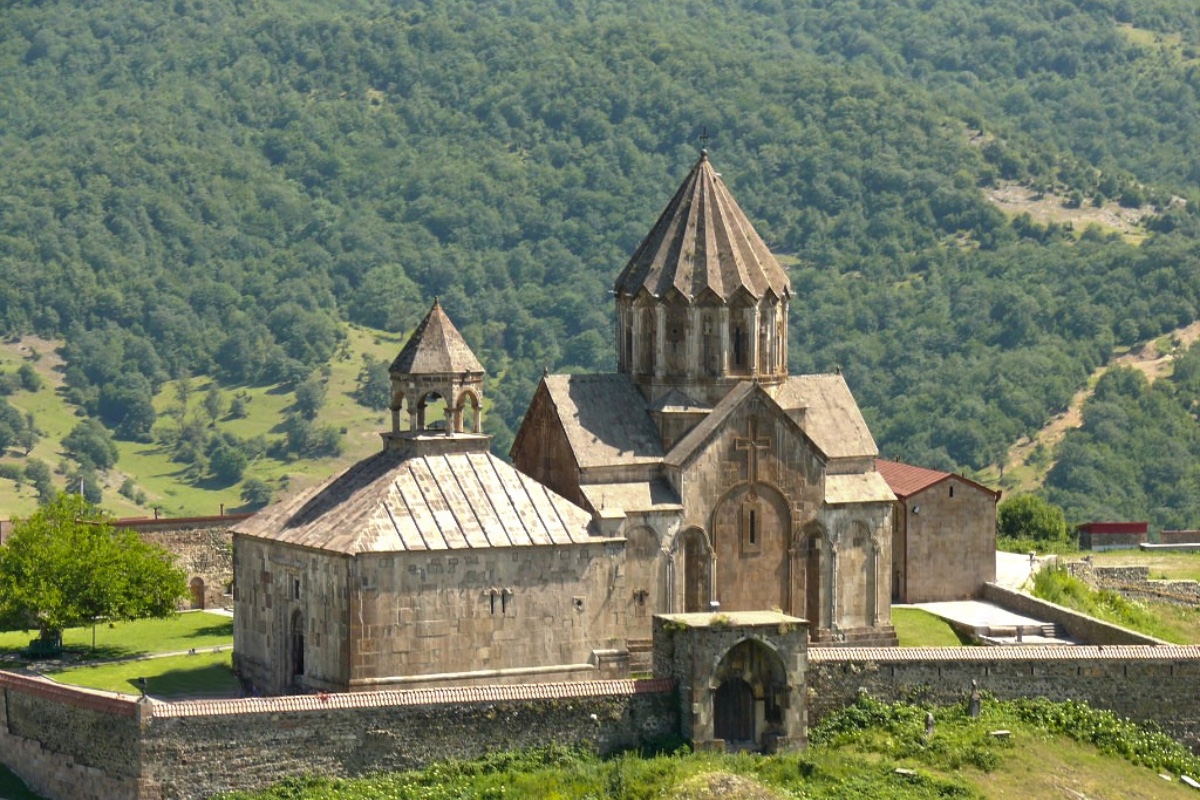
Perched atop a hill on the right bank of the Khachenaget River, Gandzasar represents the pinnacle of medieval Armenian architecture and stands as the primary historic-cultural symbol of Artsakh. From the 14th to the 19th centuries, it served as the see of the Armenian Catholicosate of Albania (Aghvank), remaining an integral part of the Mother See of Holy Etchmiadzin.
Historical fact: The main church of the monastery, the Cathedral of Saint John the Baptist (Surp Hovhannes Mkrtich), was built between 1216 and 1238 by Hasan-Jalalan Dawla, the grand prince of Central Khachen, who explicitly styles himself in the stone inscription as “Grand Prince of Artsakh and the Lands of Khachen.”
Architecture: The sixteen-sided drum of Gandzasar’s dome features exceptionally rich ornamentation, covered with high-reliefs depicting Adam and Eve, Christ and the monastery’s ktitors (the princes holding a model of the church in their hands). Architectural historians, notably Anatoly Yakobson (“Gandzasar,” 1987) and Patrick Donabédian (“The Arts of Armenia,” 1989), note that the umbrella-shaped roof of the dome and its compositional solutions directly mirror and build upon the architectural schools of Ani, the medieval cultural capital of Armenia and Hovhannavank in Aragatsotn, refuting any claims of a foreign origin.
The toolkit of cultural vandalism today
Following the ethnic cleansing of Artsakh, the process of erasing the Armenian historical presence has moved into a practical phase. The tactics employed by Azerbaijan are multi-layered; they encompass blatant physical destruction as well as architectural alterations carried out under the political guise of “restoration” — a process experts define as “white vandalism.”
How the destruction occurs:
- Altering domes and distorting architectural identity: To strip churches of their canonical Armenian architectural profile, structural changes are implemented. The most prominent example is the Holy Savior (Ghazanchetsots) Cathedral in Shushi, whose canonical pointed Armenian dome was removed under the pretext of “renovation” to give the building an alien, Russianized or “Albanian” appearance.
- Removal of crosses and eradication of icons: Christian crosses are systematically removed from the peaks of occupied monuments (as seen with Saint Elishe in Madaghis and dozens of other sanctuaries). Inside, frescoes and icons are scraped off or painted over. Most tragically, monuments have faced total physical demolition: the historic Kanach Zham Church (St. John the Baptist) in Shushi has been completely razed to the ground, its entire structure systematically demolished as documented by satellite imagery from Caucasus Heritage Watch, completely erasing its physical presence.
- Scraping inscriptions and smashing khachkars: Since stone inscriptions and khachkars cannot be reconciled with the false “Albanian” narrative, they are either mechanically ground off walls or completely smashed. Medieval cemeteries are frequently obliterated, often under the guise of road construction projects.

Photos of the Holy Savior (Ghazanchetsots) Cathedral in Shushi Before and after Azerbaijan’s takeover (Wikimedia Commons).
Gross violations of international law
Azerbaijan’s modus operandi is not merely a byproduct of localized conflict, but a direct violation of international commitments and humanitarian law:
- The 1954 Hague Convention: This convention for the Protection of Cultural Property in the Event of Armed Conflict and its protocols strictly prohibit any acts of vandalism, theft or alteration directed against cultural heritage.
- UNESCO declarations: The intentional destruction of cultural heritage is classified as an international crime. For years, Azerbaijan has blocked independent UNESCO fact-finding missions from entering the region to conceal its actions.
- The International Court of Justice (ICJ) ruling: On December 7, 2021, the UN International Court of Justice issued an order indicating provisional measures, legally obligating Azerbaijan to prevent and punish acts of vandalism and desecration affecting Armenian cultural heritage, including churches, monuments and cemeteries. The blatant disregard for this ruling by Baku stands as a direct challenge to the entire international legal system.
Silence is complicity
The protection of Artsakh’s historical and cultural monuments and the preservation of their authenticity has long ceased to be a solely Armenian concern. It is an urgent matter of preserving global Christian civilization and the shared cultural heritage of humanity. When a centuries-old cathedral is lost or distorted, the entirety of world culture is impoverished, dealing an irreversible blow to historical truth.
In the current information age, where physical access to Artsakh’s monuments is barred to native Armenians and independent international observers, the primary front of this struggle shifts to media, academic and diplomatic arenas. In this environment, the voices of international journalists, historians, archaeologists and the public at large become the sole shield capable of halting the machinery of vandalism.
The stone witnesses of Artsakh have been separated from their daily caretakers and protectors, yet they continue to speak through their foundation stones, inscriptions and carvings. Ensuring that this voice is not silenced, and that history is not rewritten for political gain, is our collective civic and moral duty. Indifference and silence in the face of cultural genocide are equivalent to complicity in the crime. We are obligated to speak out while the stones still stand, and before history is permanently rewritten.