


“Genocide continues where it meets no resistance”
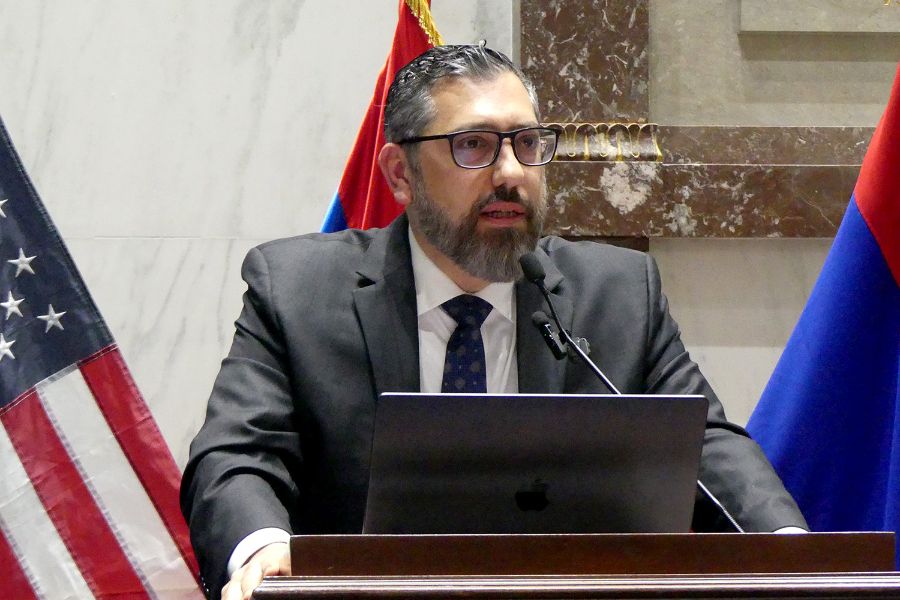
The following remarks were delivered by international human rights lawyer Karnig Kerkonian Esq. at the Capitol Hill Armenian Genocide Observance on April 15, 2026.
Leather pouches for water.
It was the second week of May 1915. My 12-year-old grandfather was in his father’s shoemaker shop in Aintab sewing leather pieces together to make pouches for water.
You see, for the previous several days, 100s and then 1000s of Armenian families from the town of Marash were being herded through Aintab southward, starving and thirsty – being deported, though they did not know this, to the Syrian desert.
The incident was lodged in my grandfather’s psyche forever. Leather pouches for water.
“It never occurred to us that we would be next,” he reflected a lifetime later. It never occurred to us that we would be next. A 12-year-old boy, soon to be orphaned, witnessing a heart-wrenching incident.
But genocide is not an incident. Genocide is a process. Genocide is an engineered process – and, when you are inside that process, it is only the incident that is visible to you, only the incident that consumes you.
When historians look back at this moment, however – this moment we are in right now – when they look back in 200 or 300 years, the incidents we are experiencing right now will be brief bullet points, a sentence perhaps, in one larger chapter in our people’s history.
There will be a direct line from the Hamidian Massacres in the late 1800s, to Adana in 1909, to 1915, to Shushi Massacres of the 1920s, to the pogroms in Istanbul in the 1950s, to Kirovabad to Sumgait to Baku in the 1980s and 90s – and yes, to Nagorno-Karabakh, just 932 days ago.
But that’s not all.
You see, the process is not done.
We are here commemorating 1915 as we are standing inside the ongoing genocidal process against the Armenian people – a process taking place right now.
Don’t take my word for it, listen to Erdogan himself. In 2020, he joined Aliyev at a military parade in Baku and – while praising the campaign of war crimes and atrocities his Turkish military executed with Azerbaijan against the Armenians of Nagorno-Karabakh – Erdogan openly praised Nuri Pasha.
Who is Nuri Pasha? He was the executioner of the eastern flank of the 1915 genocide. Erdogan said that, with military onslaught against Nagorno-Karabakh, the soul of Nuri Pasha was finally at peace.
But there’s more.
Just a few years later, and after ethnically cleansing the entire 4000-year-old indigenous Armenian population of Nagorno-Karabakh, Aliyev stood in front of a bonfire in Stepanakert and published, on X no less, his statement that, having eliminated the entire Armenian population, he was now burning away even the aura of the Armenians.
This is the lens by which the perpetrator understands the very moment we are in today.
You see, the complete ethnic cleansing of Nagorno-Karabakh was not an “incident.” It was a latest installment in an ongoing plan that has brought the complete annihilation of the Armenian state and the Armenian people to its final 25 miles.
More on those 25 miles in a minute.
This is the precise lens through which we must view the catastrophe unfolding. This is the precise lens through which we must assess every “incident” unfolding. We are not here simply commemorating the past. How can we be?
The persecution of the Armenian Church, today? The dismantling of Armenian institutions, today? The language of the Armenian constitution being dictated by the Baku regime, today?
Every incident, every single incident must be seen through the perpetrator’s lens.
Yes, even TRIPP. The marketing of TRIPP as some sort of “security” measure or some intricate “front office / back office” design is the side show. TRIPP exists because of one controlling reality: Azerbaijan refuses to acknowledge the actual sovereignty of Armenia. Aliyev has explained this on X himself: “Armenia is not even a colony, it is not even worthy of being a servant.”
Now, Aliyev cannot have Azerbaijani trucks stop at checkpoints manned by border guards of a state that Aliyev has repeatedly claimed is not a sovereign state. TRIPP solves this problem first. TRIPP is the end run. TRIPP is the compromise – the act of appeasement – so Aliyev does not have to acknowledge the de facto sovereignty of Armenia.
And so – without any legal safeguards or guardrails – TRIPP will evolve in due time to become the final 25 miles of the plan to choke the Armenian state. Without question, Armenian Americans will be blocked from investing in the controlling American interest in TRIPP. Those investments will be reserved, I assure you, for “private” interests – “private” investors aligned with Baku and Ankara.
Baku and Ankara do not hide their plans; they telegraph them. During the first months of the blockade, I met with EU representatives in Yerevan who “assured” me that the Azerbaijani Foreign Ministry had told them not to worry – that the removal of the Armenians from Nagorno-Karabakh would not be bloody. That they would be able to execute it with the blockade and then, when the people were on the brink, simply open the Lachin Corridor in one direction.
They are saying the quiet part out loud. This is not about economic opportunity; this is about a geostrategic final strike.
Today, the Azerbaijani army sits inside Armenian sovereign territory – land which Aliyev openly calls Western Azerbaijan. He works with the assistance of private companies to destroy Artsakh Armenian homes and to level Armenian churches.
And there is more coming, why wouldn’t there be? We ourselves have cleared the way for the process: the removal of the word “Artsakh” from the Armenian state’s vocabulary; the removal of the image of Mount Ararat from immigration stamps; the removal of Artsakh history from Armenian schoolbooks – and, sure, why not, direct flights from Los Angeles to Yerevan on Turkish Airlines.
Welcome, my compatriots, to the final stage.
We are not watching incidents. We are inside a living, ongoing process to destroy the Armenian people, their agency, their memory, their own sense of national identity.
This is gift of genocide.
And this is why the Artsakh Armenians’ right of return to their indigenous homeland matters so existentially right now – not just for the Artsakh Armenians, but for the rest of the Armenian people, indeed for the Armenian state itself.
Because the perpetrators of genocide do not stop at appeasement. This was the colossal lesson of the Second World War: perpetrators do not stop at appeasement. Perpetrators must be confronted.
Advocating for the right of return of the Artsakh Armenians is not merely a mechanism to secure a fundamental human right. It is an essential mechanism to obstruct the ongoing, relentless genocidal march made possible by every previous act of appeasement.
Forgo the right of return of the Artsakh people, and we will be demanding, in our very lifetimes, the right of Armenians to return to their homes in Syunik
The genocidal process marches on, more emboldened, indeed more reaching.
Azerbaijan has even attempted to thwart the Armenian community’s struggle in Jerusalem. Of course they have: the struggle of the Jerusalem Armenians exhibits the will to persevere, to assert, to remain. But Armenian perseverance and agency will not be tolerated by Azerbaijan – anywhere.
What interrupts the genocidal process is not hope, but resistance: clear, deliberate and unyielding.
The Artsakh people’s right of return to their indigenous homeland is the refusal to normalize genocide against our own people. We are not 12-year-old orphans in the desert. After all we have seen, we cannot say “we never thought it was going to happen to us,” to Syunik, to Meghri, to Yerevan.
History is long, and the voices, memories and narratives we insist on preserving are the ones that survive across that long history. And if genocide seeks to erase a people, then memory, resistance and return are how a people defeat that erasure over time.
Yes, this is difficult work. Of course, it is. Of course defeating genocide is difficult work. Genocide is rooted in unfathomable hate, uncompromising evil.
But what we carry matters. What we remember matters. What we understand matters. And what you do next matters.
We are the survivors of a people who were supposed to be eliminated. Today, we are advocates, activists, lawyers, politicians, diplomats. I say again, we are not orphans in the desert. We must stop burying our heads in the sand.
We have fought against denialism and brought the most powerful nations on earth to the truth. We have stood with our people, people whose entire histories were called “disputes.” We have stood in courtrooms, parliaments and congresses, archives and refugee centers, ruined monasteries—and felt, again and again, the presence of something that refuses to die.
This is not the time to waver.
Even if you do not live to see the return of the Artsakh Armenians, you are still responsible for it. Even if justice is deferred, you are not excused. Even if the world pretends not to see, you are still called to bear witness.
We do not get to choose the chapter in our long history we are born into, but we do get to choose what kind of ancestor we will become.
There is no future without brave people willing to carry the weight of what came before, without brave people willing to accept the challenge of their own moment.
You are each one of those brave people. You have each carried the weight of what came before and you have each risen to countless monumental challenges. But we are not done.
The existential moment of the Armenian people is upon us – and we are all standing together inside of it.
Genocide continues where it meets no resistance. And, if we are to be anything at all, we, together, must be that resistance.
Thank you.