The HomelandCulture

Redefining tradition: Yezidi activist Haje Bakoyan on women’s rights and community change
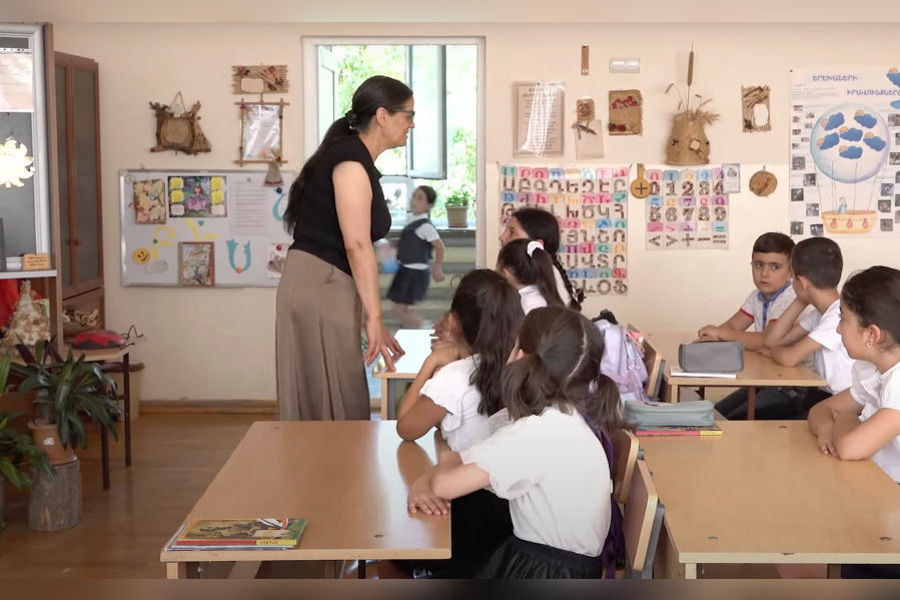
Haje Bakoyan is among the most visible advocates for women’s rights within Armenia’s Yezidi community. As the director of Shams Humanitarian NGO, her work challenges deeply rooted gender norms while resisting the notion that empowerment requires abandoning tradition. Instead, Bakoyan argues that change is possible by preserving what sustains the community and confronting what limits women’s freedom.

Bakoyan’s activism is rooted in personal experience. From an early age, she witnessed girls leaving school not because of a lack of ability, but because education was discouraged by family expectations and community norms.

“From childhood, I saw girls who didn’t continue studying simply because the family didn’t allow it, or because tradition stood in the way,” she told the Weekly.

She followed that same path herself. Bakoyan married young and initially did not pursue higher education. When she later attempted to resume her studies, she encountered resistance both within her family and her broader environment.

“Who would accept that an 18-year-old daughter-in-law would suddenly decide to study?” she said. “I constantly heard that a girl should marry early, and that intellectual work is not a woman’s role.”

Those experiences became a turning point. Bakoyan said she realized that silence only reinforces the cycle. “If I stayed quiet, the next girl would stay quiet, too,” she said. “I decided I had to speak — not to fight tradition itself, but to defend the values that make a woman strong and mentally free.”

Bakoyan believes change begins when someone refuses to accept imposed limits as inevitable. For Yezidi women, she identifies three foundations for independence: access to education, at least minimal family support and a community environment that does not punish women for ambition.

“If the family doesn’t stand in the way, the community will gradually start to accept you, to accept change,” she explained. “People respond to real examples — to success stories that are built day by day.”

She rejects the idea that women’s rights must come at the expense of tradition. In her own life, Bakoyan remains observant of Yezidi customs while maintaining firm boundaries around her autonomy.

Being strong doesn’t mean weakening the family,” she said. “That is unacceptable to me.”

This slideshow requires JavaScript.

Balancing activism with family life requires careful planning and support, particularly from her husband, whom she credits as a partner in her work.

“He always tells me that if one girl’s life changes because of my work, that’s also his victory,” she noted.

For her children, Bakoyan aims to model possibility rather than sacrifice. “I want to be a role model, not someone who gave everything up.”

The effects of her advocacy are already visible. Bakoyan says girls have approached her saying they decided to remain in school after seeing her example. Some, she added, have promised they will complete their education.

Beyond early marriage, Bakoyan identifies lack of self-confidence as one of the most damaging barriers facing Yezidi girls.

“For years, girls hear that their words don’t matter,” she stated. “Eventually, they stop believing in themselves. That affects everything: education, mental health and quality of life.”

She points to three main obstacles preventing Yezidi girls from pursuing higher education: fear of sending daughters far from home, often linked to concerns about safety; financial hardship; and rigid interpretations of tradition that deprioritize women’s education.

Still, she notes gradual progress. “Every year, more boys and girls are studying,” she pointed out. “That alone is significant.”

Haje Bakoyan delivers a presentation on the Shams Humanitarian NGO

Economic participation among Yezidi women is also increasing, though slowly. Many women face limited work experience, restrictions on working outside the home and the risks associated with entrepreneurship. Even so, Bakoyan notes a growing number of women engaged in small-scale businesses, particularly home-based production.

One of her most impactful initiatives was the program “Life Starts Anew After 40,” implemented in partnership with the Women’s Fund Armenia. The program targeted women who believed meaningful change was no longer possible for them.

“The goal was to give women a second breath,” Bakoyan explained.

Participants took part in professional trainings, mental health workshops and community projects. According to Bakoyan, several women went on to start small businesses, manage social media platforms and, most importantly, develop confidence in their own abilities.

“Traditions give us strength for centuries, but not all customs are eternal.”

This slideshow requires JavaScript.

Practices that threaten women’s safety, education or freedom, she argues, must be confronted. Traditions tied to faith, family, respect and communal unity, however, should be preserved. For Bakoyan, dialogue — not confrontation — is the only sustainable path forward.

She also stresses the absence of effective mechanisms to prevent early marriage and calls on the state to develop targeted educational programs for Yezidi women that emphasize opportunity alongside protection. 

This slideshow requires JavaScript.

Looking ahead, Bakoyan envisions the role of the Yezidi woman in 5-10 years as one where “women will have their own income, their voice will be heard and they will be more courageous.” 

“The future of the Yezidi woman is bright,” she added. She plans to continue expanding educational platforms where women can speak freely — and where tradition and progress are no longer treated as opposing forces.

All photos are courtesy of Haje Bakoyan unless otherwise noted.

Armik Grigoryan

Armik Grigoryan is a freelance journalist from Yerevan. She studied at the Department of Journalism at the Armenian State Pedagogical University. Grigoryan has deepened her knowledge through various educational programs, including a three-month course at Factor TV. She has also participated in more than 10 professional training sessions and completed internships at leading TV stations in Armenia. Currently, she works in TV. Grigoryan enjoys writing about social issues, human rights, culture and arts, as well as tourism.

Leave a Reply

Your email address will not be published. Required fields are marked *


Back to top button