




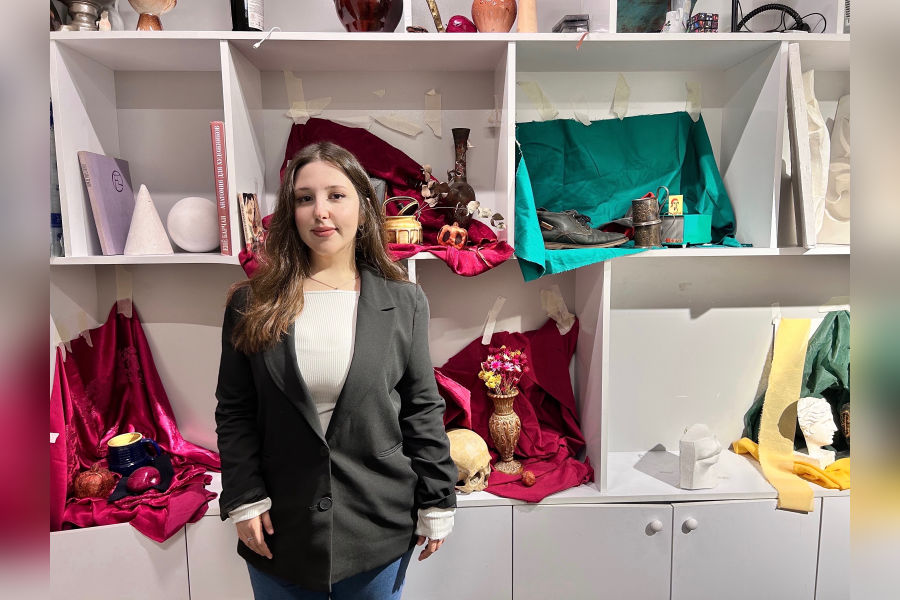
There are people whose fate, no matter how it twists and turns, ultimately brings them home. Years may take them far away — across countries, cities and shifting histories — yet the road itself remains constant. And then comes the day when the soul finds its way back to the native mountains, to Armenia. This return is not only to land, but to identity.
For artist Ani Meliksetyan, that return is marked by creative renewal and the quiet, profound moments of reconnection.
Roots and return
Meliksetyan was born in Vanadzor. When she was just 2.5 years old, her family moved to Russia in search of work, where she would spend most of her life.
“Although I lived my entire life in Russia, I always believed that one day I would return to Armenia,” Meliksetyan told the Weekly. “This happened thanks to my parents.”
When asked what homeland means to her, she did not hesitate.

“On a general level, it is the people, the nature, our language,” she said. “But on a very personal level, homeland is the home of my soul. Here, I am most honest with myself.”
In Armenia, she explained, emotions are not concealed. One can grieve openly and rejoice without restraint. In Russia, such freedom was not always possible.
Despite growing up abroad, Armenian was always preserved within the family. Meliksetyan credits her grandfather and father for insisting on the importance of language, teaching her not to forget her mother tongue, to keep it pure and to remain rooted.
Her family’s roots lie entirely in the Lori region, while stories passed down from her grandparents and great-grandparents trace back to Artsakh, specifically the village of Voskanapat.
Learning to see
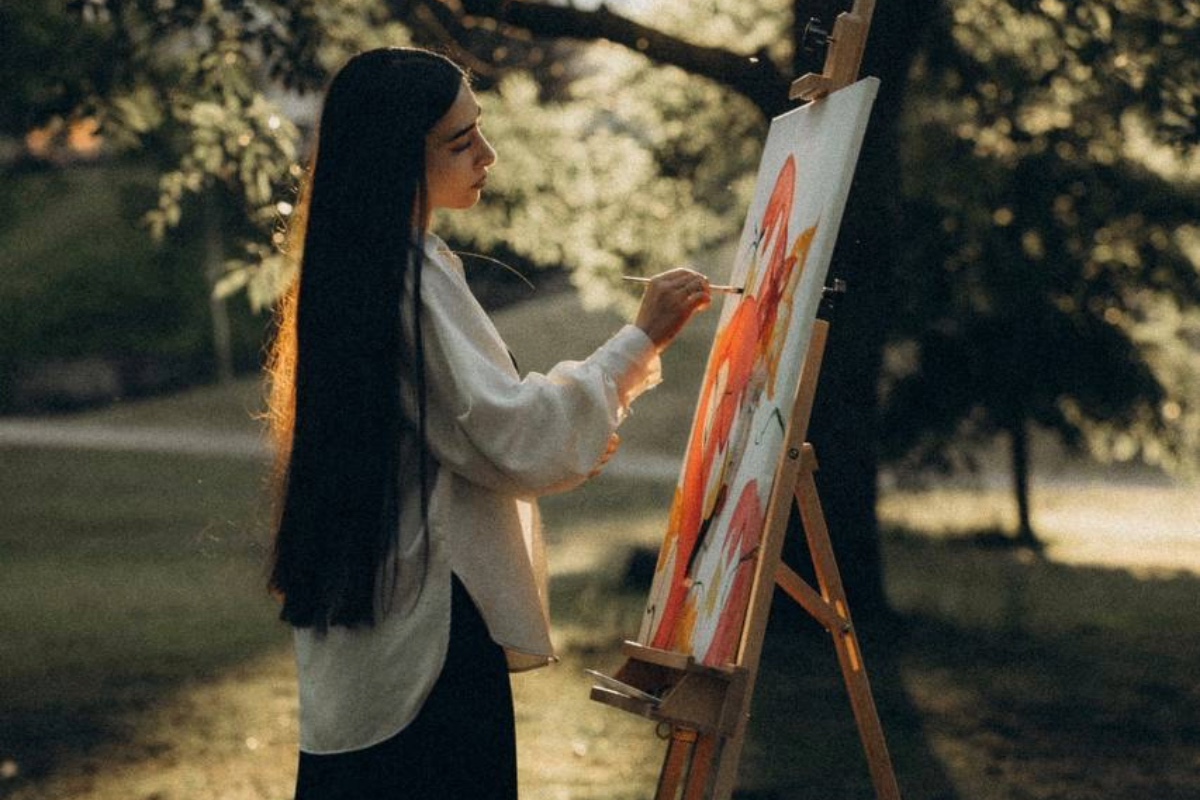
Meliksetyan has been creating art since childhood, but it became a conscious path when she learned not only to look, but to observe.
“What does the sky resemble? Whose gaze does the mountain hold?” she recalled. These childhood questions evolved into a way of seeing that would later shape her artistic practice.
Her formal education began at Ryazan Art School No. 1 in Russia, continued at the Wagner Art College and later at the Surikov State Academy of Fine Arts in Moscow.
In 2022, following the outbreak of the Russia-Ukraine war, her life shifted dramatically. Two years of academic pause and work eventually led to a decisive return to Armenia. Today, Meliksetyan studies in the painting department at the State Academy of Fine Arts of Armenia.

Painting memory and absence
All of the works Meliksetyan has created since returning reflect an inner rebirth.
“I marked the day of my return — Dec. 17 — in several paintings as a form of memory,” she explained.
That date appears in works such as Memory and Undeliverable Letter, part of a broader body of work rooted in absence, silence and recollection.
Meliksetyan often paints buildings — not as static objects, but as living witnesses.
“I am interested in painting spaces where life exists in concept, but no people are present,” she explained. “Through buildings, I convey that life once existed here.”
Many of these canvases depict partially ruined or cracked structures, reflecting her understanding of life not as perfection, but as transition. This sensibility inspired the title of her first solo exhibition, Silent Moment.
She is particularly drawn to Armenia’s color palette — deep greens, mountain tones and muted concrete shades — which recur throughout her work.
Her painting Silent Transition, depicting the door of the Geghard chapel, speaks of contemplation. “In a dark space, I try to find the light and reach it,” she said.
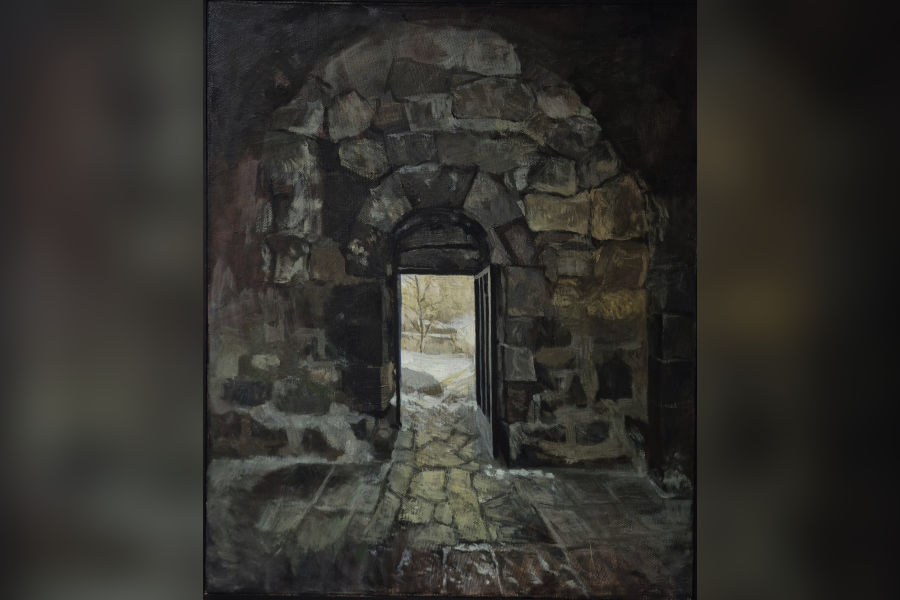
When asked, “What is faith?” she answered: “Faith is being honest with myself. It is love: the foundation of everything. Love drives us to create, to reveal, not to lose the light in the darkness.”
Toward the light
From Nov. 21–29, Meliksetyan held her first solo exhibition at the Pyunik Development Center (Buzand 3/1) in Yerevan. The exhibition featured works created in Armenia, centered on return, identity, silence and contemplation.
“I am part of nature. I do not separate myself from animals or plants,” she said. “I am part of this planet, but I am also Armenian. That is important for me to emphasize.”
When asked what inspires her, her answer was immediate: love — for people, nature and science — as a driving force to live, create and continue.
She also spoke warmly of her teachers, recalling a mathematics instructor who taught her not only the subject, but how to think and ask questions. She remembered her grandfather, Voskan Meliksetyan, a patriotic engineer and her closest childhood companion, who accompanied her to art school for years and became one of her most formative influences.
The exhibition featured approximately 18 to 19 paintings. The gallery’s serene white space was arranged by Meliksetyan together with her father. We spoke at length about dark tones, the struggle to bring light, and the motion created by contrasts. “I am not afraid of darkness,” she said. “I accept it because I try to add light there. This is my struggle.”
One particularly significant work is Road, a painting she reworked repeatedly.
“I worked on it for a long time, erased, repainted. It holds the pain of war, the paths of forcibly displaced people in Armenia, but also my personal fear of leaving Armenia one day.” The sky in the painting symbolizes hope — “light emerging from darkness.”
Meliksetyan finds meaning in small, easily overlooked details: an old electrical socket by a window, a drop of water on glass. “In these details,” she said, “life feels more present than in a perfect image.”
Ani Meliksetyan’s story is not only one of return, but of rediscovery. She came to Armenia as a person reclaiming her light, her linguistic roots and her inner path. In her paintings, buildings become biographies, silence becomes speech, darkness becomes inquiry and light becomes revelation.
And if an artist ever asks, “Where am I going?” Meliksetyan’s answer today is clear. She is moving toward the light — shaped by love, experience, pain, memory and homeland.

That journey has only just begun.
Meliksetyan’s artistic journey can be followed on Instagram at @meliksetyan__ani.
All photos are courtesy of Ani Meliksetyan unless otherwise noted.

Liebe Frau Sedrakyan,
vielen dank für diesen Artikel. Ich habe Ani im August beim kopieren eines Bildes im Historischen Museum in Jerewan kennengelernt. Ich danke Ihnen sehr für die Erläuterung zu ihrer Kunst. Sie hatte mir zum Licht schon etwas geschrieben, doch jetzt verstehe ich es besser.
Liebe Grüße Christian
Dear Christian,
Thank you for your message. It’s lovely to hear about your encounter with Ani in Yerevan last August. > I’m delighted that the article provided more clarity on her artistic style and her approach to light. Your appreciation for her work is greatly valued.
Sincerely,
Sedrakyan
Mr. Christian,
Thank you for your message. It’s lovely to hear about your encounter with Ani in Yerevan last August. > I’m delighted that the article provided more clarity on her artistic style and her approach to light. Your appreciation for her work is greatly valued.
Sincerely, Anzhela