



Armenia’s Church–State tensions need clarity, not conflict
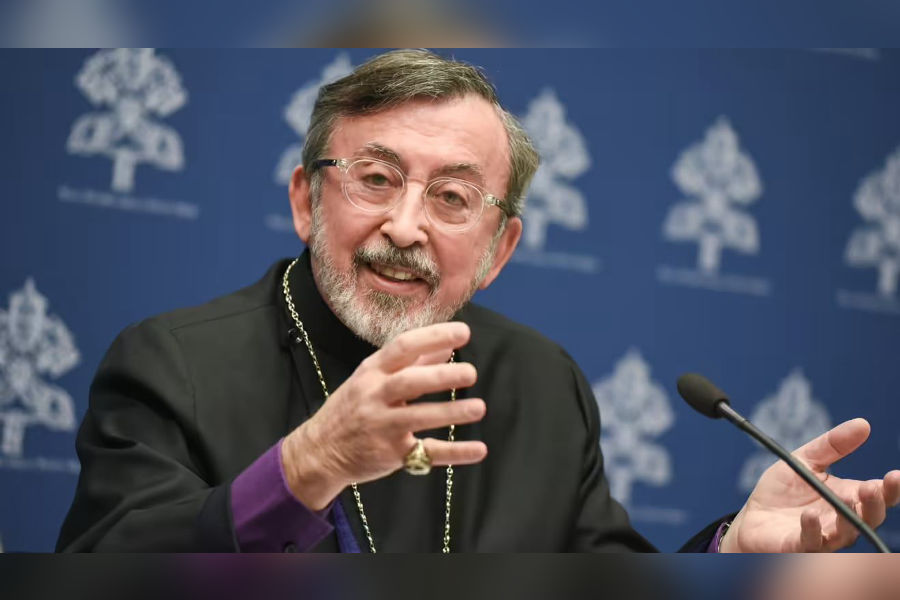
The Armenian people are living through a historic turning point. For the first time in centuries, we have an enduring and independent Republic of Armenia. Yet, roughly three-quarters of the Armenian Apostolic faithful live outside its borders, in a vast and diverse diaspora.
This new reality raises an urgent but often confused question: What is the proper role of the Armenian Apostolic Church, and what is the proper role of the state?
Armenian identity and Christian faith have been tightly woven together. Our medieval writers often spoke of God and homeland in the same breath. This bond helped Armenians survive foreign rule, genocide and dispersion.
But what helped us survive statelessness can easily create confusion in a modern republic.
Today, the Mother See of Holy Etchmiadzin stands on the territory of a sovereign Armenian state. The Catholicos of All Armenians resides in Armenia. Yet, most Armenians who look to Etchmiadzin as their spiritual home live abroad. Is the Church mainly the religious arm of the Republic of Armenia? Or is it a global spiritual body for Armenians everywhere, with a mission that cannot be reduced to any one state?
In the Catholic world, the Holy See (the Vatican) and the State of Italy eventually defined their relationship clearly in the Lateran Treaty of 1929: one is a spiritual center with a worldwide flock; the other is a nation-state with its own political responsibilities. Armenia faces a similar need for clarification, adapted to our own history and circumstances.
Such clarity begins with a few basic principles.
First, the Armenian Apostolic Church has a spiritual and moral mission, not a political one. Its core tasks are to preach the Gospel, celebrate the sacraments, form conscience, comfort the suffering and preserve Armenian Christian culture and memory. It has every right — and sometimes, the duty — to speak on moral questions that affect society: justice, corruption, dignity, war and peace, the protection of the weak. But it is not a political party and should not be turned into one.
Second, the Republic of Armenia is a secular state. That should not mean an anti-religious state. It means a government that serves all citizens — believers and non-believers, Apostolic and other — without imposing or enforcing a particular theology. The state must guarantee freedom of conscience, equality before the law and protection of human rights.
At the same time, a mature secularism can recognize the special historical role of the Armenian Apostolic Church in the life of the nation, and cooperate with it in areas like education, social services and cultural preservation — within clear legal boundaries.
Why, then, are tensions so high?
Part of the answer lies in expectations formed in another era. For centuries, when Armenia had no state, the Church often acted as the main organized Armenian institution: mediator, educator, protector, diplomat. Some still expect it to play that political role. Others, reacting against this, demand that the Church remain silent in all public matters. Both positions misunderstand the difference between partisan politics and moral witness.
Another part of the answer is politicization. In today’s heated atmosphere, political actors sometimes try to use Church symbols and language to advance their own agendas — or attack the Church to weaken their rivals. This harms both the Church’s spiritual credibility and the quality of democratic debate.
Finally, there is a gap between perspectives in Armenia and in the diaspora. For many in the diaspora, the Church is their primary national institution. For many inside Armenia, it is one institution among others, operating within a fragile and contested political environment. Without careful listening, these different experiences feed mutual frustration.
How do we move from confusion to clarity?
One path is to follow, in our own way, what other states and churches have done: publicly define the relationship between Church and State. That could mean:
- Reaffirming the independence of the Church in spiritual and internal matters
- Confirming the secular nature of the Republic and its neutrality toward all faiths
- Recognizing, in law, the unique historical and cultural role of the Armenian Apostolic Church
- Setting rules to prevent the misuse of Church structures for partisan purposes
- Creating regular, transparent channels of dialogue between State and Church leadership.
None of these alone would resolve all conflicts. Disagreements would remain — and they should, in a free society. But it would reduce the temptation to turn every dispute into an existential struggle between “old Armenia” and “new Armenia,” or between “religion” and “progress.”
In a time of serious national challenges — security threats, social hardship, mass emigration and unresolved trauma — Armenia needs both a competent state and a credible Church. The state must focus on justice, security and the material well-being of citizens. The Church must focus on faith, moral formation, hope and identity. They serve the same people, but in different ways.
Armenian Christianity has always combined patriotism and piety in a distinctive way. That heritage should not be a weapon in a power struggle. It should be a source of wisdom as we learn, perhaps for the first time, how to live as citizens of a modern republic and as heirs of an ancient Christian people.
Clarifying the respective roles of Church and State in Armenia will not diminish either institution. Done well, it will enable both to serve more honestly and more effectively, ensuring that neither political power nor spiritual authority is abused. In this way, the Armenian people — at home and throughout the diaspora — can face the future with clearer minds and steadier hearts. This important mission can be accomplished through a strong partnership amongst the leaders of Church and State, committed to a moral theory that safeguards the well-being of our people both in the homeland and in the diaspora.

Very well written and beautifull post. Thank you Srpazan Hayr, spoken with love and care!
t is sad to read Archbishop Barsamian’s assertion that “…the Armenian Apostolic Church has a spiritual and moral mission, not a political one. Its core tasks are to preach the Gospel, celebrate the sacraments, form conscience, comfort the suffering and preserve Armenian Christian culture and memory.“
With all due respect to Archbishop Barsamian, the dichotomy between the spiritual and the political has been imposed on humanity by a “Globalist” movement that has successfully argued with the power of money and control of social communication platforms, that spirituality belongs to the sphere of the individual while political activism is inherently a social endeavour focusing on the collective salvation of a nation within the temporal reality of our planet.
This “Globalist” dichotomy, wedded to “Relativism” and “Mindless Consumerism”, disregards the fact that GOD did not resign from the realities of our world and decided to retire in a Cathedral or a Monastery. The dichotomy rests heavily on the twisted logic that depicts our spirituality, our relationship to GOD as a bond with no impact on our social environment or the collective well-being of a nation. The dichotomy managed to convince us that “Politics” is strictly a secular struggle. Many Armenians fell in the trap and accepted the previous argument at face value, and the end result became very clear during the last three decades following independence; politics lost its moral matrix and purpose, and it became an arena where the rich and the powerful exploit the weak and the marginalized, not to advance the collective good but to glorify the exploits of megalomaniacs masquerading as popular political figures, or noble oligarchs claiming to have the best interest of the nation in heart and mind.
Globalism, relativism, and mindless consumerism succeeded with flying colours to debase the spiritual heritage of Armenia, the first country to adopt Christianity as a State religion, by creating for us a mighty earthly idol (The Mighty Green Dollar) that we are worshiping today because it has successfully turned politics into a matter of self-aggrandizement, self-expediency, and self-interest at the expense of the collective good. For more details consult the following article:
Open Letter To His Holiness Karekin II
https://artsakhtheinadequateresponse.blogspot.com/2022/04/open-letter-to-his-holiness-karekin-ii.html
Archbishop Barsamian is inviting us to respect the “Wisdom” of a leader (Nikol Pashinyan), theoretically heading a “Secular Democratic” government, but in practical reality committed to the goal of consolidating and imposing on a nation his personal obsession with power. Today, we have in Armenia a Prime Minister who shamelessly reinforces the clear notion that his authority cannot be the subject of any challenge. Almost four centuries ago (1655), France’s “Sun King” Louis XIV vehemently insisted that “I am the State, I am the Law”, to solidify the message that his monarchy is “Absolute” and no institution or individual will be allowed to challenge the “Divine Right” of the king.
At a press conference on August 28, Pashinyan echoed the words of Louis XIV by insisting “I am the government. No one can have any position that contradicts my position. This is the clearest proof of his dictatorial mindset, despite his constant claims of leading a democratic country.”
Source: Pashinyan’s government: Dismantling Armenia from within
Harut Sassounian – Armenian Weekly September 16, 2025
Armenia’s absolute ruler wants to create a “Real Armenia” with no spiritual heritage, with a citizenry focused on “Por Yev Pogh”-a stomach full of food and a pocket full of money. According to Pashinyan’s political agenda “God is dead, long live the new God of Armenia-the green mighty DOLLAR.”
Should we seek reconciliation with a “Secular” ruler determined to destroy the Armenian Apostolic Church and declare himself “The new Catholicos of All Armenians?
“Pashinyan may soon declare himself the new Catholicos of All Armenians”
Harut Sassounian Armenian Weekly December 17, 2025
Or should we remind Archbishop Barsamian that Christianism is a revolutionary religion that does not accept any form of appeasement of evil? I strongly believe that we should highlight to any concerned party that the spiritual, moral, and political revival of Armenia is a precondition for genuine freedom in a secular State such as Armenia. A freedom dedicated to the protection of the dignity of a nation. A freedom that rejects to worship the green mighty dollar. A freedom that refuses to cooperate with tyranny. A freedom that rejects to surrender Armenia to money merchants committed to destroy Armenia by undermining the very values that gave us a sense of purpose, a cohesion, and a spiritual heritage that kept us together during our worst moments of despair.
,
We need to remind Archbishop Barsamian that our Lord entrusted us with the sacred duty to resist and fight evil, especially an evil (Nikol Pashinyan) who destroyed the social fabric of the Armenian nation by driving a wedge between the Hayastantsi and the Artsakhtsi, between Hayastan and the Spurk (Diaspora), between the “Spiritual Armenia” we inherited from our ancestors and the “Real Armenia” he is trying to build in the image of Aliyev and Erdogan.
Nikol masterminded and implemented the “Engineered Defeat” of the 44-Day War. He sacrificed 5,000 brave Armenian soldiers to safeguard his political career.
In 2020, Nikol Pashinyan destroyed the Armenian Army, the shield of the nation, now he is working hard to obliterate the soul of the Armenian nation-The Armenian Apostolic Church.
For more details read:
“First He Destroyed the Army. Now Pashinyan Wants To Destroy The Armenian Apostolic Church”
https://artsakhtheinadequateresponse.blogspot.com/2025/06/first-he-destroyed-army-now-pashinyan.html
Our Lord Jesus, expects us to forgive sinners. But Nikol is not an ordinary sinner, he is the incarnation of evil in a human form. On April 26 2022, eight-month pregnant, 29-year-old Sona Mnatsakanian was rammed by the lead car of the motorcade escorting Pashinyan to an important meeting. None of the cars, including Pashinyan’s limousine made an attempt to stop and provide basic medical assistance to a human being in the clutches of death. Pashinyan continued his journey because he didn’t want to miss an important appointment.
Any person who had a chance to read Dr. M. Scott Peck’s masterpiece, “People of the Lie: The Hope for Healing Human Evil”, will confidently argue that there is a big difference between an evil heart and a sinner who errs simply because he/she is not perfect, and vulnerable to bad judgment calls.
Since 2018 Pashinyan has been deceiving a nation with no conscience, hurting others with no remorse, spinning outrageous fabrications to destroy the Armenian Apostolic Church, while pretending that he is simply seeking accountability and transparency.
None of us is a shining example of moral perfection. However, no sinner will allow the darkness of evil to control his heart, mind, and soul. All sinners feel guilt, and accordingly seek redemption. An evil person like Pashinyan is beyond redemption and salvation, simply because like all sociopaths he does not experience guilt.
According to the principles elaborated by Dr. Scott Peck, there are clear indicators that Pashinyan is no ordinary sinner. He is a person with an evil drive that animates his mind, and shapes his personality where you clearly discern;
a) A mind that twists the facts, misleads to avoid taking responsibility, denies reality, concocts preposterous stories, and withholds information.
b) If you scrutinize all the disasters he imposed on the Armenian nation from the 44-Day War to his recent assault on The Armenian Apostolic Church, and all the twisted words he used to justify his misdeeds, it is obvious that he is an expert at fooling others and a master of manipulation. Review his public speeches and his Facebook writings, and you will find that he never experienced the inner peace that comes only from “Divine Grace”.
c) Nikol is a populist sociopath who craves and struggles hard to maintain control and impose his will on an entire nation. He rejects feedback, real accountability, he refuses to listen to any form of constructive criticism, and the voice of The Lord does not have a place in his day-to-day reality because the Lord insists on repentance.
We do not have to collude in the name of UNITY, or in the name of a passive coexistence between a secular State and The Apostolic Church, with an evil person like Pashinyan. From the Old Testament we learned that “He who is kind to the cruel, will end up being cruel to the kind.” By tolerating Nikol we will expose future generations of Armenians to all kinds of cruelties that will be imposed on Armenia after he sells the land, piece by piece, to the enemy.
I myself, learned long time ago that “HEAVEN FAVOURS THE STRONG WHO IS JUST” not the one who invites others, in the name of love and “Unity” to reconcile and coexist with an evil like Pashinyan.