


The Syunik strategy: How four IMO medalists are driving regional transformation

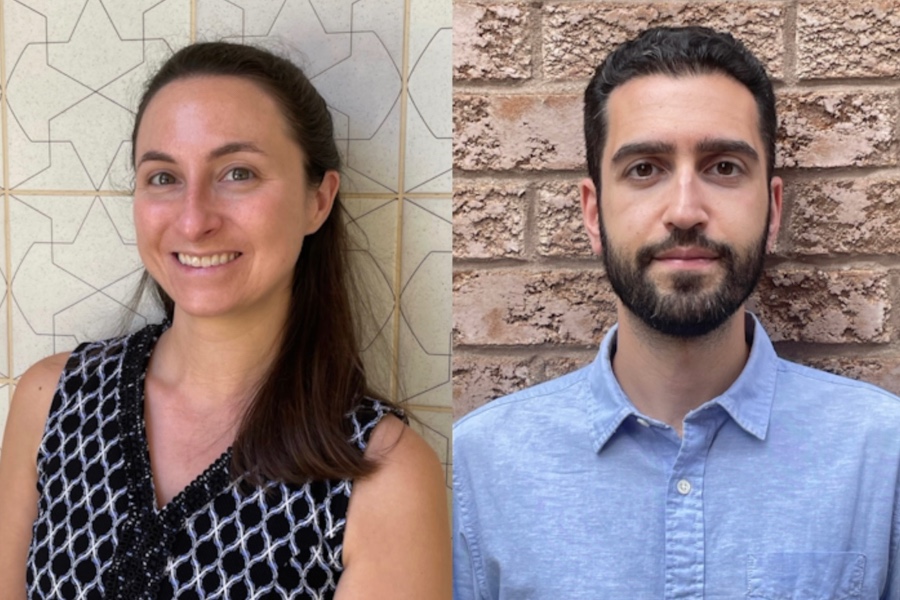
The Kapan Math Club (KMC) was founded in June 2020 by an entrepreneur and four International Mathematical Olympiad (IMO) medalists, a highly credentialed team committed to nurturing top-tier talent in Armenia’s regions. Headquartered in Syunik, the club has quickly become a hub for advanced mathematical education, focusing on developing the critical thinking and problem-solving skills needed to produce the nation’s next generation of scientists, engineers and entrepreneurs.
Co-founders Aleksandr Karalyan and Garik Avetisyan spoke with the Weekly about their unique hybrid teaching model, the reasoning behind their focus on Olympiad-level mathematics, their track record of student success at the national level and their vision for expanding their “human capital” investment model across Armenia and beyond. They detailed how a lean budget of $140,000 supports over 300 students and how their ultimate goal is to increase tenfold the number of innovators essential to the country’s long-term resilience.
This interview has been edited for length and clarity.
Milena Baghdasaryan (M.B.): Your website states KMC was founded in June 2020 by “an entrepreneur and four winners of the IMO.” That’s an impressive founding team. Can you tell us the story of that first meeting? Who is the entrepreneur, and why Kapan?

Aleksandr Karalyan (A.K.): The idea came to Garik Avetisyan, an entrepreneur from Kapan, who discovered that many of his startup’s successes were based on solutions developed by former Olympiad participants from STEM subjects. He decided to start Olympiad Math Clubs outside of Yerevan, in Syunik. Studying past Olympiad participants, we found strong evidence that they become brilliant scientists, engineers, software developers and entrepreneurs.

M.B.: Your teaching staff (Aleksandr, Gagik, Vahe, Lyov) are all IMO medalists. Why is it important that you are the ones teaching?
A.K.: That’s a good question. The school math program is built in a way that everybody, regardless of ability, can master it. However, for a gifted kid, the school program is very easy. That is why the International Math Olympiad (IMO) started in 1959, to give gifted kids the opportunity to learn more and to compete with each other. The Olympiad math program is harder than a regular school program, and the majority of school teachers don’t have the knowledge and skills to teach children in that manner.
When we started the program in 2020 with just 40 kids, we didn’t have trained teachers who could handle this material. However, as we gradually began to scale, we started enrolling local teachers. We currently have eight local teachers in Kapan, Goris and Sisian. Our IMO medalist teachers are working to develop the curriculum and provide training, enabling them to teach in the classroom.
The current setup is the following:
- Grades 5-8 Lessons are conducted offline with local teachers.
- Grades 9-12: Lessons are conducted online with IMO medalist teachers, covering material too advanced for regular school math teachers.
M.B.: How many lessons have you hosted to date, and what achievements have your students earned?
Garik Avetisyan (G.A.): For the 2025-26 educational year, we admitted 340 students; currently, we have 311 students. This reduction is because not all students continue, due to the complexity of the program. Since 2020, we’ve conducted more than 4,000 lessons, and our students have won 17 titles at the Republican Math Olympiad.
In Armenia, Olympiads are conducted in three stages: school level, marz (region) level and republican level (national). Students need to pass the school and marz levels to reach the republican level. For every class, there are first, second and third ranks of diplomas, as well as honorable mentions.
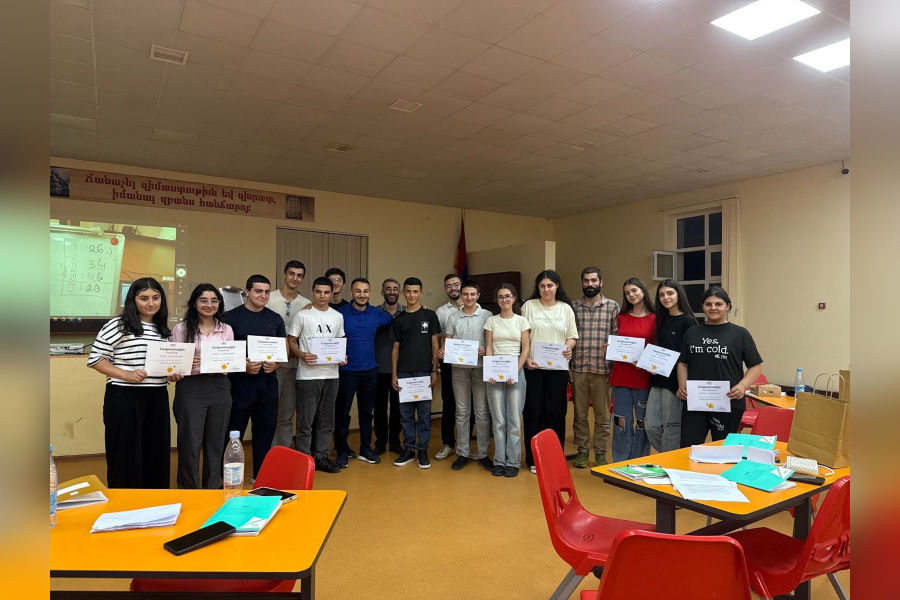
So far, our students have received 17 diplomas and honorable mentions at the Republican Math Olympiad. Students from grades 10-12 with diplomas get a chance to participate in the IMO selection process. Last year, two of our students participated but did not advance. Also last year, the Syunik marz outperformed all other marzes combined; only Shirak marz had one diploma/honorable mention. Currently, KMC is the biggest organization that trains Olympiad Math outside of Yerevan, both in terms of the number of students and results.
Our current yearly budget is $140,000; we have grown nearly three times in the number of students, and this growth necessitates an increase in the budget. We try to remain super lean. 95% of all our expenses are salaries; the teaching rooms are provided free of charge by the Syunik Regional Administration. Per-student cost changes from year to year due to salary growth for teachers and changes in administrative costs. So, the most accurate per-student cost is now approximately $420.
Our philosophy is the following: “We invest most of our funds into human capital. We don’t fundraise for construction or equipment.”
We have a very small admin team: two fundraising specialists, one SMM (social media marketing) manager, one video animator and 18 teaching staff. We don’t pay for office rents, as this is provided by the Syunik Regional Administration. We just have some subscription fees to pay for Zoom, website hosting and everything else is allocated to salaries. For a $100 donation, three students can learn for a month at KMC.

M.B.: You’ve evolved from an online-only model to a hybrid one, hiring four local teachers in August 2022 for on-site lessons in Kapan and Goris. How do you find and train these local teachers to meet your Olympiad-level standards?
G.A.: You are right; we are growing fast! Currently, there are eight local teachers. They pass a rigorous selection process via interviews, during which Aleksandr Karalyan, our co-founder and program coordinator, together with our IMO teachers, evaluates the future candidates’ math skills. If a teacher is selected, there are two meetings every week between the local teachers and the curriculum developer. First, he shares the program of the coming week, and then they meet to discuss solutions. As noted, the higher classes with the most difficult problem lessons are conducted by the IMO medalists.
M.B.: Your site says eighth and ninth graders are still online, while younger students are on-site. Why this split? Is the on-site component the long-term goal for all students?
A.K.: Initially, grades 8 and above were taught online, but with the gradual improvement of local teachers’ expertise, eighth grade is now being taught offline this year. From the ninth grade onward, there is a switch back to online learning, due to the greater complexity of the program in the higher classes. Older children also tend to lose less from the online format than younger ones.
M.B.: In addition to serving over 300 students, you also offer training for local math teachers. Are you seeing a “ripple effect,” where the overall quality of math education in Syunik’s public schools is improving?
A.K.: Most of our local teachers are also math teachers in regular public schools.
While we do not formally measure this, there should be a second order of magnitude of impact on a broader audience within the public school system.
M.B.: You have an internal competition called “Math Battle.” Can you explain what this entails, and how activities like it help foster a competitive, high-achieving spirit among students from Kapan, Goris and Sisian?
A.K.: Our program runs for 10 months, from August to the end of May and the beginning of June. Olympiads start in November, and the republican stage finishes in February, so to keep kids motivated, we conduct “Math Battle.” The good thing is that this is a team game where several teams of participants try to solve the problems together. It is not only about providing the answer but also about providing the proof.
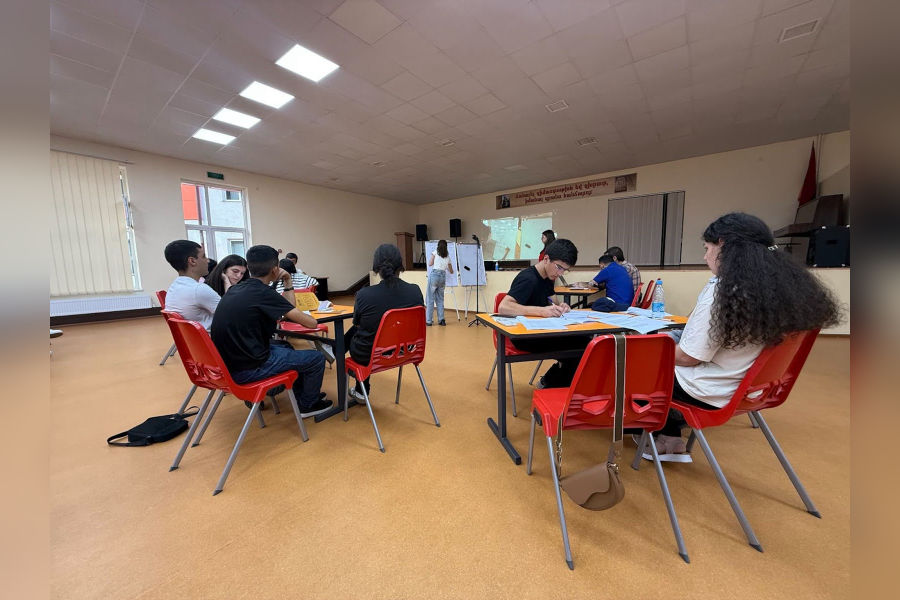
M.B.: Your 2025-2026 plan mentioned expanding to Meghri, organizing a summer school and producing 30 interactive video lessons. How is progress on these initiatives going, and what is your next major strategic goal?
G.A.: Our current goal is fundraising stability and preserving what we have, as keeping up with 311 students is challenging. If we secure an institutional donor, we would expand to Meghri, but for now, we need to preserve what we have.
M.B.: While your mission focuses on Syunik, your online model has the potential to break down geographic barriers. Right now, could a gifted child from Gyumri, Vanadzor or even Yerevan join your online classes? Is your ultimate vision to bridge Armenia’s educational divide, connecting Yerevan and the regions, and uniting the nation’s top math talent?
A.K.: Yes, students from other marzes have joined our online classes. The thing is that in higher classes, it is very difficult to catch up, and we also noticed that the online format is not effective for younger classes (fifth to seventh grade). That is why we start with offline lessons, and after several years, the kids who continue with the program transition to online learning. IMO medalists who can conduct the online lessons are scarce, but our plan is to expand gradually to other regions as well, provided we achieve enough financial stability.
If we estimate that 5-10% of all students are gifted in STEM, then there are over 264,000 middle school kids (fifth to ninth grades) outside of Yerevan. This means that there are 13,000-26,000 STEM-gifted kids who could become top-level scientists, engineers or entrepreneurs, but we lack the necessary environment. We have immense talent that could uplift the Armenian economy by billions of dollars. Imagine the future we could have if we fully realized the potential of our kids.

M.B.: For a reader in the diaspora who is inspired by your story, what is the single most urgent need you have right now?
G.A.: The single most urgent need we have right now is fundraising stability and securing long-term institutional support.
We started in 2020 and have successfully executed our initial plan. The impact of what we do will be visible in the long term; there is no immediate “nice ribbon to cut” or photo opportunity, but our work will have a significant impact on Syunik and Armenia in general. We do not know the challenges our kids will face in 20 years, but we are sure that Kapan Math Club students will have everything necessary to handle the complex problems they encounter.

Instead of memorizing formulas and techniques, our students are learning to deduce logical arguments, prove solutions and apply creativity to solve complex math problems. It is the best “gym for the brain.”
We are looking for friends who can help us. You can support us with monthly Patreon donations. If you want to have a bigger impact, please contact us directly to discuss a larger contribution.
M.B.: What’s your most ambitious goal?
G.A.: We try not to get too ahead of ourselves, but in general, we would like to spread the math clubs and, in the future, physics and biology clubs throughout Armenia and even throughout the diaspora. The ultimate goal is to multiply tenfold the number of extraordinary individuals capable of innovating at the intersection of science, engineering and entrepreneurship, thereby strengthening Armenia.