



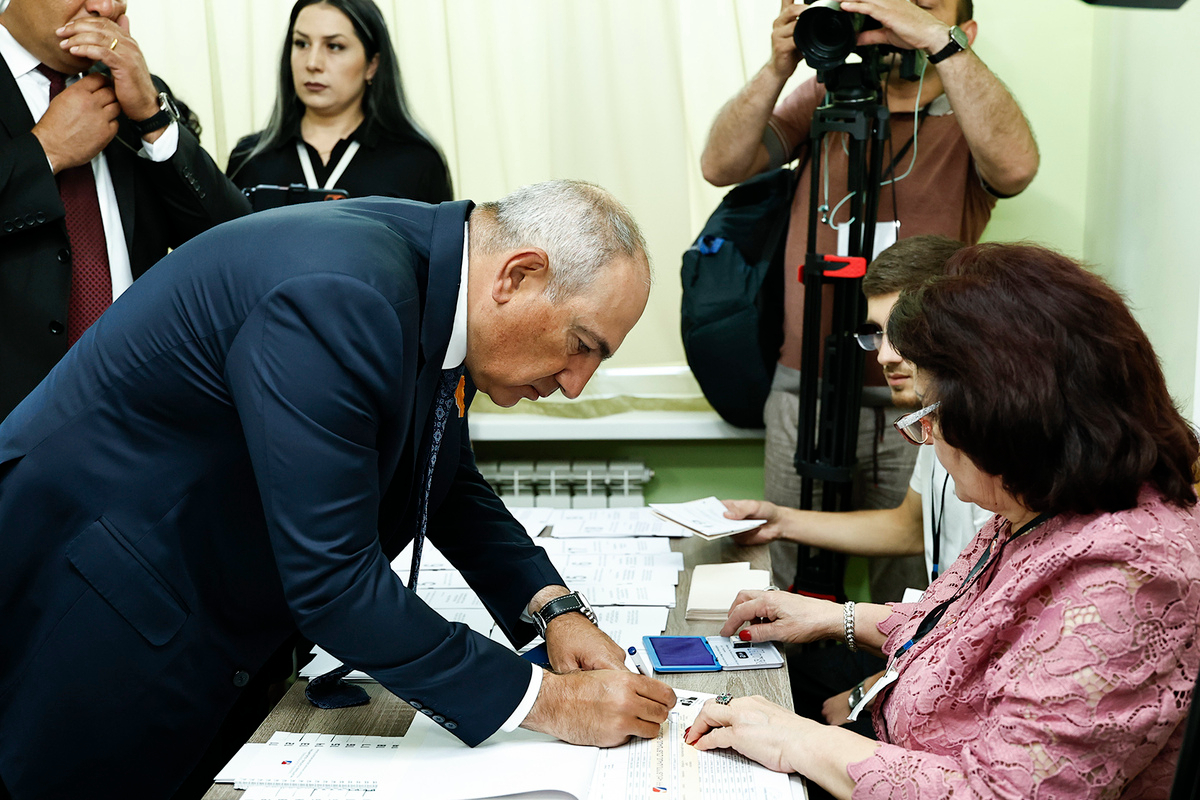
YEREVAN — The ruling Civil Contract party emerged with the largest share of votes in the Vagharshapat municipal elections, according to results released by Armenia’s Central Electoral Commission (CEC). The vote, held on November 16 across the newly consolidated Vagharshapat community in Armavir Province, saw Civil Contract candidate Argishti Mekhakyan receive 48.51% of ballots cast.
With all 47 precincts counted, Civil Contract received 15,298 votes (48.6%), ahead of the opposition “Victory” Alliance, which garnered 10,051 votes (31.8%). The national-democratic “Mother Armenia” party finished a distant third with 1,692 votes (5.4%), narrowly surpassing the electoral threshold.
Turnout reached 45.1%, with 31,535 of 69,924 eligible voters participating. Eight political forces competed, and six domestic observer organizations monitored the election process.
Civil Contract is expected to secure 19 of the 33 council seats, allowing the governing party to form an administration without coalition partners. The “Victory” Alliance is set to take 12 seats, while “Mother Armenia,” having crossed the threshold, is expected to receive the remaining two.
Opposition candidate Sevak Khachatryan did not concede, indicating that his alliance will take up its mandates to prevent the misuse of administrative resources.
A critical backdrop: The June territorial merger that reshaped the electoral map
The November 16 vote was the first municipal election after the government’s June 20 decision to merge the Khoy community — comprising 17 villages — into the Vagharshapat municipality, following the resignation of Vagharshapat mayor Diana Gasparyan in July.
Amendments to the laws on administrative-territorial division and local self-government consolidated Vagharshapat city (23 precincts), Voskehat village (2 precincts) and Khoy community (17 villages, 22 precincts) into a single, enlarged Vagharshapat community with 47 precincts.
At the time, political analysts warned that the consolidation would have significant electoral implications. Gohar Meloyan, executive director of the International Center for Parliamentary Development, described the merger as the election’s “Achilles’ heel”, noting that it fundamentally altered the voting landscape. Preliminary analyses appear to confirm the political impact.
In the original Vagharshapat territory alone, the combined opposition forces won 19,182 votes, with Civil Contract receiving 7,975 votes (41.5%) and the “Victory” Alliance 7,499 votes (39%). With the addition of Khoy’s 22 precincts, the ruling party’s share rose to 48.5%, while the opposition fell to 31.9% — a swing that effectively secured Civil Contract’s dominant position in the final tally.
The shift was especially pronounced in the Khoy area, where Mekhakyan, who previously served as Khoy’s mayor, maintains substantial local influence. In the 17 villages of former Khoy, he won 7,064 votes, compared with Khachatryan’s 2,552. By contrast, in Echmiadzin city proper, the margin was only a few hundred votes. CEC data reinforce the trend: more than half of Mekhakyan’s total votes originated from the former Vagharshapat area, but the decisive margin came from the newly merged villages.
The merger also altered the political configuration, with parties crossing the threshold. Without the Khoy precincts, as later analyses showed, five parties would have entered the council — not three — potentially neutralizing Civil Contract’s ability to form a unilateral majority and opening space for coalition bargaining.
The June consolidation, therefore, not only changed the geography of Vagharshapat but also dramatically reshaped its political landscape — an issue that is expected to dominate the discourse ahead of parliamentary elections in June 2026.
Election monitoring findings: Observers report “deliberate and unacceptable” violations
Allegations of widespread and intentional electoral violations cast a shadow over the November 16 vote, according to the “HayaQve” civic initiative.
Speaking at a press conference on November 18, the organization’s co-founder Avetik Chalabyan stated that the scale of irregularities during the municipal elections was “unacceptable and deliberate.”
The “HayaQve” mission, the largest observer delegation in the enlarged Vagharshapat community, deployed 123 observers across 47 polling stations, monitoring the pre-election and voting process from October 27 through election day.
Chalabyan stressed that the aggregated results obscure the distinct political preferences of Vagharshapat and the newly added Khoy cluster of 17 villages. While Khoy’s precincts favored Civil Contract and the “Victory” Alliance, Vagharshapat proper showed stronger support for Civil Contract and the Republic party — the latter ultimately failing to cross the threshold, largely due to Khoy’s vote distribution. These discrepancies, he argued, raise “serious questions about the justification” for merging two communities whose electorates demonstrate “such distinct political preferences.”
Chalabyan also criticized Prime Minister Nikol Pashinyan’s early congratulatory message to the Civil Contract candidate, issued before the results were finalized. He described the statement — which suggested that the election would also accelerate the resolution of matters within the Armenian Apostolic Church — as “strange and unconstitutional,” emphasizing that local government elections have no bearing on the Church’s internal processes and that none of the candidates had campaigned on ecclesiastical issues.
The monitoring mission, Chalabyan said, documented unprecedented violations, particularly in Khoy. These findings will be included in a forthcoming detailed report, as “mass interference with citizens’ right to vote” appeared intentional and had a tangible impact on the final outcome.
Among the most prominent issues were voter crowding and coordinated pressure, especially in rural areas. Groups of 30-40 middle-aged men were observed gathering near polling stations — in some cases, effectively blocking road access — and reportedly advising voters on how to cast their ballots. Although Armenian law prohibits gatherings within 50 meters of polling stations, Chalabyan argued that the placement of certain precincts made enforcement of this prohibition impossible. He also noted that current legislation imposes no specific penalties for such crowding.
While no direct cases of vote-buying were identified, he reported two incidents — now the subject of criminal investigations — involving attempts to influence voters “under the guise of charity” and through the distribution of valuable gifts.
Lessons learned: What the Vagharshapat vote reveals about Armenia’s political landscape
The results of the Vagharshapat municipal election prompted a wide-ranging reassessment among analysts and opposition figures regarding the state of Armenia’s political system, the balance of power and the strategic challenges ahead of the 2026 parliamentary elections. Two prominent voices — Ishkhan Saghatelyan, representative of the Armenian Revolutionary Federation’s Supreme Council and MP from the “Hayastan” Alliance, and Abraham Gasparyan, political analyst and founder of the Genesis Armenia think tank — offered detailed takeaways that highlight both structural issues and emerging political dynamics.
Saghatelyan underscored the significance of the approximately 15,000 voters (47%) who resisted what he described as government pressure and irregularities by casting their ballots for opposition forces, particularly the “Victory” Alliance, which secured around 32% of the vote. He also praised the political parties that chose to participate, arguing that they provided meaningful alternatives and carried out their share of responsibility despite the imbalance of resources.
Both Saghatelyan and Gasparyan stressed that the vote dispels the notion that the opposition is weak or irrelevant. Gasparyan noted that while Civil Contract secured a numerical advantage in the new council, the true strength of that majority will be tested in practice, especially in a city like Vagharshapat, where, he argued, voters have shown a persistent capacity to resist “empty propaganda, anti-Church rhetoric and ineffective governance.”
A recurring theme in Saghatelyan’s assessment is the ruling party’s concentrated use of administrative, institutional and organizational resources in a single community. He argued that Civil Contract’s votes represented just 21.8% of the total electorate, and that only because turnout was 45% did that translate into nearly 48.5% of counted ballots.
Both Saghatelyan and Gasparyan emphasized that higher voter turnout could significantly alter electoral outcomes. Gasparyan framed participation rates as a decisive variable capable of reshaping future political trajectories, noting that “people may remain silent in the streets, but that does not mean they will vote for the authorities.”
Saghatelyan identified vote fragmentation as one of the central structural obstacles facing opposition forces. Parties that fail to cross the electoral threshold, he argued, inadvertently “dilute the opposition electorate” and facilitate the continuation of the ruling party’s power. He called for strategic consolidation — whether through unified blocs, broader alliances or coordinated candidacies — to prevent wasted votes and to counter the ruling party’s systemic advantages.
Gasparyan offered a different but complementary diagnosis, suggesting that Civil Contract’s performance reflects less the strength of the party itself and more the “personal vote” attracted by its candidate, Argishti Mekhakyan — driven by social networks, local relationships and family name recognition. This, he argued, exposes the ruling party’s ongoing struggle to institutionalize itself as a coherent political force capable of consistently reproducing support at the local level, especially in urban communities.
Looking forward, Saghatelyan outlined three priorities that opposition forces must pursue if they hope to compete effectively in the 2026 national elections:
- Expand public engagement: Communicate the importance of electoral participation and work to ensure significantly higher turnout.
- Build protective mechanisms: Establish systems capable of reducing or counteracting the use of administrative resources, electoral violations and coercive pressures.
- Consolidate forces: Encourage smaller or at-risk opposition parties to coordinate, merge or form broader alliances to prevent further fragmentation.
Gasparyan echoed this call, urging “persistent, methodical work” rather than disillusionment. He argued that real political victories are built through “learning from setbacks and maintaining strategic discipline.”
Taken together, these analyses portray the Vagharshapat election as both a warning and an opportunity. For the opposition, it highlighted areas of resilience — significant voter support even under adverse conditions — as well as structural weaknesses that require urgent attention.
Both experts converge on one overarching conclusion: the lessons of Vagharshapat will shape the strategies, alliances and voter mobilization efforts leading into the pivotal 2026 parliamentary elections.


I am full of foreboding that Pashinyan is going to rig the June 2026 elections.
I hope Pashinyan’s patrons, the Turks and the Americans, undertand that Armenia will explode if he does.
What, exactly, is the point of Democracy when elections can be so easily rigged?
This outcome is both very suspicious and disturbing. When Pashinyan’s approval rating is so low (13% according to a poll conducted by the International Republican Institute (IRI) in June 2025), the outcome is obviously rigged. I don’t believe for a second that Pashinyan has somehow suddenly become popular in Vagharshapat and in Armenia – especially in Vagharshapat of all places, the seat of the Catholicos and of the Armenian Apostolic Church, who he is persecuting and wants to purge and control. This is an “outcome” that he plans to emulate in all of Armenia with the June 2026 elections. If he indeed “wins” the elections through vote rigging, an uprising will be the only and the last chance to depose him. If Pashinyan prevails and crushes all the opposition, Armenia’s downhill slide to dictatorship and puppet state status will materialize.