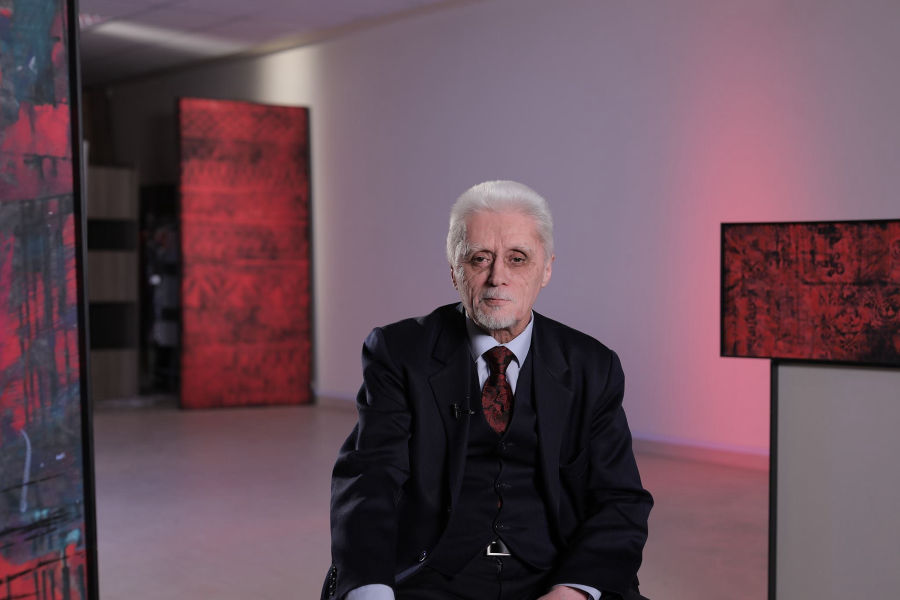


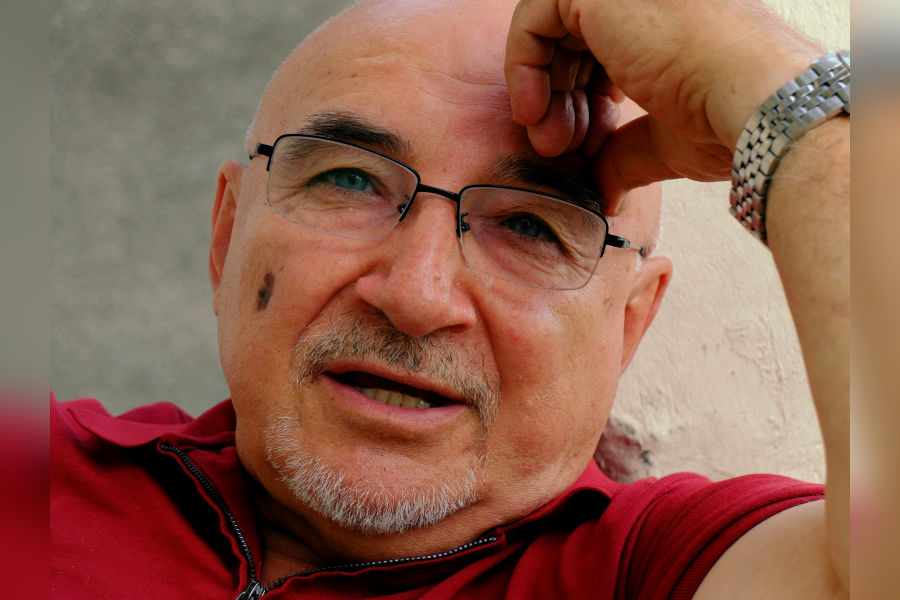
Kevork-George Kassabian is one of those rare individuals whose life seamlessly intertwines science and art, forming a mindset in which technology serves the spiritual and creativity fosters inner harmony. For him, creation is not merely a means of expression — it is a journey toward self-discovery and a way to perceive the world from new perspectives.
I met Kassabian in his Yerevan studio, greeted by his warm smile. The room was bathed in light, its walls adorned with masterfully woven lines and shapes. At the center sat an unfinished work — Vishapagorg (“Dragon Carpet”) — which seemed to symbolize the very nature of his art: always in motion, existing on the boundary between past and present.
I first attended his exhibition in 2023 and immediately sensed how deeply Armenian patterns and carpets had influenced him. In Kassabian’s work, these symbols carry a unique power: they are not merely aesthetic forms but echoes of memory and roots.
“I have always believed that people create not only for the things visible to the world but also for the emotions and energy they wish to share with others,” he explained.

Kassabian was born in Syria to an Armenian family and his childhood was immersed in a culturally diverse environment, blending Armenian traditions, Arab daily life and Western influences.
“Living among different cultures taught me to pay attention to details. Every flower, line or sound can teach you to see life through new eyes,” he recalled.
The Armenian community in Syria instilled in him a sense of identity. Stories from his grandparents — survivors of the genocide — became a source of inner strength, reminding him that being Armenian is not just about heritage, but also responsibility.
These early experiences shaped not only his sense of self but also the foundation of his creative philosophy. When he moved to Canada as a young adult, he encountered a new world: a new language, mindset and way of life. Yet, this experience shaped his worldview. He delved deeply, not only into art but also psychology, technology and the intersections between human emotion and creative expression.
“I have always felt that the human mind and emotion can complement each other. When they intersect, new ideas emerge,” he said.
Kassabian’s creative universe is built on the unity of contrasts. For him, art and science do not conflict — they are simply different languages of the same quest. “I cannot think of technology without human emotion. Similarly, art interests me only when it can connect with reality.”
In his work, simplicity never equates to superficiality. Every line, color or symbol carries its own inner energy. Armenian patterns and carpets serve as a bridge between tradition and innovation. He transforms ancient symbols into abstract forms.
“Art is a constant experiment to achieve balance. Every line, dot or plane carries thought and feeling. Art moves — both inward and outward,” Kassabian explained.
He believes technology should expand human creative potential. Kassabian works without boundaries, combining digital design with handcrafted techniques. “Creation happens when one is free. Giving freedom to the creative environment means creating a new culture,” he emphasized.
Kassabian’s philosophy naturally extends to his family life, which he describes as a cornerstone of his world: “Family should be the place where you are accepted as you are. That’s where self-confidence and creative energy come from.”
Married for several decades with two children, Kassabian and his wife relocated permanently to Armenia, later joined by their children. “I remember when they were little, they didn’t want to come to Armenia at first. But over time, they didn’t want to leave. That’s the connection I’ve always wanted them to have with the land,” he recalled with a smile.
In Kassabian’s family, art and values are passed down through conversation, experience and example. According to him, children should not be forced to love their homeland — they should simply be shown why it matters.
At the core of his philosophy is the growth of the individual, a principle that unites his creative and personal life. He believes that without self-awareness, neither art nor science can be fully realized.
“One must learn to listen to the inner voice, feel others and understand that creativity and knowledge should serve inner development and tolerance,” he said.
The word “balance” frequently appears in his discourse. For the artist, balance is not calmness but active movement toward self-reflection. “Mistakes are not failures; they are experiences. They show what is important, what is incomplete. Without making mistakes, you cannot understand where you are headed.”
For Kassabian, art is also a psychological process: a form of self-healing. He believes every creation is a dialogue between the artist and their inner world — sometimes silent, sometimes explosive, but always honest.
Kassabian’s creative journey extends beyond Armenia. His works have been exhibited internationally, and he has been exhibiting in Armenia since 2004.
His art often serves as a bridge between generations and cultures. “I want my work to inspire others — not to imitate me, but to find their own path. The important thing is to listen to your inner voice and create.”
Ultimately, his aim is for Armenian culture to be presented to the world not merely as a relic of the past, but as a living, contemporary system. “Armenian patterns are never old for me. They breathe in new forms, if we know how to listen to them.”
Kassabian’s words seem to encapsulate the message running through his entire career: art is a way of life, science is its language and the human being is the connecting force that brings everything into harmony.
For more information on the artist, please visit Kassabian’s website at https://georgekassabian.am/
All photos courtesy of Gevorg Asilyan unless otherwise noted.