



“Issues of the Armenian Genocide” course in schools: New approaches and experiments
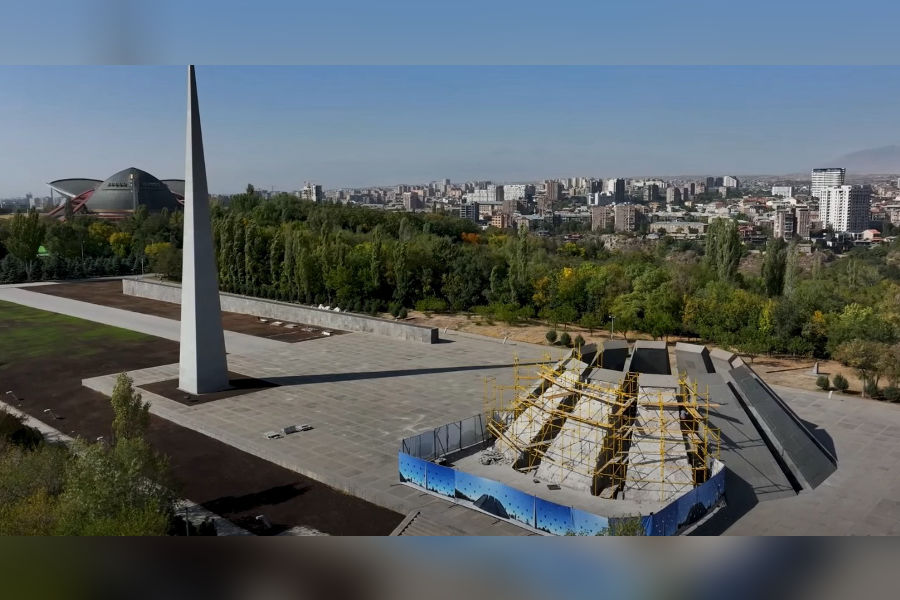
For many years, the Armenian Genocide was taught only in specific sections of the “History of Armenia” curriculum, using a conventional approach. Experts argue that the topic should be taught in a more systematic, in-depth and interactive way — one that not only impacts factual knowledge but also shapes national memory, civic responsibility and moral understanding.
Taking this need as a starting point, the Armenian Genocide Museum-Institute developed the “Issues of the Armenian Genocide” course curriculum, which was officially approved by the order of the Republic of Armenia’s Minister of Education, Science, Culture and Sports, Zhanna Andreasyan, on June 13, 2023. The program, designed for 11th-grade students, spans 68 hours over two semesters and includes a thematic plan, bibliography, exercises, discussions, images and recordings of survivors.
While designing the curriculum, the Museum-Institute considered observations from teachers who had participated in its educational programs in recent years. The goal is not only to provide teachers with materials but also to equip them to guide students in studying the Armenian Genocide in a clear, comprehensive and effective way.
Implementation in schools
At its first stage, the “Issues of the Armenian Genocide” course was piloted in only two schools: Voskepar Secondary School in the Tavush region and Talin Secondary School in the Aragatsotn region. The program has yet to expand to additional schools.
In a conversation with the Weekly, Armenian Genocide Museum-Institute Director Edita Gzoyan noted that the lack of methodological and educational resources has been the main obstacle to wider implementation:
“We initially developed the curriculum and provided teachers with extensive literature, but the entire responsibility for building the lessons remained on them,” she explained. “Considering their workload, that created certain difficulties. We are now preparing a methodological guide that will include ready-made lessons, exercises, discussion topics, images and survivors’ recordings. Our goal is for teachers to teach the subject more confidently and freely,” Gzoyan continued.
In recent years, the Museum-Institute has also organized summer schools for teachers. This year was their seventh summer school. “At first, we focused on providing new knowledge, but now, since the subject is already officially available in schools, our goal is to make the teaching process easier and more stimulating,” the director emphasized.

According to Gzoyan, although the ministry’s decision made the course available in schools, psychological and methodological professional support remains essential for effective implementation. That is why the Museum-Institute collaborates with educational foundations: “We prepare the scientific part — the texts — and our partners help develop the methodology and psychological approaches for working with students,” she explained.
Gzoyan is convinced that interest in the topic grows year by year, as students from Yerevan and other regions regularly participate in the Museum-Institute’s educational programs.
“We have even held online lectures for distant regions and consistently receive positive feedback from both students and teachers,” she stated.
Voskepar School’s experience
In the border village of Voskepar, Tavush, history teacher Gayane Siradeghyan has taught grades 5 through 12 for over a decade. In 2023, she introduced the “Issues of the Armenian Genocide” course at her school.
Siradeghyan recalled that it all started with a summer camp: “I saw the announcement for the Armenian Genocide Museum-Institute’s summer camp on Facebook. I applied, was accepted and attended the three-day program. There, I saw that the course had already been implemented in the Talin School. I thought, Why shouldn’t we have the same in our school?”
After returning to the village, she spoke with the school administration, which approved the initiative. The school sent an official letter to the regional governor’s office and, by autumn, the first class was underway.
During lessons, Siradeghyan uses films, academic materials and resources provided by the Museum-Institute. She says that these resources help students stay focused, especially when the topic feels heavy. Sometimes, she pauses films or lectures to ask questions to ensure that everyone is following along. To make the lessons more interactive, she occasionally organizes small debates, noting that even quieter students participate, gaining confidence and seeing the topic from different points of view.
“At first, it was difficult because there was no teacher’s manual, and I had to prepare every lesson myself. It was very time-consuming. Now, we are waiting for the methodological guide, which will contain ready-made lessons and discussion topics.”
Siradeghyan noticed that her students have become more curious and active, asking more questions and connecting past events to present-day issues. “When I see that they are engaged and actively participating in discussions, I know that the topic is reaching them.”
She believes that the course helps students understand the causes and consequences of the genocide, compare it with other nations’ histories and examine human rights issues from a broader perspective. The forthcoming methodological guides will allow teachers to present the material more effectively and comprehensively.
Siradeghyan also emphasized that the program — created collaboratively with teachers — enables students to systematically study the Armenian Genocide, grasp its causes and consequences and develop awareness for preventing similar injustices in the future by considering human rights and historical justice from a broader perspective.
Broader impact
The “Issues of the Armenian Genocide” course not only provides students with historical knowledge but also fosters national identity and civic responsibility. The program integrates traditional textbooks with new methodological approaches, interactive materials and survivors’ stories, giving students a deeper and more complete understanding of the genocide.
This initiative is significant, not only from an educational perspective, but also from a cultural and social one. It helps preserve memory, supports teachers in delivering the material and shapes students’ thoughtful engagement with both past and present events.