



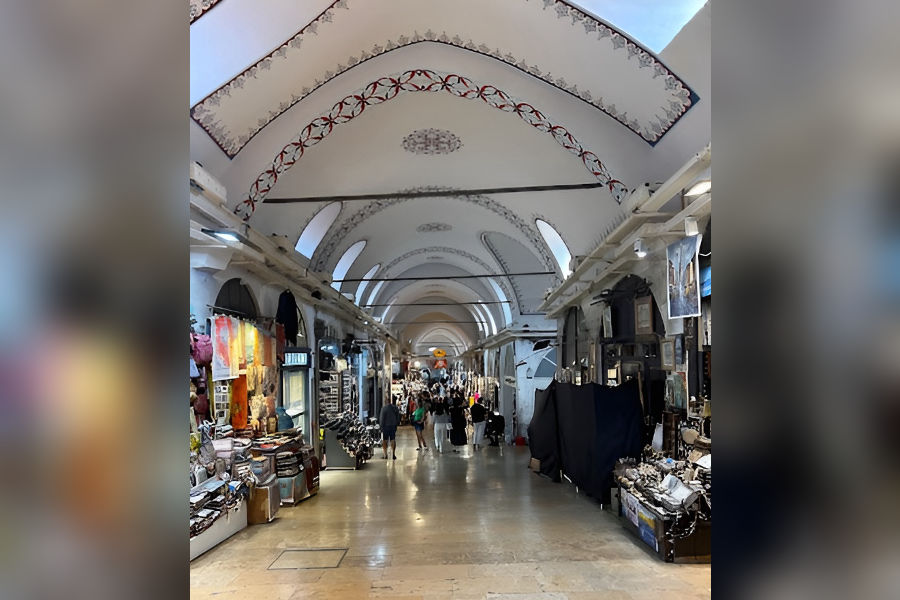
This past week, my mother and I wandered into the alleys of the Grand Bazaar in Istanbul. I did not want to dwell on the palpable loss, but instead to discover parts of myself. Enduring accomplishments of Armenians whose skills helped shape the soul of the city must be celebrated — yet they are so often forgotten.
As soon as we entered the bazaar, the thick air was filled with the smell of incense and roasted nuts. The yells of hawkers and the distant hum of hammers on metal permeated the


The few remaining Armenian artisans left in Istanbul should be encouraged to leave Turkey for Armenia, to contribute and teach their craftmanship to Armenians and and enrich Armenian talent, instead of Turks.
Dear Deni, Wonderful article. I had relatives The Baharyans, who worked in the Grand Bazaar as jewelers. When the Armenians of Marash were driven out after the Battle of Marash in 1920 (see my book: We Armenians Survived! Battle of Marash 1920,) surviving jewelers ended up in Syria. The pieces they created in Syria were absolutely incredible. I know as my mother, Evelyn went to Syria from Mosul, Iraq when she was engaged to my father, Sarkis in 1937. He gave her money so she could purchase bracelets, and other pieces. She left Mosul and went to Aleppo as the great Armenian jewelers were there.
This will be the most fateful election of Armenia since independence, and will be a choice between democracy or a full-blown Pashinyan dictatorship. Since dictators like Pashinyan don’t leave power willingly, democratically and peacefully, and will try to cling to it at all costs, mayhem is very likely lying ahead.
The descendants of the Armenian Genocide in the Levant can’t find any peace and tranquility. They are the most hapless lot in the Armenian Diaspora. War, destruction and death always follow them, be it in Mosul, Aleppo, Baghdad, Beirut or Tehran, only to be uprooted again, flee and start from scratch again in the West. I holidayed in Aleppo and Damascus in 2009, and befriended a local Armenian artisan and his wife in Aleppo, who had a shop in the famous Al-Madina Souq, and they showed me the sights of the city. They were so welcoming and kind, and their hospitality left such a sweet memory in me, which became bittersweet after the Syrian Civil War broke out two years later. When the Syrian Civil War broke out, they fortunately managed to flee with their two children to France in 2012, with only what they could carry. Their house, their shop, the historic souk was destroyed. They saved themselves and managed to find work outside Paris, but the loss they suffered has traumatized them. What they suffered, is shared by hundreds of thousands of Armenians, who had to flee wars and conflicts of the Levant the past five decades.
My early childhood education started there in the Grand Bazaar of Istanbul..?It was a the biggest University of the planet..?You have to learn everything…how to start from nothing to something..When eventually I took my diploma of life…there was nothing impossible in the business world.
God blesses..the soil and spirit of my old masters..who though me..how to be successful..in the journey of business world
The descendants of the Armenian Genocide in the Levant can’t find any peace and tranquility. They are the most hapless lot in the Armenian Diaspora. War, destruction and death always follow them, be it in Mosul, Aleppo, Baghdad, Beirut or Tehran, only to be uprooted again, flee and start from scratch again in the West. I holidayed in Aleppo and Damascus in 2009, and befriended a local Armenian artisan and his wife in Aleppo, who had a shop in the famous Al-Madina Souq, and they showed me the sights of the city. They were so welcoming and kind, and their hospitality left such a sweet memory in me, which became bittersweet after the Syrian Civil War broke out two years later. When the Syrian Civil War broke out, they fortunately managed to flee with their two children to France in 2012, with only what they could carry. Their house, their shop, the historic souk was destroyed. They saved themselves and managed to find work outside Paris, but the loss they suffered has traumatized them. What they suffered, is shared by hundreds of thousands of Armenians, who had to flee wars and conflicts of the Levant the past five decades.
Bravo, Deni!!!!
Dear Deni—
Your stories are precious to Armenians. I feel with each article you wrote you areare learning more about what it means to be Armenian. It’s a shame adults in the comments go off irrational tangents. You are our future!