


Confusing and contradictory statements on Zangezur road

If you’re confused by the contradictory statements made by officials from Armenia, Turkey and the United States surrounding the Zangezur road, you’re not alone.
The saga began on Nov. 9, 2020, with the ceasefire agreement signed by Armenia, Azerbaijan and Russia following Armenia’s devastating defeat in the war over Artsakh.
Article 9 of that agreement stated: “All economic and transport connections in the region shall be unblocked. The Republic of Armenia shall guarantee the security of transport connections between the western regions of the Republic of Azerbaijan and the Nakhichevan Autonomous Republic in order to arrange unobstructed movement of persons, vehicles and cargo in both directions. The border service of the Russian Federal Security Service shall be responsible for overseeing the transport connections. Subject to agreement between the parties, the construction of new transport communications to link the Nakhichevan Autonomous Republic with the western regions of Azerbaijan will be ensured.”
Months ago, when Prime Minister Nikol Pashinyan repeated his inaccurate claim that the 2020 agreement does not mention Russia, a reporter asked if he would accept international oversight of the road connecting mainland Azerbaijan to Nakhichevan via Armenia. Pashinyan rejected the idea.
On July 1, analyst Olesya Vartanyan published an article for Carnegie Russia-Eurasia Center, reporting that the U.S. was proposing international management of the Zangezur route, an idea previously floated by the European Union. On July 2, Vartanyan told RFE/RL’s Armenian Service that Josh Huck, a U.S. Deputy Assistant Secretary of State, presented the proposal to Armenian and Azerbaijani officials during his May visit. An unnamed source told Middle East Eye on July 14 that Turkey had originally suggested the plan, despite denials by Pres. Recep Tayyip Erdogan. The Middle East Eye added: “The Armenian side demanded that the [American] company should also work on the Nakhichevan side of the corridor, which was unacceptable for Baku.”
Notably, the state department declined to confirm Carnegie’s report.
Then came an unexpected and controversial comment from U.S. ambassador to Turkey Tom Barrack on July 11. He inserted himself into the debate, saying: “Türkiye with Armenia still suffers under the old impression of what Türkiye had done to Armenia, in genocide…. They [Armenia and Azerbaijan] are arguing over 32 kilometers of road [in reality, 43 kilometers.], but this is no joke. It’s been going on for a decade—32 kilometers of road. So what happens is, America comes in and says, ‘Okay, we’ll take it over. Give us the 32 kilometers of road on a 100-year lease, and you can all share it.’ But these tribal points of view do not fade. We came into a ‘e pluribus unum’ [out of many, one]. What does that mean? It means, give up the masses for one. It exists in America. It doesn’t exist there. It’s individual, family, tribe and then the nation…”
It’s bizarre that the U.S. ambassador to Turkey, not the state department, is making foreign policy declarations on Armenia and Azerbaijan. This is clearly outside his jurisdiction. Meanwhile, the U.S. ambassadors to Armenia and Azerbaijan have remained silent. Pres. Donald Trump picked an unqualified real estate investor for a highly sensitive diplomatic post. Barrack has been involved in several prior scandals. He was once called before a congressional committee to testify on a questionable gift related to the purchase of then-Attorney General Edwin Meese’s house. In 2021, Barrack was indicted for acting as an agent of a foreign power, obstruction of justice and making false statements to law enforcement. He was later acquitted after trial.
More disturbingly, in his July 11 interview, Barrack described Armenians as having “a tribal point of view,” a deeply insulting remark from someone of Lebanese heritage and a native of Los Angeles, home to one of the world’s largest Armenian communities.
Armenia’s Deputy Foreign Minister Mnatsakan Safaryan told Azatutyun.am that Yerevan does not oppose “outsourcing” certain functions to a licensed international company. He noted that multiple countries have submitted proposals currently under review.
Ani Badalyan, spokesperson for Armenia’s Ministry of Foreign Affairs, confirmed that “various international partners regularly present their ideas on the normalization of Armenia-Azerbaijan relations, including the unblocking of transport infrastructure between the two countries.”
However, on July 14, Pashinyan’s spokesperson, Nazeli Baghdasaryan, contradicted both Safaryan and Badalyan: “Such a proposal is not acceptable to the Republic of Armenia…[which] has not discussed, and is not considering, outsourcing control over its sovereign territory to any third party.” She added: “Armenian law only allows leasing of agricultural land for farming, rendering Ambassador [Barrack]’s proposal legally unfeasible.”
Pres. Erdogan added yet another twist during a summit in Stepanakert: “Even though Armenia was initially against the Zangezur corridor, it is now showing a more flexible approach.” This aligns with Pashinyan’s statement expressing willingness to facilitate Azeri transit through Armenia.
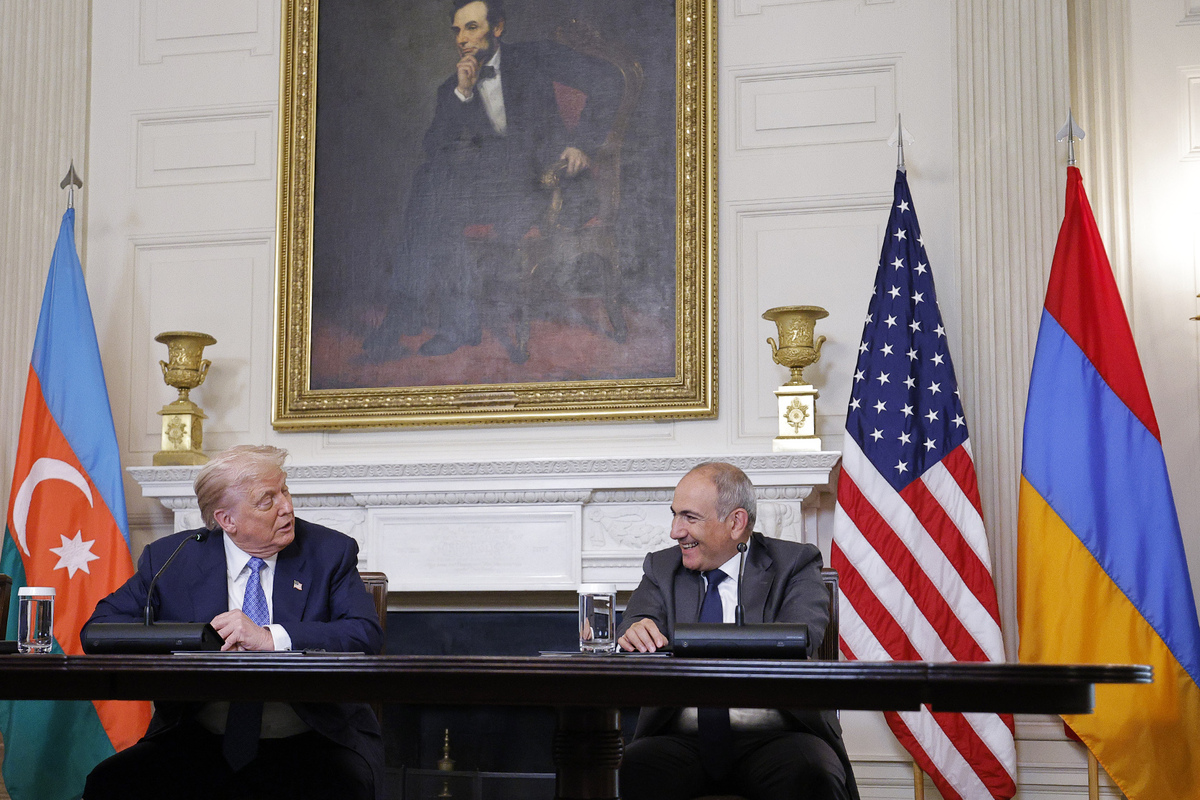
The situation became even more convoluted when Pres. Trump declared on July 14: “And we’ve solved another one: Armenia and Azerbaijan. It looks like that’s going to come to a conclusion—a successful conclusion.” Many analysts linked this to his quest for a Nobel Peace Prize.
Pashinyan contradicted his own spokesperson during a July 16 press conference, claiming the U.S. proposal was acceptable to Armenia. He incorrectly equated the leasing of the road with foreign management of Armenia’s airport, water system, railway and postal services.
When journalists sought clarification, the state department again declined to comment, suggesting they contact the White House.
On July 19, Azerbaijan’s President Ilham Aliyev once again demanded a corridor through Armenia: “Our cargo and citizens should not see the face of an Armenian border guard there every time. This is our demand. This is a legitimate demand, a fair demand. Otherwise, our citizens will be in danger.”
The incompetence and inconsistency across the board have sown public confusion, with mixed signals from all sides, trust and clarity remain in short supply.


Russia who brokered the 9 November ceasefire supported it’s ally having to cede control of its internationally recognised territory in what is within a ceasefire protocol. In the event of a peace agreement and diplomatic relations with Azerbaijan an agreement to open transport links is a reasonable matter. Within the protocol of a ceasefire between two antagonists this is a subjugation but it should be borne in mind that Russia following Byzantine strategy can only have weak and helpless allies even if this results in them giving up on them or losing them such as Syria this doesn’t matter to Russia it simply cannot have strong allies such as the USA has with Israel and thus why Russia can never form a proper alliance with China and indeed despite being communist comrades the Sino Soviet split occurred.
The US ambassador statement about the social realities of Armenia in contrast to the USA was actually being honest and realistic and not trying to expect what may be the case in the USA and not automatically expecting same or similar in another part of the world. His acknowledgement of the ill feelings and the genocide shows appreciation of realities indeed suggesting the same company work in Azerbaijan is fair but of course Azerbaijan rebuffed such a proposal.
Nevertheless with both Armenia and Azerbaijan now at odds with Russia and it’s own preoccupations in Ukraine along with it’s failure to uphold even its own rights in Azerbaijan over its peacekeeping mission in NK . It’s end of border control for air visitors within Armenia means a Russian role is rather less likely than it initially was .