




Lion and fox: A story of betrayal and bravery in Syunik
The road curled and uncurled through lush forests and fields of small farms. Blue and green mountains formed an ever-changing, jagged horizon.
We arrived in the village of Yeghvard, the southeasternmost Armenian village in the Syunik region. A little three-nave basilica church, built in 1700, stood on a hill, surrounded by old graves. From the village, we could see the distant mountains of Iran and a silver sliver of the Araks River, which separates Azerbaijan from Iran. Here, the borders of three countries converge in one beautiful view and speak only of tranquility.
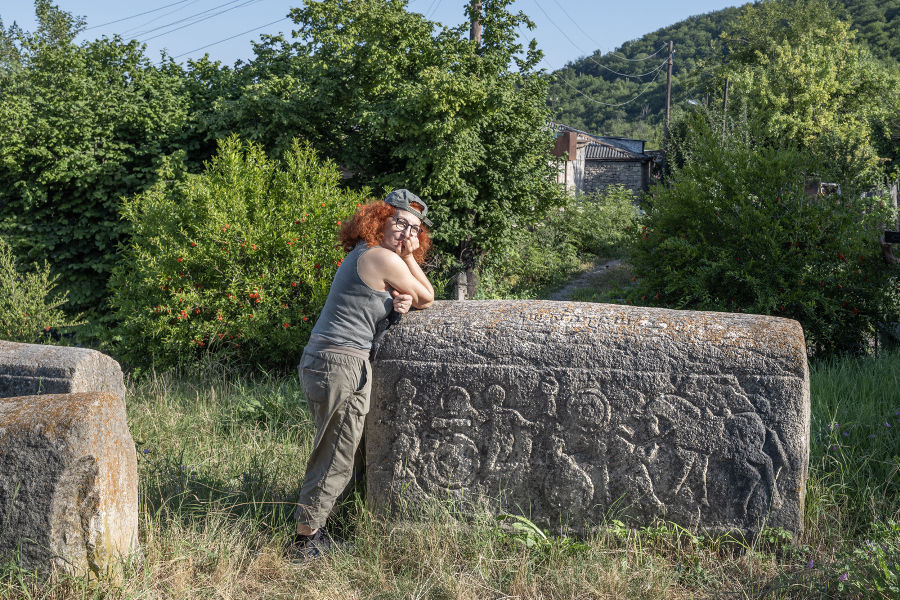
From the many descriptions we had heard, we recognized the gravestone. It is the largest in the cemetery, carved in the shape of a traditional Armenian cradle. Its rich relief carvings had been worn down over time.
There lies my eighth great-grandfather, with whom the only personal connection—until today—was the old family tree my father expanded in his neat handwriting. It had a large circle in the middle, reading Toros Ishkhan. As a child, I was fascinated by tracing the bloodline through the many names, down to my brothers and me.


Today, we are standing by his grave.

Let us take a short excursion through history. It is the beginning of the 18th century, and Armenia is fighting both Persian and Ottoman rule. Armenian military forces were organized under the command of Davit Bek, and by 1722, Artsakh and Syunik were effectively under free and autonomous Armenian rule.
Toros Ishkhan (prince) was one of the heroes of the Armenian liberation movement and a main supporter of Davit Bek. He protected Kapan and the surrounding areas in Syunik from the attacks of Fath-Ali Khan in the early 1700s.
But on July 8, 1725—300 years ago today—he fell in battle against Fath-Ali, defeated not by the enemy he was fighting, but by one of his own. A traitor had attacked from the rear. The loss of that battle unfavorably changed the history of Syunik.
The field where the battle took place, called Field of Lilies (shushans, nargis), is visible from the cemetery. They say flowers grew where the heroes’ blood was spilled.
The relief on the face of the gravestone shows a scene from the battle; on the back is a lion’s head in the mouth of a fox, symbolizing the tragic betrayal.
The story is as new as old, crossing borders and resonating throughout time.
Today’s heroes and traitors do not ride horses and swing swords. They launch drones and spread lies with ever more precision. Today, they are called politicians, and the damage is deadlier.

I am a citizen of two countries, Armenia and the United States. In both, a simple act of speech is perceived by one group as bravery and by another as treason.
This division has become tragic, though the moral code we explain to children still seems simple: Don’t lie. Don’t cheat. Don’t steal. Don’t support violence. Don’t take food from the hungry, medicine from the sick or land from the farmer. Don’t lie to your people, don’t lie to the world. Don’t kill.
This notion might be perceived as naïve and fantasized. But maybe—just maybe—if it were implemented across the globe, the world would be more livable.
A passerby stopped, asked who we were and introduced himself: Spartak Zakaryan, the mayor of Yeghvard. He shared a story. During the Soviet era, the village church was damaged and a road was built through the cemetery, separating three graves from the church. Over a decade ago, the decision was made to restore the church and rebury Toros and the two others in the courtyard, returning the hero to his rightful place.
A team of specialists from the archaeological center carried out the reburial. Spartak, who witnessed the event, recalled that Toros measured 1.95 meters tall—without his skull. His head was missing. That detail confirmed the historic account: the traitors struck him in the mouth, knowing he wore chainmail.
For some reason, the height of my long-dead ancestor left a deep impression on me. I have been thinking about how we have been diminished—not just in physical stature, but in moral character.
I am neither a warrior nor a hero. All I can do is feel the pain of the displaced Armenians of Artsakh, the bombed and starving Palestinian children and the many others forced from their ancestral lands.
These are the marginalized and terrorized people across the world, often sick and poor. Like the people of present-day Syunik, they live in a state of uncertainty about their future, not knowing when the bombs might drop or if they will be deported and separated from their families and homes.
I am not a hero, but I hope one will soon rise. This world is in desperate need.
All photographs by Ted & Nune

Thanks for the touching story! Though with sad ending, but valuable hisory work, and not just only for yourself and your family.
Wow what a great story And to be part of that history and then be able to touch it in this timeline! Your writing really brings it to life !
That’s so cool! Love you ♥️🥰😍
Utterly tragic and poignant that Toros Ishkhan was betrayed and killed by a fellow Armenian.
Division and disunity have always been Armenia’s curse.
The Turks always cut off heads to terrify people.
They learned their methods from their Mongol masters. But unlike Mongols, the Turks lack manhood and bravery and that is why they resort to such acts. Turkish leaders never refrain from threats and blackmails against our nation because they know they can. But when it comes to doing the same and facing equal or bigger force, for example Russia or USA, their little leader Er-dog-an, with his Napoleon Complex, lays down his prayer rug in front of them, kneels down and asks for forgiveness. That is the TRUE Turkish character for you. While they treated Hamas leaders as heroes and gave them a hero’s welcome into the Turkish parliament, they stood aside and did absolutely nothing, other than a lip service, and watched Israel raze Gaza to the ground and kill tens of thousands of Palestinians. What happened to Turkish Power they love to talk about so much? That power is only for much weaker enemies and adversaries. Turkish power means chasing with $30,000,000 F16s the Kurdish militia armed with $500 AK-47s. They portray themselves as lions when facing sheep but then they turn into sheep when faced with lions. That is why we Armenians must always treat Turks the Turkish way and do it in a thousand folds.
A few years ago I and a friend from Yerevan visited Yeghvard, in Syunik marz, where we visited the church and the gravesite of Toros Ishkhan. We then proceeded to Kapan. There, near a growing toxic lake created by a mining company, is an unmarked, uncut and very ordinary looking stone. Locals pointed out that this is the gravestone of Melik Frangul, the traitor responsible for Toros Ishkhan’s death. My friend said that school children, if they visit this site, are encouraged to spit on the traitors grave.
1.95 metres = 6 ft. 4 inches – and that was without his head, if we account for his head, he would have been 2.184 metres – 7 ft. 2 inches.
Toros Ishkhan – a giant!
What a man!
What an Armenian!
What a hero!
A powerful article. Thank you for sharing this history and your reflections.
What a beautiful story to know and read and your words are so very true. I am praying for the same hero, our world desperately needs one!