


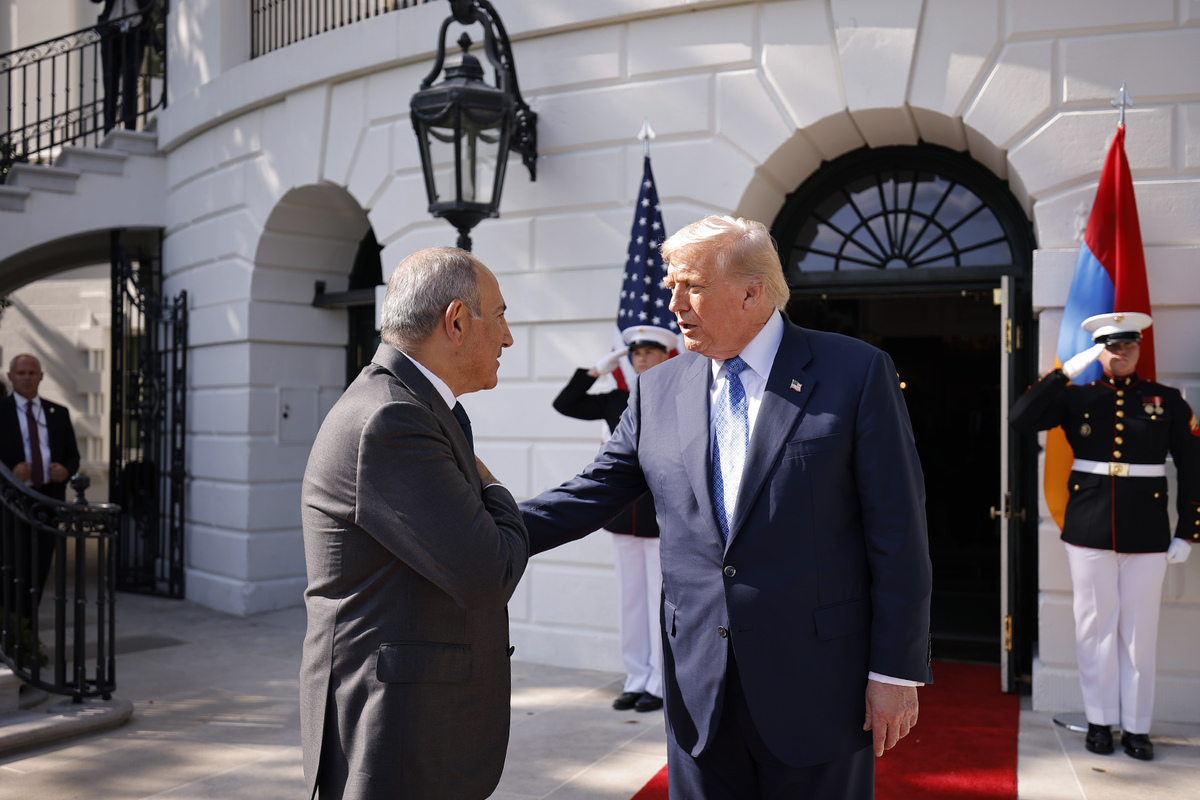
Around one year ago, on Aug. 8, 2025, Prime Minister Nikol Pashinyan and President Donald Trump signed a Memorandum of Understanding on an AI and Semiconductor Innovation Partnership. On Aug. 8, 2026,, almost to the day, Pashinyan stood in Hrazdan for the opening of Firebird’s AI factory. He made a point of noting the anniversary. The facility is real, the Nvidia hardware is there, and the export licenses that made it possible flowed, in large part, from that MoU. That much is fact.
Having sat through more than a few ceremonial openings over the years, I know the difference between a ribbon-cutting and actual capability. This one matters. Armenia now has a major AI computing site on its soil. The first phase started around half a billion dollars; the expansion talk is already in the multibillion-dollar range with tens of thousands of advanced GPUs planned. For a country that for years sat outside the circle of advanced American technology, that is not nothing.
Still, the MoU itself is a thin document. Non-binding. No money attached. No legal obligations. It simply sets out an intention: deepen work on secure semiconductor supply chains, build up Armenia’s semiconductor ecosystem, commercialize AI applications, and try to improve Armenia’s standing under U.S. export controls. It talks about private investment, public-private partnerships, possible joint research, stronger export controls, and training people to use the technology. Useful language. Not a finished plan.
Some results are already visible. The export licenses came through. Firebird opened. Yerevan State University has an AI center and a supercomputer. Armenian officials have sat down with American semiconductor companies that already operate here. These steps are real and should be acknowledged without exaggeration.
But an AI factory is not yet a national technology ecosystem. Data centers of this scale will eventually need hundreds of megawatts of reliable power. Who controls that power, and how secure it is, will determine whether the hardware actually runs or sits idle. Armenia is providing the land, the electricity, and the political space. Under the current structure, most of the high-value compute and the profits that come with it appear to stay with the foreign operators. Local jobs, genuine skills transfer, and Armenian ownership of the applications that run on these machines will not appear automatically. They have to be insisted upon.

Advanced semiconductors are dual-use by nature. Technology transfers framed as purely commercial can later prove difficult to control. Armenia should not wait for problems to appear. We have every reason to insist on rigorous end-use monitoring and to help set the rules under which this hardware operates on our soil. Transparency is not a courtesy — it is a requirement of sovereignty.
For those of us in the diaspora who work in law, technology, or public institutions, the Hrazdan opening is more than a news item. The skills and capital already exist among us. The MoU and Firebird open a practical door — joint research, talent pipelines, targeted investment in Armenian startups, real university partnerships. Statements of solidarity are easy. Showing up with competence and capital is the measure that matters.
Armenia will not be transformed by one memorandum or one data center. Lasting strength comes from steady accumulation: reliable energy, trained people, real local value creation, and the ability to negotiate terms instead of simply receiving them. The August 2025 MoU opened a door. The Hrazdan facility shows the door can lead somewhere concrete. Whether that somewhere strengthens Armenia, or merely hosts someone else’s infrastructure, depends on the choices made now — on energy security, on economic returns, on dual-use controls, and on whether the diaspora treats this as a working opportunity rather than a symbolic one.
Our grandparents carried unfinished business across oceans. They did not endure that journey only to survive. They crossed so that their descendants could one day help rebuild a nation strong enough to stand on its own feet. That duty still belongs to us. Building institutions — technological, economic and sovereign — that can endure is part of the same unfinished work. An AI partnership can serve that purpose if we meet it with clear eyes and firm resolve. It will fail us if we treat it as a substitute for the harder labor of securing Armenia’s future ourselves.