


It’s not every day that you get to see Armenian characters, stories or culture onstage — outside of an Armenian church or community center — let alone ones that feel so true to life and relatable.
But playwright Talene Monahon has found a way to teach thousands of years of Armenian history and tradition, discuss the questions of race, identity and belonging that Armenians wrestle with daily, raise awareness of past and current atrocities against Armenians and showcase delicious Armenian recipes — all in a hilarious and powerful play directed by the esteemed David Cromer.
If you want to understand the complexity of being Armenian American, go see “Meet the Cartozians.”
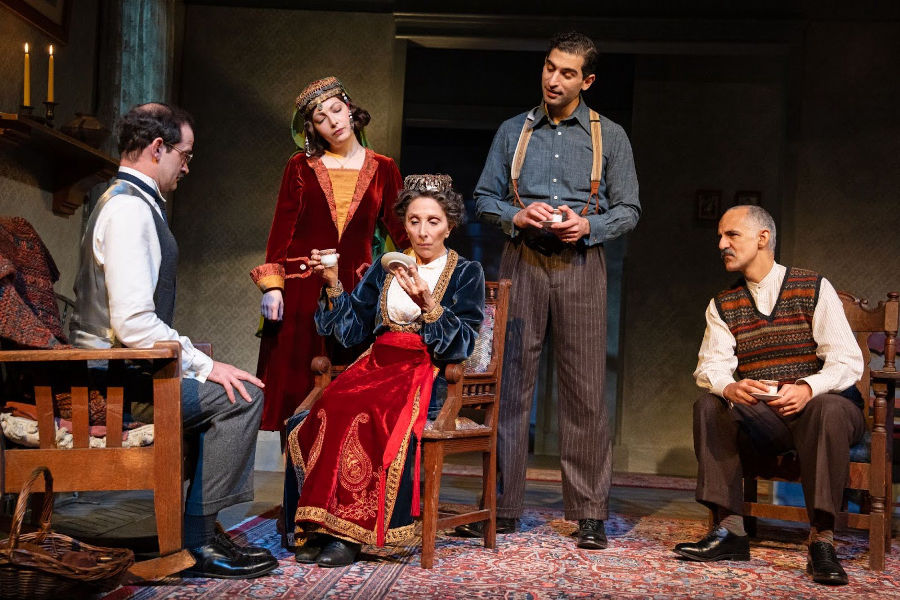
Part One begins in the 1920s, in Portland, Oregon, home of the Cartozian family, complete with a khachkar (Armenian cross) on display and an Oriental rug (or five) — a credit to scenic designer Tatiana Kahvegian.
Will Brill plays Wally McCamant, a lawyer preparing his client, Armenian immigrant Tatos Cartozian (Nael Nacer), for an upcoming trial. The U.S. government is revoking Tatos’s citizenship, alleging that he is not “a free white person.” Tatos, therefore, needs to prove that Armenians are white — based on the actual court case United States v. Cartozian. Nacer embodies the dignified, modest nature of Tatos, successful yet stoic in the face of trauma.
Monahon draws on her Armenian and Irish heritage to juxtapose the Irish and Armenian immigrant experiences in the U.S. over the years. As McCamant remarks, “I personally requested to take on your case because I saw my own Irish family in the Armenians.” Comparisons and contrasts also become a theme throughout the piece.
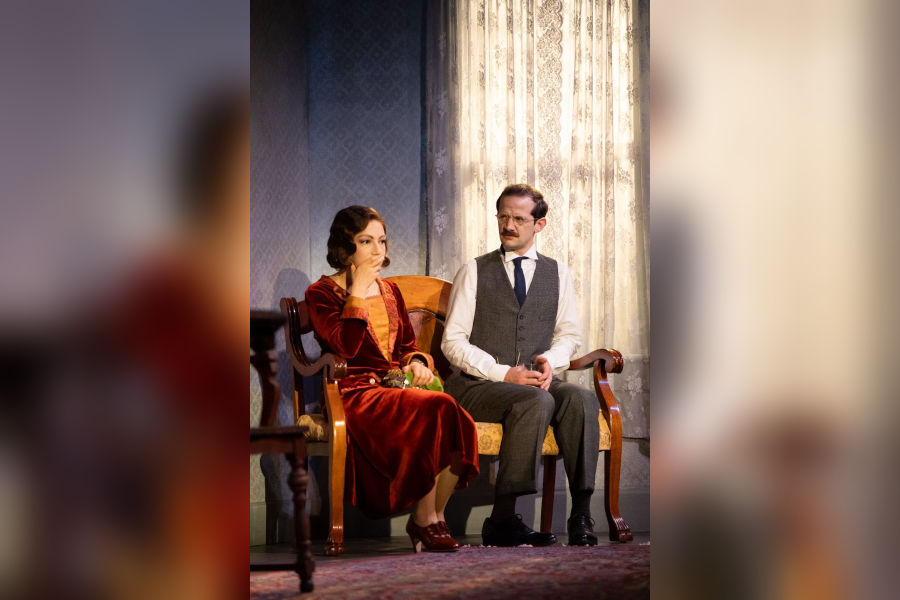
The production pays remarkable attention to detail, ensuring accurate representations of Armenian culture. For example, since the Cartozian family is from the town of Sivas in historical Armenia/present-day Turkey, they use Western Armenian expressions like Inch gulla gor? (What is happening?) and hajis (please), thanks to the expertise of voice and dialect coach Gigi Buffington.
Tamara Sevunts plays the quintessential eldest immigrant daughter, Hazel Cartozian, translating not only legal terms but also cultural norms and expectations between Armenians and Americans. As she straddles both worlds and both languages, she must navigate systems and situations far beyond her understanding. Even after all her help, she is still not enough in the eyes of her Nene Markrid (Andrea Martin), who calls her “an old maid.”
Martin’s Nene is quite the character — a classic Armenian grandma, loud and sometimes offensive. She yells at McCamant in broken English, pressing him about why he didn’t finish eating the feast of Armenian delicacies in front of him, like simit and kadayif. Brill’s animated reaction to tasting the Armenian candy offers a well-placed dose of physical comedy.
When Tatos’s son Vahan (Raffi Barsoumian) finally arrives home, the energy shifts — he is Nene’s “strong boy,” after all. Barsoumian plays the boisterous, confident and, at times, overly familiar Vahan with ease and in stark contrast to Sevunts’s quiet, deferential and respectful Hazel.
Together, the group tries to answer the same questions I’ve asked my whole life: Are Armenians white? Are we Asian, European? Are we Middle Eastern? We speak Armenian, not Arabic. We’re Christian, not Muslim. Where do we belong? What does it mean to be Armenian? What does it mean to be Armenian American?
These questions are further explored in Part Two of the play, but with a completely new time, place and cast of characters. It is 2024, in Glendale, California, where representatives of the Armenian community are gathered on the blindingly bright set of a reality show (complete with golden chalices) to celebrate Armenian Christmas and discuss their heritage with the star of “Meet the Cartozians,” a fictionalized Kim Kardashian.
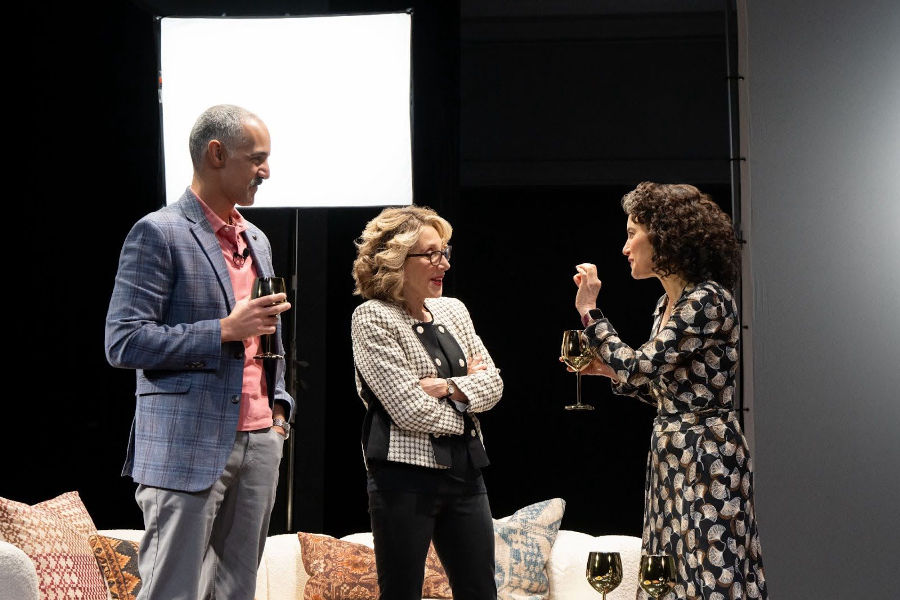
It’s 100 years later, but the conversation remains the same: Who are we?
As polite conversation quickly devolves into an emotionally-charged argument, the diverse group of representatives spar, illuminating generational differences in experience and opinion: Leslie Malconian (Susan Pourfar) and Nardek Vartoumian, as the ultra-progressive millennial activists; Robert Zakian, the quiet and compromising Gen Xer; and Rose Sarkisian, as the assimilated Boomer with slightly outdated ideas (sometimes echoing McCamant’s, especially around religion).
On the topic of religion, “Christian” is mentioned 26 times in the play. Often, it’s part of the phrase “good Christian people,” which McCamant uses to describe the Irish and Armenian communities. It catches my ear because, while Armenians are very proud of being the first Christian nation, there’s a specific connotation in the way McCamant says it — especially compared to how he refers to Armenia’s Muslim neighbors. He essentially equates Christianity with “goodness,” and “goodness” with “whiteness.” It is an idea reflective of the time (remember, Part One takes place in the 1920s), but one we also, unfortunately, see resurging today. In Part Two, Pourfar’s Leslie makes an impassioned argument: “When a genocide is out here happening — and people don’t call it what it is — that’s f**ing trauma!”
None of these characters speak Armenian, frequently mispronouncing traditional dishes — referring to simit as “sim-it” instead of “seem-eet” and boreg as “byoo-reg” instead of “buh-reg.” As someone who also doesn’t speak Armenian, I appreciate that they are heavily involved in their community and heritage in other ways.
Culture is multifaceted: language, music, food, clothing, art, history, religion and more. Therefore, it’s hard for an entire diaspora to agree on which aspect to focus, protect or promote, as the group argument illustrates. Perhaps there is no single answer; perhaps the answer is all of the above.
With each new term or topic — MENA vs. MENASA vs. SWANA vs. SSWANA, for example — the characters (and audience) are forced into uncomfortable conversations about race, identity and privilege. And that’s the point. These are conversations that need to happen and have been happening within the Armenian community and beyond. The script itself even addresses this in the casting note, saying that casting “will be complicated from a racial/ethnic perspective, and it should feel complicated.”
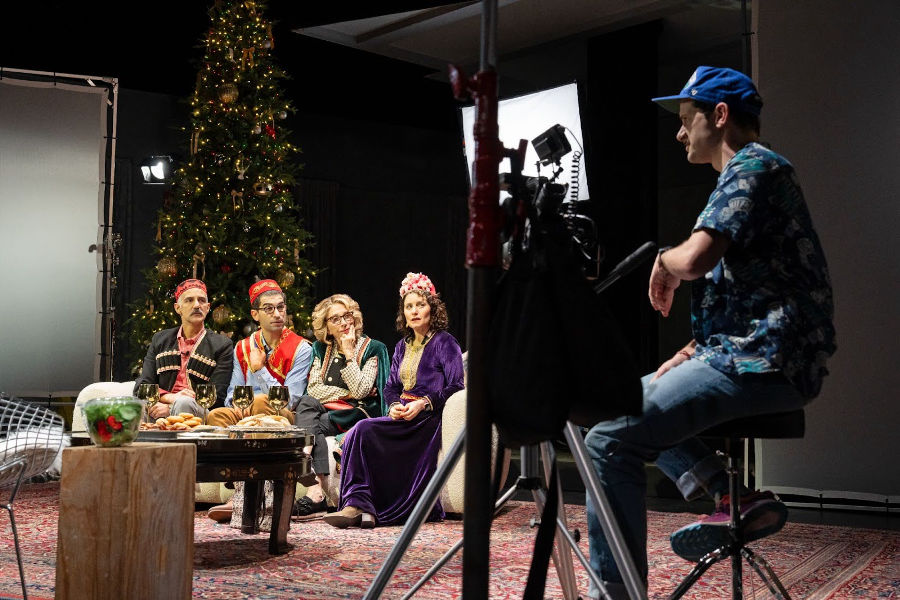
The entire cast plays double duty, once again embodying characters that seem very different on the surface, but deep down bear striking resemblances — Nacer, as both Tatos and Robert, is asked to speak louder; Barsoumian, as both Vahan and Nardek, is treated differently because of the way he looks; and Sevunts, as Hazel, demonstrates the positives of assimilating, while as the celebrity, she represents the danger of assimilating too much.
Whether any individual feels “invisibilized or marginalized” or not, there has been a historic and successful campaign to make Armenians extinct — to erase us. However, to paraphrase Robert near the end of the play: “There’s something eternal about being Armenian…We’re still here, through all of that.”
We are still here…and now, we’re off-Broadway.
Tickets for “Meet the Cartozians” are available through December 7, 2025, at Second Stage Theater’s Irene Diamond Stage at The Pershing Square Signature Center.


Dear Rosie,
I am trying to find contact info for Eric Bogosian and Andrea Martin, both of whom you have interviewed…..great articles!
We would like to honor them in Philadelphia April 25 on the occasion of America’s 250th and the unveiling of the Armenian Heritage Walk – a beautiful garden with majestic boulders from Armenia and plantings indigenous to Armenia – located steps from the main entrance to the Philadelphia Museum of Art.
I sincerely appreciate any help you can provide.
In the meantime, I welcome you to visit our website – armenianheritagewalk.org