ReviewsLiterary Corner

Book Review: ‘You Must Become Field’
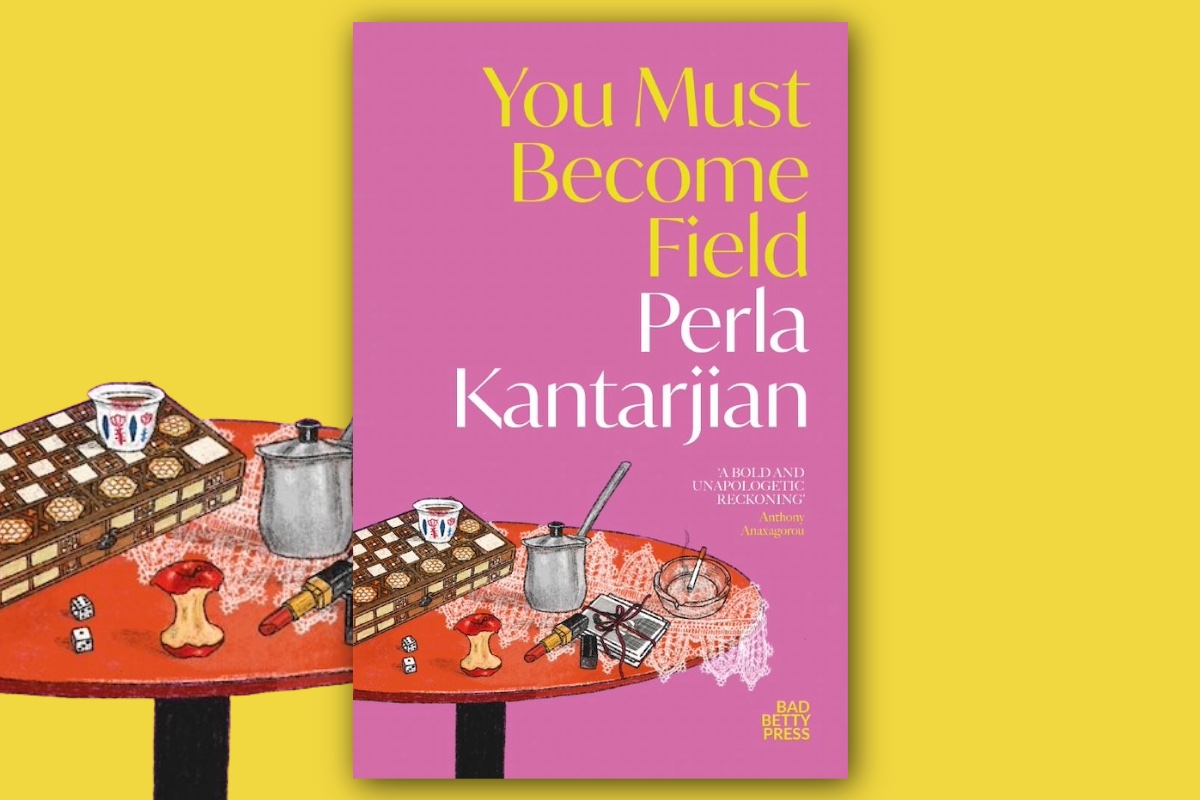
There are books about belonging, and then there are books that make you understand why belonging can be so complicated. Perla Kantarjian’s powerful debut poetry collection, “You Must Become Field,” is the latter. 

Moving between English, Armenian and Arabic, the Lebanese Armenian writer creates a poetry of inheritance, displacement and survival in which Armenia, Lebanon and England become places carried within the body. 

As a fellow author of Armenian and Lebanese heritage, I read these opening lines with particular recognition: “I descend from interruption. / I carry my home in my mouth / and my mouth in my hands.” Here, home is described as something embodied and portable, carried through memory, language and family stories that capture the inheritance of diaspora. 

Kantarjian traces generations of movement beyond the Armenian Genocide into a much longer history of upheaval, displacement and endurance. The past continues to shape family identity across generations, while work, community, neighborhoods and family traditions become vessels through which it survives. 

The Lebanese Armenian experience emerges as one of reconstruction, where an inherited history of survival takes new form in another homeland. Kantarjian refuses to separate Armenian identity from Lebanese life; Lebanon is not simply where Armenian survivors arrived, but a place where families rebuilt, worked, raised children and made new memories. 

Advertisement Subscribe Today!

Consequently, Armenian and Lebanese cultures exist not in separate compartments, but through kitchens, accents, surnames, friendships, food and inherited habits. They overlap without cancelling one another.

The collection then turns toward England, where cultural belonging takes a different shape. Kantarjian explores what it means to encounter one’s own history within British institutions, particularly when objects, monuments and cultural histories can make one’s own identity appear distant or museum-like. 

These encounters also reveal the discomfort of cultural ignorance: moments when histories foundational to one person’s identity are unknown, misunderstood or reduced to something obscure by others. 

London also offers instances of diaspora recognition. Encounters with other migrants, familiar foods and accents that sound “not from here” remind readers that displacement does not necessarily mean isolation. 

In these brief exchanges, belonging emerges through a shared understanding of what it means to live between places, carrying more than one sense of home.

Elsewhere, Kantarjian examines the unequal ways countries preserve, lose and remember their pasts. 

British landscapes shaped by painstaking preservation are placed alongside memories of Lebanon, where conflict and historical rupture have altered what remains. Armenian geography enters this meditation too, as both physical landscape and imagined ancestral homeland.

The collection makes a similarly powerful connection between privilege and necessity through its treatment of darkness.

Contemporary consumer culture, for instance, can turn light into something decorative, desirable and easily purchased, while in Lebanon, prolonged electricity shortages can make it a basic necessity. Through intimate domestic images and observations of everyday life, Kantarjian exposes the distance between these realities.

Kantarjian’s poems ask what it means to live among carefully preserved histories and abundant infrastructure while carrying memories of places where both history and basic necessities have been interrupted. Seemingly ordinary objects acquire different meanings depending on where and how one lives.

These tensions are ultimately transformed into an act of creation. Kantarjian gathers family history, Armenian mythology, Lebanon, migration, language, landscape and contemporary violence without allowing any single inheritance to dominate the others. What emerges is a collection concerned with what survives: in language, memory, family, place and imagination.

Armenia and Lebanon are both countries shaped by histories that have left their wounds across generations. To belong to both is to inherit not one history of rupture, but two, and to carry them simultaneously can create a particularly vulnerable way of seeing: alert to absence, displacement, injustice and the fragility of what others may take for granted. Kantarjian makes that vulnerability not a weakness but a source of perception.

To become field, in this sense, is to let those histories take root without being consumed by them, remaining open to what has been lost, what continues to grow and what might yet emerge from wounded ground.

“You Must Become Field” is Perla Kantarjian’s debut poetry collection, published by Bad Betty Press on Sept. 24. Readers can learn more about Perla Kantarjian and her work on her website, perlakantarjian.com. 

Angelina Der Arakelian-Dennington

Angelina Der Arakelian-Dennington is an award-winning screenwriter, author and journalist based in Cyprus. She draws on her experience as a descendant of Armenian Genocide survivors and as a member of the Armenian diaspora to explore the intersection of culture, literature and entertainment, examining questions of identity, belonging, memory and storytelling across borders.

Leave a Reply

Your email address will not be published. Required fields are marked *


Back to top button