I arrived at the Museum of Modern Art ahead of schedule for my interview with artist Hayduk Smbatyan. While the gallery was quiet, Gayane, a staff member, told me that the hall had been packed for the past few days.
“Yesterday, people were pouring in all day long,” she said. “They were admiring the canvases and hoping to meet Smbatyan, but he wasn’t here.”
After circling the gallery several times and examining the works in detail, I decided to take a short break. Gayane offered me her seat and opened the guestbook. “Hayduk is a very talented artist; I’ve known him for a long time,” she said, pointing out comments that were exclusively positive.
The painter Artur Hovhannisyan had highly praised Smbatyan’s art, while an anonymous visitor had gone as far as calling him one of the best artists of our time.
While I was leafing through the guestbook, Hayduk walked in. We exchanged greetings and decided to conduct our interview while walking through the gallery. He spoke with a certain hesitation; it seemed easier for him to express himself through color than words. We decided to start from the very beginning: his childhood.
“There were no artists in our lineage,” he said. “I was born in Etchmiadzin. My father is an economist and my mother is an engineer. My grandparents were teachers. For my relatives, what I do is as fascinating as it is unexpected.”
Back in school, art was his favorite subject. Noticing his passion for the craft, his teacher had one day called his parents in, advising them to pay close attention to their son’s talent.
“In the beginning, I painted landscapes and still lifes, and focused on my academic assignments. You paint, you experiment, but at some point, you feel that something is still missing. Over time, you discover the expressive language that truly feels like your own,” he said.

Today, his work is abstract.
“Art should be felt, not explained,” he said. “We listen to music without needing a commentary, yet it moves us all the same. Many artworks should be perceived in exactly that way — without the need for additional explanation.”
For him, being “correctly” understood is not the priority. “It is more important that people understand themselves. If my work creates a connection with their inner world, that is enough.”
Neutral tones dominate his canvases. According to the artist, this is a reflection of the volatility of our times. Global and domestic events, the influence of the media, and the pressures of daily life all shape his internal mood.
“You cannot decide in advance whether you will work with cool or warm colors today. You wake up in the morning and feel the hue of the day. A person is constantly changing, and no feeling ever repeats itself. It is this very unpredictability that makes the creative process so intriguing,” he said.
Smbatyan spends most of his days with children, teaching at the Henrik Igityan National Center for Aesthetics. Afterward, he returns home to continue his own work. “I honestly don’t know if I learn more from them or they from me; working with children is a true joy.”
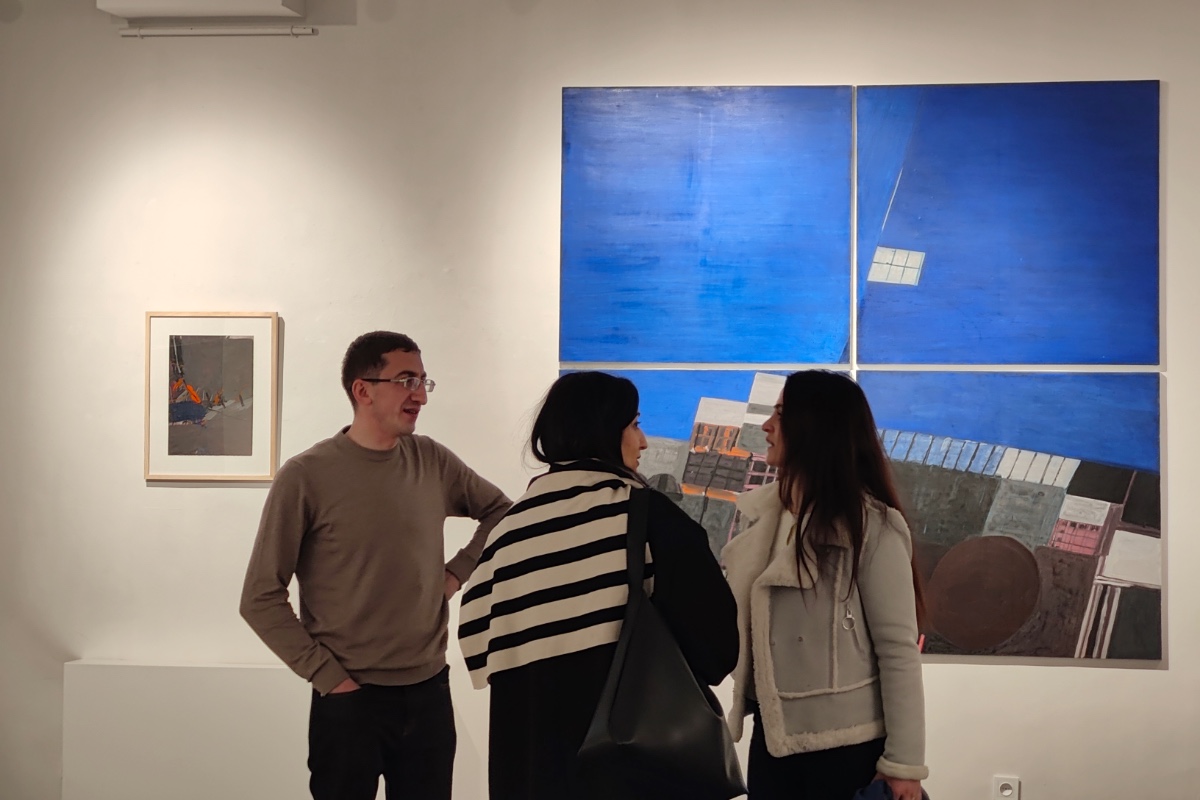
On the gallery walls, his small-scale works are composed of four or nine segments that merge into a single whole. Each segment, however, can also be perceived as an independent piece. Together, they form a structure reminiscent of a window.
Yet, Hayduk’s “windows” are not transparent; they are, instead, mirrors. When he says it is not mandatory to understand him, he is actually proposing a personal confrontation. By eschewing titles, he removes the “map” we are accustomed to rely on in galleries. The square object becomes a bridge between the spiritual and the material.
Here, the tension between perception and “neutral” reality emerges: What we see has already passed through our internal filter. Smbatyan’s works are precisely about that filter — the reality through which a person attempts to understand both the world and themselves.
The absence of titles is immediately striking. According to the artist, assigning a title to a canvas is akin to imposing boundaries upon it.
“Sometimes you paint without knowing exactly what the outcome will be,” explained Smbatyan. “Later, you might find various associations or notice resemblances to certain images and try to name them, but that, to some extent, becomes a limitation.”
Nevertheless, on rare occasions, a work might be granted a title.
“If a distinct association arises — if the image has a recognizable resonance for me — I might name it. But if that clarity isn’t there, I don’t attempt to invent a meaning artificially.”
For Smbatyan, a title is a boundary, and he does not seek boundaries. His refusal to be “understood” is not an attempt to withdraw, but rather a form of freedom. He strips the viewer of verbal anchors, leaving them in an open field of colors and forms. It is an invitation to encounter one’s own inner world without intermediaries or prefabricated explanations.
We are left alone before the canvas, without a prompt or guidance. The experience becomes less a conversation with art and more a test of what’s within us when art ceases to offer answers, leaving us to our own sensations.