



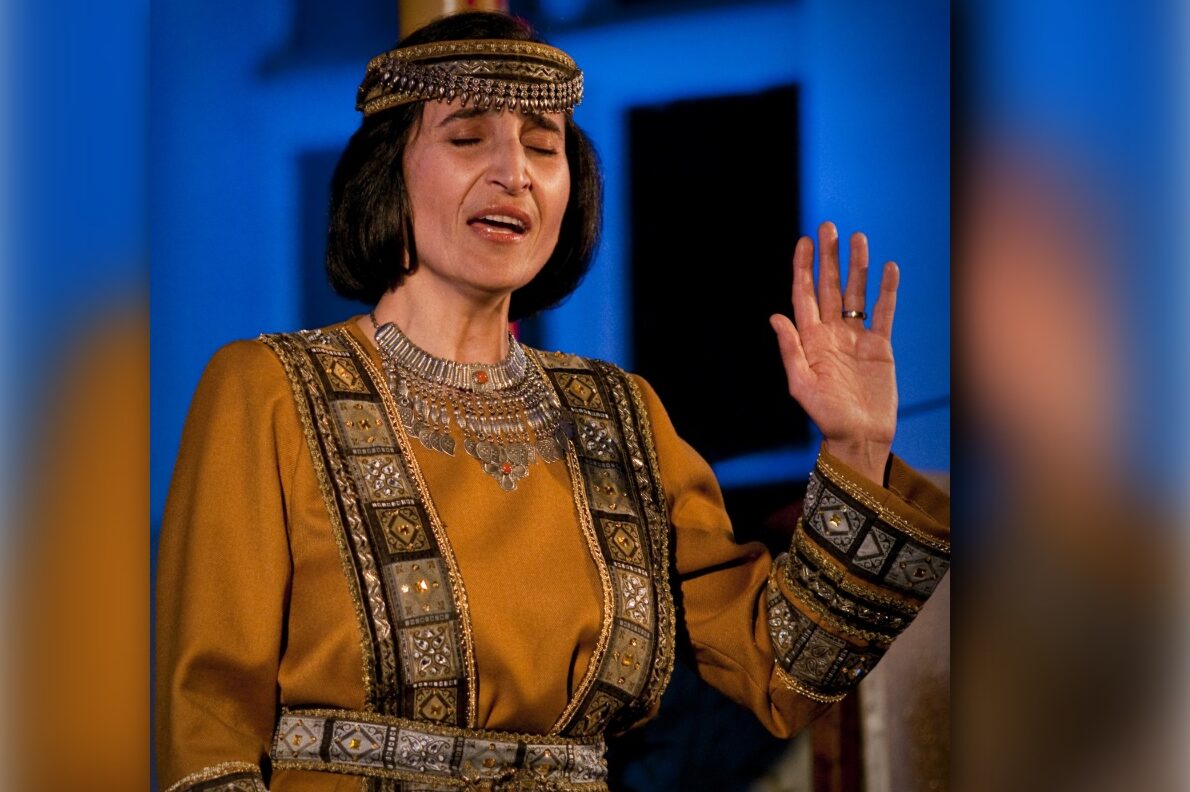
Folk singer Hasmik Harutyunyan’s melodic voice can bring listeners back to their roots, connecting the past with the present.
“I’m an ordinary person who lives in the past as well as the present,” said the singer.
Harutyunyan was born in 1960 in Yerevan into a large family that she describes as filled with love and, of course, music. Her family roots trace back to Mush, in Western Armenia. Music and dance were a constant presence in her childhood home, where tradition was cherished alongside an appreciation for the new.
Although Harutyunyan specialized in mathematics, she also studied music and education. Her life took a turn when she met renowned Armenian folk musician Hayrik Muradyan and his daughter, Maro. After Harutyunyan sang for Maro, she was invited to join the Agunk Ensemble, a group dedicated to preserving Armenian musical traditions.
“It was a beautiful ensemble that kept the tradition of our forefathers alive. I learned so much,” she said.

Harutyunyan continued with Agunk after Maro’s death in 1987, singing, dancing and helping keep the ensemble’s traditions alive.
In 1991, the Shoghaken Folk Ensemble was formed in Yerevan, with Harutyunyan, her brother Aleksan and duduk player Gevork Dabaghyan among its founding members.
Her musical journey eventually led to an unexpected love story. Harutyunyan was invited to participate in a five-CD collection. Her future husband, Andranik, heard the recordings and became determined to meet the singer. After traveling to Armenia three times, he finally met Hasmik through a connection with Dabaghyan.
The couple married in 2000, and Harutyunyan eventually moved to the United States.
Harutyunyan’s musical career continued to grow in the United States. Her husband sent one of her recordings to Traditional Crossroads in New York, leading to new opportunities.
The kamancha and kanoun were incorporated into the Shoghaken Ensemble, and Harutyunyan participated in Yo-Yo Ma’s Silk Road Festival and toured in the United States and abroad.
Among Harutyunyan’s favorite songs are the lullabies brought from Western Armenia. Her mother sang lullabies to her five children, and each child had a different favorite. Those childhood memories became an important part of Harutyunyan’s own musical mission.
During the First Artsakh War, she gathered her nieces, nephews and other children to teach them traditional Armenian folk songs. That work led her to create the Hayrik Mouradian Traditional Song and Dance Children’s Ensemble.
“Working with children and music makes my soul rich. There is strength in music,” she said.
She realized that she had a deep desire to introduce the world to Western Armenian lullabies. That dream became a reality in 2004 when her album “Armenian Lullabies” was released and was praised in The New York Times.
“I realized that my forefathers needed me to continue the path that they were denied. This is a big responsibility, and I welcome it. I want the new generation to be interested in their ancestral songs. We have to build that bridge between the youth and the older generations,” she said.
“Working with children and music makes my soul rich. There is strength in music,”
For Harutyunyan, preserving music goes beyond performing songs. It is about memory, identity and a connection to a homeland from which many Armenians were forcibly displaced. “I’m so grateful that we have continued the legacy of our ancestors, archiving the songs that were almost lost to the Armenian Genocide,” she said.
Her passion is evident when she performs for older generations. At Ararat Home in Southern California, she has witnessed the deep emotional draw of her music. Her songs can bring listeners back to childhood memories.
Harutyunyan also believes in the power of the duduk. While the instrument is sometimes associated with sadness, she views it differently — as the sound of the homeland.
“I’m so grateful that we have continued the legacy of our ancestors, archiving the songs that were almost lost to the Armenian Genocide.”
Her commitment to young people remains a focal point. She works with schools and organizations that support Armenian culture. At UCLA, where she is now in her third year as a mentor, she works with students to strengthen their connection to Armenian culture through music, the oud and traditional arts. She believes Armenian communities must do more at the college and university level to expose both Armenian and non-Armenian students to this vibrant cultural heritage.
“The mission of my life now is to create a bridge between the older generations and the youth, giving them food for their souls with music. There is a movement now to reconnect with our past, and I think it’s fantastic,” she said.
For Harutyunyan, that connection begins in the cradle and continues throughout a child’s life, wrapped in the tenderness of music and tradition. Through her voice, she keeps alive the songs of her ancestors while giving a new generation the opportunity to discover and honor their roots.
Hasmik Harutyunyan’s performances can be found on Instagram, Facebook and YouTube.