


The HomelandCulture

Artsakh weaver rebuilds her life through her craft 
When residents of Berdzor were given about a month to evacuate their belongings in August 2022, Milena Ordiyants had a different priority from most.

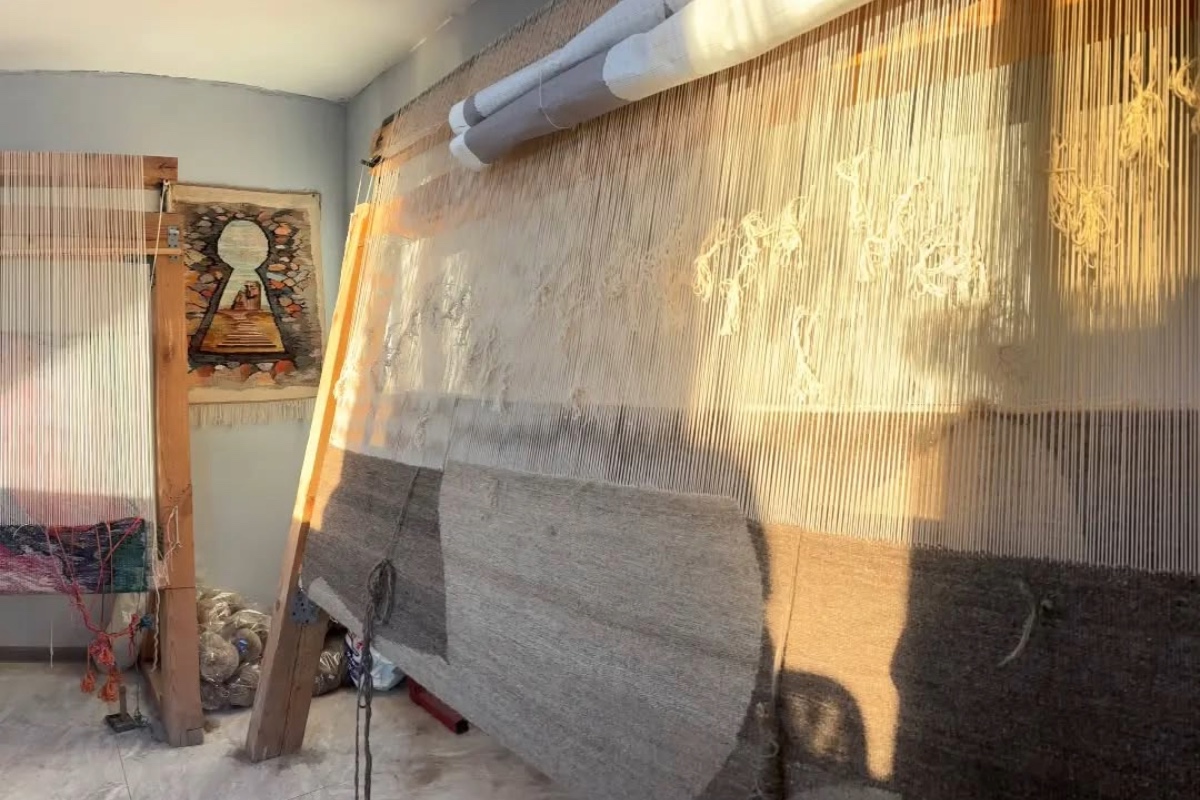
“The house was already damaged, but for me, the most important things were my tools of the trade,” she recalls. “I took my loom, threads, sketches, sewing machine and my children’s pictures. Household items can be replaced, but these things cannot be restored.” Today, that wooden loom stands in her studio in Dzoraghbyur, Kotayk province. Milena spends much of her day there, working with the same rhythmic movements she learned decades ago across a life shaped by repeated displacement — from Baku to Yerevan, Shushi, Berdzor and finally central Armenia.

For her, the loom is part of the life she built through her craft — and one of the few things she could carry with her when that life was suddenly left behind.

A weaver in Shushi

Milena Ordiyants.

Milena was born in Baku. Amid the anti-Armenian violence and mass displacement of 1988, her family moved to Armenia. During the difficult years of the 1990s, Milena watched her maternal aunt, an artisan originally from Artsakh, take weaving commissions at home to make a living. “I would sit beside her, watch and help. She taught me the fundamentals. I always dreamed of having a loom at home and weaving. Years later, when I was already in Shushi, that interest turned into a profession.”

After finishing school in Yerevan, Milena moved to Shushi to live with her grandmother.

Advertisement Subscribe Today!

In 2000, she began working at a local carpet-weaving cooperative that employed around 20 to 30 women. At the same time, she enrolled in the designer-painter department at the Arsen Khachatryan Humanitarian College, where she specialized in tapestry weaving. What stayed with her from those years was the sense of community around the looms.

“The looms were large, and we all stretched the warp together. It was a long and complex process. Whenever we started a rug, we would celebrate with sweets. When we finished and cut it from the loom, we would all applaud, set out a small table and celebrate. Those traditions brought us together; no one worked alone.” Weaving was becoming a profession, a community and eventually a way of life.

The Berdzor years

After three years in Shushi, Milena married and moved to Berdzor.

For nine years, she taught at the town’s art school, introducing children to the fundamentals of tapestry weaving and carpet making. She later continued teaching at the Agape charitable organization, where she led tapestry and sewing classes. Her professional life remained closely tied to Artsakh. Following the 2020 war, the family temporarily took refuge in Goris, but both Milena and her husband continued working in Artsakh, serving together for the Artsakh Ministry of Emergency Situations in Lisagor, in the Shushi region.

Then came another displacement.

In August 2022, the transfer of Berdzor and the surrounding corridor forced residents to leave. Milena returned to the house to collect what she could. Leaving the furniture behind, she took the loom.

More than a year later, the September 2023 military offensive and the mass displacement of Artsakh’s Armenian population ended any possibility of returning to the life she had built there. Her home, workplace and community were no longer accessible.

The “Anahit” lesson

After spending two months in Goris and seeing how difficult it was to find work there, the family moved to Kotayk.

They used a state-supported housing certificate they had received after the 2020 war to purchase a half-built house in Dzoraghbyur. They had kept the certificate unused because they had hoped they would eventually be able to return to Stepanakert.

Starting over was not easy. During the first months of displacement, Milena experienced a creative crisis. She had little desire to work and had lost her inspiration. Everything began to change when former and new clients started contacting her.

“You can’t work with a client and remain depressed all the time; you have deadlines to meet and quality to maintain. Staying busy also helped me get through that difficult period,” she says.

That demand eventually led to the establishment of Anahit Carpet. Anahit is both the name of Milena’s daughter and the heroine of Ghazaros Aghayan’s well-known fairy tale. In the story, Anahit agrees to marry Prince Vachagan only if he learns a trade. When he is later taken captive, the skill he has learned helps save him. “When we were thinking about the brand name, I remembered that story. This work saved me too — it pulled me out of a deep depression, helped solve my family’s financial problems and became a means of livelihood,” Milena said.

A practical skill that had once been taught to her became the means through which she could regain a measure of independence after displacement.

Her experience reflects a broader challenge facing displaced people from Artsakh. According to Armenia’s Ministry of Labor and Social Affairs, as of Dec. 31, 2024, more than 21,800 forcibly displaced persons from Artsakh had found employment in Armenia, while around 4,600 were registered as self-employed or as founders of an organization.

Milena is one of those who rebuilt a livelihood through self-employment, relying primarily on a skill she had practiced for decades.

Milena’s Artsakh-themed sketches.

Dyes, motifs and memory

Today, Anahit Carpet produces custom tapestries using Armenian wool yarns and natural dyes made from plant and mineral materials. Depending on its size and knot density, a single piece can take from several weeks to several months to complete.

Three large looms now occupy her workshop. Milena moves between them according to deadlines. On the worktable, sketches lie beside loosely wound skeins of wool waiting to become part of another piece.

Tapestries created in Dzoraghbyur were featured at the National Gallery of Armenia during a public panel held as part of the closing program for the exhibition “Weaving Culture. Anna Boghiguian.”

The landscapes where Milena has lived continue to shape the work she creates. “When choosing colors, I often draw on the shades of Artsakh’s nature — the colors of the rocks and forests.”

The colors and patterns therefore allow her to preserve elements of a place she can no longer physically return to.

Milena wishes for peace and the possibility of returning home. For now, she is working toward expanding her workshop and eventually training apprentice weavers. She also has advice for other displaced people. “Even if it is difficult to find a job, at least find a small hobby, something you are passionate about. First and foremost, you need to take care of your mental well-being so that you can move forward. The most important thing is not to give up.”

Anna Harutyunyan

Anna Harutyunyan is a freelance journalist from Yerevan. She graduated with honors from the Department of Journalism at the Armenian State Pedagogical University and successfully completed the one-year educational program at Hetq Media Factory. She is currently pursuing her master’s degree in journalism at the Armenian State Pedagogical University. Her main interests include data journalism, culture and social issues.

Leave a Reply

Your email address will not be published. Required fields are marked *


Back to top button