


A seat at the table requires an independent voice
Why the Sept. 16 White House meeting and the subsequent Yerevan Prayer Breakfast raise a larger question about Church independence, diasporan responsibility and political maturity
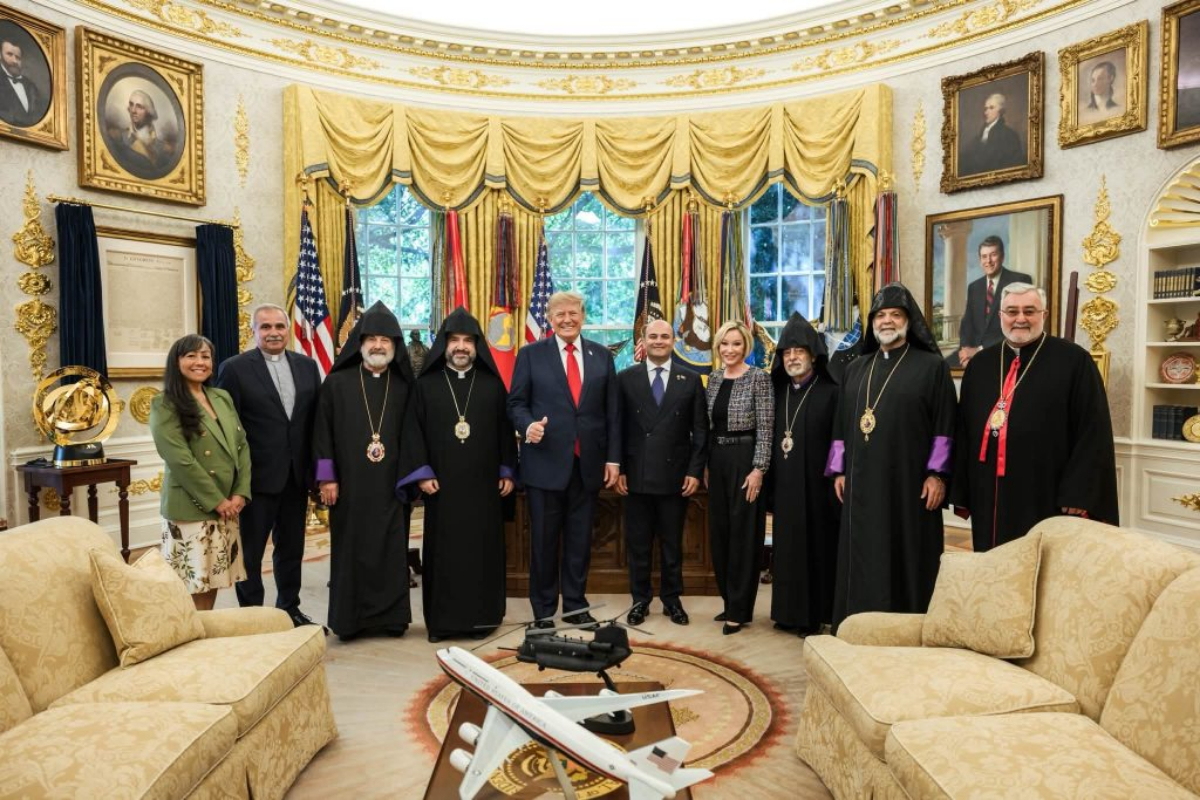
The image of Armenian spiritual leaders gathered in the Oval Office with the president of the United States is, on its face, a positive one. Armenian clergy should have access to the highest levels of the American government. They should be able to speak directly with presidents, senior officials and policymakers about the Armenian people, the Christian heritage of Armenia, the condition of Armenian communities worldwide, and the moral questions that arise from war, displacement, captivity and threats to religious and cultural heritage. There is no virtue in self-imposed distance from political power when access can be used responsibly.
The Sept. 16 meeting, however, raises a more important question than whether Armenian clergy should enter the White House. The real question is how they enter, who defines the framework and whose political narrative ultimately benefits from their presence.
The primates of the Eastern and Western Dioceses of the Armenian Apostolic Church, the prelates of the Eastern and Western Prelacies of the Catholicosate of Cilicia, the Armenian Catholic Eparch, and a senior representative of the Armenian Evangelical community met President Donald Trump in the Oval Office. The gathering was initiated by the Embassy of the Republic of Armenia in cooperation with the White House Faith Office, and Armenia’s ambassador participated alongside the clergy. Official accounts emphasized U.S.-Armenia relations, Christian ties, religious freedom and peace, and noted that the clergy offered a collective prayer recognizing President Trump’s contribution to the Armenia-Azerbaijan peace process.
None of that is inherently objectionable. There is nothing wrong with Armenian clergy praying with an American president, and there is nothing wrong with acknowledging constructive American diplomacy where it occurs. What deserves scrutiny is the institutional arrangement. American-Armenian churches are not extensions of the Armenian state. They are American institutions rooted in American civic life, responsible to communities whose histories, convictions and national concerns extend well beyond the life of any government in Yerevan. Their authority comes in significant part from precisely this independence.
An embassy has a clear and legitimate role: it represents the government that appointed its ambassador. A church has a different role. It represents a spiritual tradition and a community whose moral obligations cannot be reduced to the objectives of a sitting administration. When a foreign government becomes organizer, convener, participant and interpreter of a meeting between American-Armenian religious leaders and the American president, there is an unavoidable risk that independent ecclesiastical authority becomes incorporated into that government’s diplomatic presentation.

This does not mean embassies and churches should never cooperate. They will inevitably interact, and at times, cooperation can serve a legitimate national interest. But the default relationship should preserve a clear institutional boundary. Meetings between American-Armenian spiritual leaders and the United States government should ordinarily be arranged to give the churches meaningful control over their participation, agenda and message. The clergy should arrive not merely as honored guests within somebody else’s diplomatic program but as independent representatives of the communities they serve.
That distinction becomes particularly important when considering what the official accounts of the Sept. 16 meeting emphasized, and what they did not. The public presentation highlighted peace, the Armenia-U.S. relationship, Christian ties and the current diplomatic process. The Eastern Diocese described the meeting positively as an opportunity to bear witness to faith and pray for lasting peace, while the Eastern Prelacy likewise described the engagement favorably. Those perspectives deserve respect. A serious community, however, must also ask what other concerns should have been placed before the president with equal clarity.
There was no comparable public emphasis on the continuing detention of Armenian hostages in Azerbaijan, the rights of the forcibly displaced Christian Armenians of Artsakh, the protection of Armenian churches and cultural monuments now under Azerbaijani control or the broader unresolved security and human-rights concerns that remain central to much of the Armenian-American community. These are not marginal matters. They go directly to the responsibilities of spiritual leadership: the defense of human dignity, the protection of Christian heritage and the obligation to speak for communities that have lost homes, institutions and security.
A photograph in the Oval Office can be valuable. Presidential access can be valuable. But access should create the space for difficult truths. If it produces only ceremonial affirmation, then the symbolism of the meeting risks becoming more important than its substance. The standard should not be whether Armenian leaders were able to enter the room. It should be whether they were able to carry into that room the full moral burden of the people they represent.
There is a second institutional concern. Engagement with Armenian clergy cannot become a substitute for substantive engagement with American-Armenian civic and advocacy organizations. The two are not interchangeable. Spiritual leaders speak to matters of faith, conscience, morality, human dignity and communal welfare. Civic and advocacy organizations engage government on legislation, foreign policy, security, human rights, accountability and the strategic interests of the Armenian people. A healthy Armenian-American community needs both. Washington should not treat a meeting with clergy as a substitute for engaging the organized civic voice of Armenian Americans, and Armenian governments should not use the stature of clergy to fill the space properly occupied by independent diasporan political institutions.
The problem is made more serious by the ongoing attack by the state authorities on the Mother See of Holy Etchmiadzin. The Church has described criminal proceedings involving Catholicos Karekin II and senior bishops as unlawful governmental interference, while Armenian authorities have maintained that the proceedings concern the enforcement of Armenian law. Whatever one’s assessment of individual legal claims, the broader reality is that relations between the state and the Mother See have moved far beyond ordinary disagreement. The Church’s leadership and governing bodies have publicly described sustained state pressure and interference, and the attack has become one of the most consequential institutional disputes in Armenia.
In that context, the Armenian government should exercise particular restraint before positioning itself as the organizer and intermediary for Armenian ecclesiastical leaders abroad. The contradiction is difficult to ignore. The legitimacy of the Armenian Church cannot be embraced when it strengthens a diplomatic presentation in Washington while the independence of the Mother See is simultaneously under attack by the state authorities in Armenia. A government cannot reasonably seek the moral capital of ecclesiastical institutions abroad while weakening the Church’s autonomy at home.
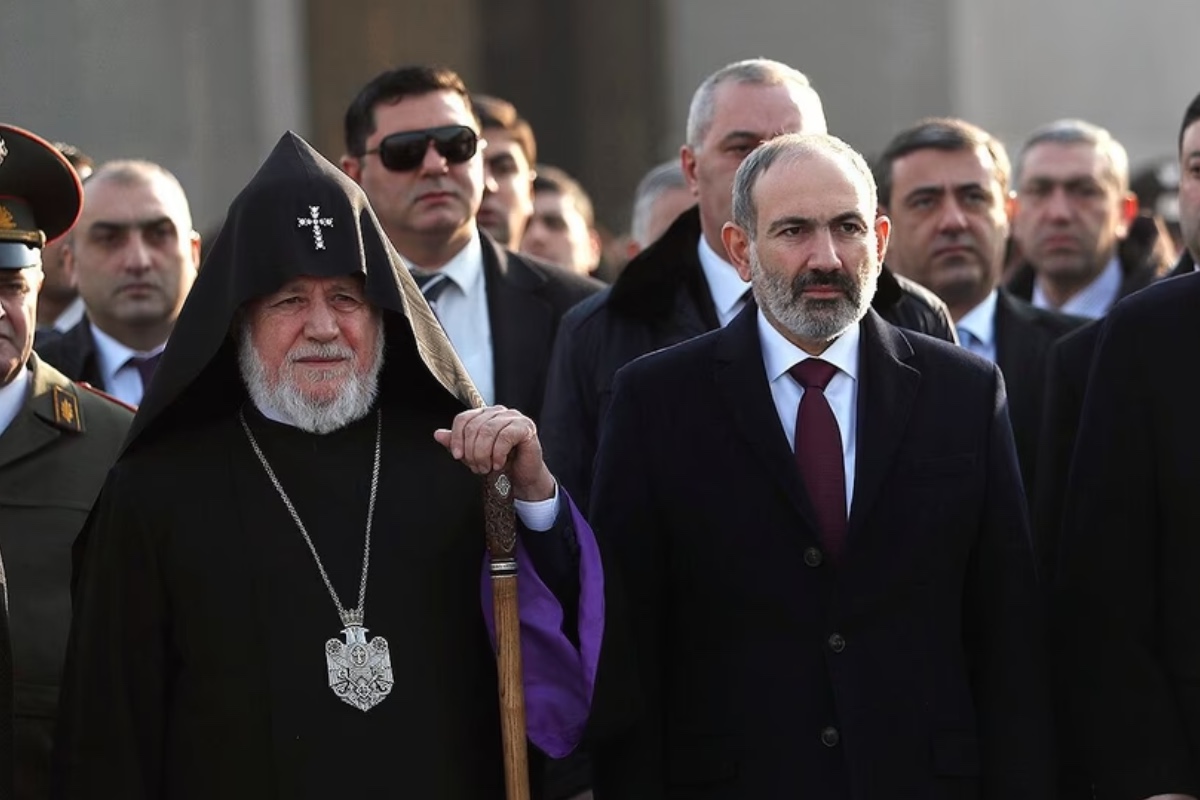
Events in Yerevan only sharpened this contradiction. On Oct. 2-3, Prime Minister Nikol Pashinyan participated prominently in the second Republic of Armenia Prayer Breakfast, an event officially described as an independent civil society initiative devoted to prayer, faith, religious freedom, peace, and dialogue. The gathering nevertheless carried unmistakable governmental visibility: Pashinyan addressed the event, his office publicized it extensively, Paula White-Cain, senior advisor to the White House Faith Office, delivered remarks, and Riley Barnes, the U.S. assistant secretary of state for democracy, human rights and labor, participated in the related official dinner. Pashinyan used the occasion to speak expansively about faith, Armenia’s Christian identity and Holy Etchmiadzin itself as the spiritual center and “Holy of Holies” of the Armenian people.
That language sits uneasily beside the government’s contemporaneous campaign concerning the leadership and governance of the Armenian Apostolic Church. Just days before the Prayer Breakfast, Pashinyan publicly argued that the Church had been “seized,” called for legislative changes, and reiterated an agenda that includes removing Catholicos Karekin II and changing the process by which the Church is governed. At the same time, the Catholicos and six senior bishops remain defendants in criminal proceedings arising from an internal ecclesiastical dispute, proceedings the Mother See has characterized as unlawful state interference, while the authorities insist they are enforcing Armenian law.
The Catholicos himself was not part of the Prayer Breakfast’s public-facing program, although reporting indicates that the Mother See was represented by Bishop Daniel Findikian. The available public record does not establish whether His Holiness personally received or declined an invitation, and that distinction should not be blurred. What is clear is that senior American participants made separate visits to Holy Etchmiadzin outside the Prayer Breakfast program. On Sept. 29, American Prayer Breakfast participants met the Catholicos at the Mother See, and on Oct. 4, after the Yerevan gathering, White-Cain attended the Divine Liturgy at Holy Etchmiadzin and met Karekin II directly.
That sequence is revealing. It shows that American religious and public figures understood that engagement with Armenia’s Christian identity could not credibly stop at a government-affiliated prayer platform; they also needed to engage the head of the Armenian Apostolic Church on his own institutional grounds. The separate visit to the Catholicos therefore reinforces, rather than weakens, the principle at issue in Washington: authentic religious engagement requires direct relationships with religious institutions, not merely access mediated through a government’s preferred framework.
For critics of the Armenian government’s conduct toward the Mother See, this juxtaposition naturally raises a charge of political hypocrisy. A government cannot persuasively celebrate religious freedom, invoke Armenia’s ancient Christian inheritance before American faith leaders and describe Etchmiadzin as the nation’s spiritual center while simultaneously seeking to determine who should lead that Church and how its internal governance should be reorganized. Supporters of the government will answer that the legal proceedings concern enforcement of civil law, that reform of Church governance is distinct from hostility to Christianity, and that the Prayer Breakfast itself was organized by civil society rather than the state. Those arguments should be acknowledged. But they do not eliminate the underlying institutional question: where should the boundary lie between legitimate state action and political intervention in the internal life of the national Church?
This is why the issue should not be reduced to personalities. One may agree or disagree with Karekin II, with individual bishops or with positions taken by the Church. The principle must survive those disagreements. If the independence of the Armenian Apostolic Church is protected only when its leadership agrees with the government of the day, it is not institutional independence at all. And if Christian symbolism is embraced internationally while ecclesiastical autonomy is contested domestically, the credibility of Armenia’s appeal to religious freedom will inevitably be questioned.
This principle cannot be applied selectively. It must govern the relationship of political power to both major centers of Armenian Apostolic life. The Mother See of Holy Etchmiadzin must remain spiritually and institutionally independent of every Armenian government, present and future. No administration should be permitted to define the limits of the Church’s moral voice simply because that voice becomes politically inconvenient. The Holy See of Cilicia carries an equally important responsibility. Its history in the diaspora is inseparable from the preservation of Armenian identity, national consciousness and the defense of Armenian rights. Its representatives should therefore approach seats of political power with confidence and independence, prepared not simply to participate in an agenda placed before them but to articulate the concerns of the communities whose trust they carry.
The Yerevan Prayer Breakfast reinforces why this is ultimately a question of political maturity in both Armenia and the diaspora. American-Armenian institutions should welcome relationships with Washington. Our churches should meet Republican presidents and Democratic presidents. They should pray with them, counsel them, and help them understand Armenia and the Armenian people. But they must do so on their own institutional footing. Likewise, American-Armenian civic organizations must retain their own role and direct access to government, rather than allowing spiritual representation to serve as a substitute for political representation. The same standard should apply in Yerevan: engagement with international faith leaders cannot substitute for respect for the independence of Armenia’s own national Church.
The example of Khrimian Hayrig remains relevant because his conception of spiritual leadership extended beyond ceremony. Access to power, in his understanding, imposed a responsibility to speak clearly and to preserve the dignity and interests of the people one represents, even when doing so is uncomfortable. That lesson is especially important when a meeting is highly visible, and the political actors involved have every incentive to shape the event to their own objectives.
The lesson of Sept. 16, then, should not be that Armenian clergy ought to decline future invitations to the White House. The opposite is true. They should go. They should go confidently, frequently and without hesitation. But they should enter as independent leaders of American-Armenian institutions, as spiritual representatives of communities deeply rooted in American civic life and as custodians of a national inheritance larger than any government or diplomatic agenda of the moment.
They should bring their own agenda. They should articulate their own priorities. They should defend the rights of Armenians whose voices cannot reach the Oval Office themselves. And they should preserve the institutional distance necessary to ensure that their moral authority is never mistaken for political endorsement.
A seat at the table matters. But what matters more is who placed the chair there, whose agenda is on the table and whether those seated around it are prepared to speak with an independent voice. That principle applies in the Oval Office, at a prayer breakfast in Yerevan and at every intersection of political power and Armenian spiritual authority.