


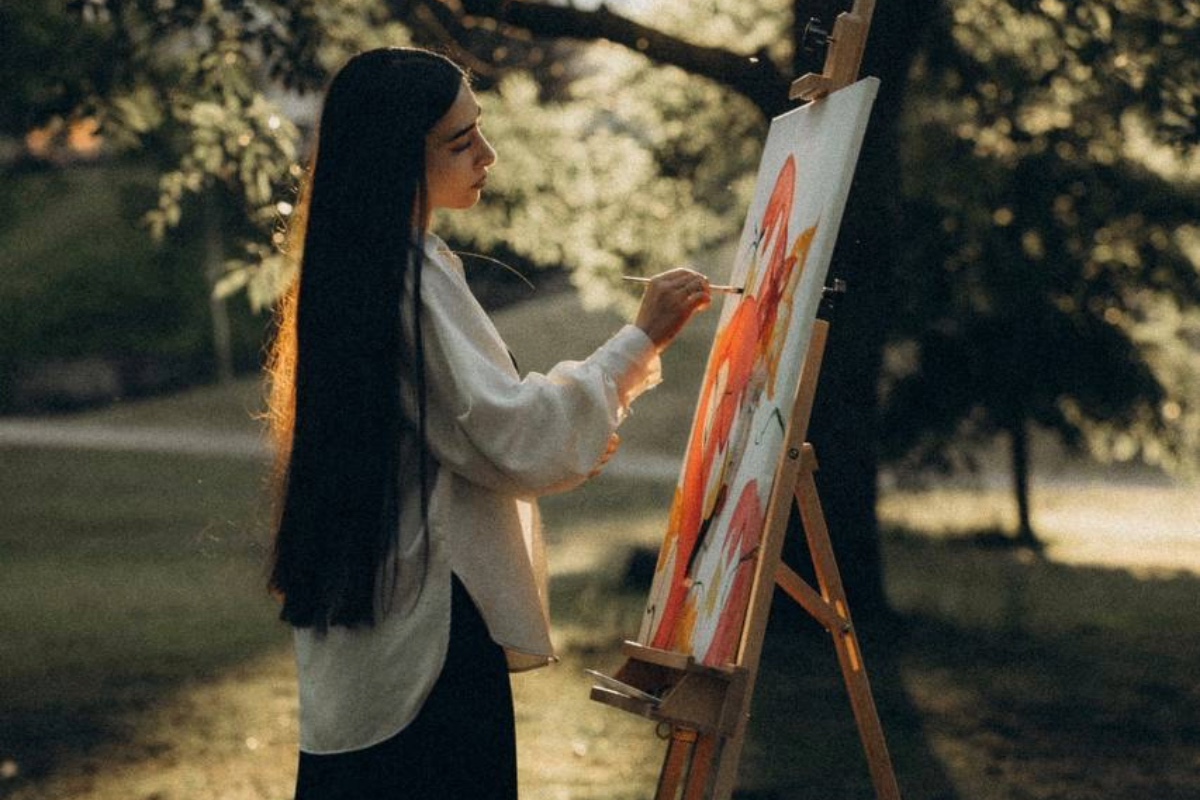
What happens when a business mindset meets artistic imagination? The result is art that offers no ready-made answers, but instead invites the viewer into a dialogue. In an interview with the Armenian Weekly, artist Anahit Rodvan spoke about her unique creative journey, her transition from the financial sector to the canvas, her sources of inspiration and her pursuit of freedom through art.
Rodvan’s path to art was not linear. Born and raised in Yerevan, she engaged in diverse activities from childhood — from sports and chess to dance and creative courses. Yet, amidst this variety, art always held a unique and irreplaceable place. From an early age, she filled her notebooks with sketches and drawings.
Still, Rodvan chose a less artistic professional route. She completed the English educational program at the International Scientific-Educational Center (ISEC), receiving a bachelor’s degree in finance and economics. She also earned a certificate from Texas A&M University and later studied programming at the “42” school.
Despite her busy schedule, her days still began and ended with drawing. The turning point came while reading Austin Kleon’s book “Steal Like an Artist,” where the author quoted Jessica Hische: “The work you do while you procrastinate is probably the work you should be doing for the rest of your life.”
“It was at that exact moment I realized those words were about my sketches. That day was perhaps the first time I honestly accepted that my true path was creation,” said Rodvan. “Although I have not received an academic art education, I have met people along my journey who believed in and were inspired by my work. And indeed, a single word can alter the direction of a person’s life more than long years of education.”
Rodvan in Manchester and Austria
Rodvan’s active creative phase began in 2022 after moving to Manchester, England. There, she participated in several group exhibitions, and in 2023, organized her first solo digital exhibition in Armenia.
Since 2024, two of her large-scale works, inspired by Martiros Saryan, have been on display at an Armenian restaurant in Manchester. Later, in 2025, her first exhibition and sale was held in Graz, Austria.
Today, Rodvan resides and creates in Austria. She does not yet have a separate studio, but her corner of inspiration is a room with a beautiful view, where she can dedicate hours to her canvases.
Contemporary art is at the core of her work. She works both with acrylic on canvas and digital art, as her artistic journey originally began in the digital medium.
“Contemporary art is closest to me. I especially love creating characters that seem to already have their own story,” she said. “New works are usually born from my own experience, memories or imagination. But often my friends also inspire me.”
Rodvan notices beauty in people, old buildings, cities and tiny details. She subconsciously stores these impressions, which later unexpectedly appear in her work.
In dialogue with the viewer
For Rodvan, painting is not mere representation; it is a living, unpredictable process where the canvas often begins to live a life of its own.
“I almost always have a certain image in my head, but during the painting process, it starts to change. Sometimes I simply stop controlling everything and just trust the movement of my hand. I don’t like it when art provides ready-made answers. For me, the dialogue is far more important,” she said.
Rodvan intentionally refrains from fully explaining her thoughts. She wants to leave room for the viewer to interpret their own story:
“I love it when someone starts to imagine, continues the story, or even sees something that I haven’t noticed. At that moment, the artwork stops being just a picture and becomes part of that person’s individual experience,” she said.
“I don’t like it when art provides ready-made answers. For me, the dialogue is far more important.”
Rodvan admits that she is her own harshest critic, and often the most difficult moment is not finishing a painting, but stopping in time and realizing that nothing more needs to be added.
“We share the same noses”
One of the works that best expresses Rodvan’s creative identity is the painting titled “We share the same noses.” At first glance, the work appears humorous and lighthearted, but it carries a philosophical subtext.
The canvas depicts a girl and a parrot. Their physical resemblance — the girl’s expressive nose and the bird’s beak — became the basis for the title, yet the true theme of the work is freedom.
“The parrot is already out of the cage, but it hasn’t flown far away; it’s still standing on top of the cage, as if on the boundary between freedom and the world familiar to it. Meanwhile, the girl looks at it not with sadness, but with a bit of envy, hope and faith. In the bird’s freedom, she seems to see what she herself is lacking.”
For Rodvan, the most important element of the painting lies in that gaze and what it holds.
“The girl realizes that a cage doesn’t necessarily have to be physical. We ourselves can keep our own selves within limits — because of fears, habits, the expectations of others or simply the life familiar to us. And sometimes, seeing someone else’s freedom is enough to ask yourself for the first time: what’s keeping me in my cage? In her eyes, I wanted to leave hope and trust in her own strength,” said Rodvan.
Born from observing the free flight of an exotic bird, the parrot in this piece is not merely a subject but a reminder that freedom sometimes starts the moment you believe you can choose it.
An exhibition at Pyunik
An important milestone in presenting her work to Armenian art lovers was an exhibition held in June at the Pyunik Development Center, Rodvan’s second solo exhibition in Armenia. It featured around two dozen canvases, original silk scarves, earrings and other handmade creations.
The Pyunik exhibition left a warm impression on her: the space offered an inviting environment for people to meet, talk about art and exchange ideas.
Rodvan credits trust in life and in her own decisions for this path she has been on. “It is that very trust that gives me the strength to accept changes, move to new countries, meet new people and continue creating,” she said.
Rodvan is currently working on new artwork and preparing for her solo exhibition planned for 2027 in Austria. Her goal is for her work to continue reaching audiences in different countries and, through the language of contemporary art, to tell the world about Armenian culture and identity.
Follow Anahit Rodvan’s work on Instagram.
Sometimes, seeing someone else’s freedom is enough to ask yourself for the first time: what’s keeping me in my cage?